What is the role of saliva in the digestion of food?
NCERT Class 10 Science | Life Processes | Texcellency Book Series
Saliva plays four critical roles in digestion: it moistens and lubricates food for easy chewing and swallowing, it contains the enzyme salivary amylase that begins the chemical digestion of starch into simpler sugars, it maintains a slightly alkaline pH in the mouth that is optimal for salivary amylase to work, and it contains mucus that binds chewed food into a soft, slippery ball called a bolus that can be swallowed easily. Saliva is the body’s first digestive step — digestion begins not in the stomach but in the mouth.
🏭 The Big Picture — Why the Mouth is the First Digestion Station
Most students think digestion happens in the stomach. The truth is — digestion begins the moment food enters your mouth. The mouth is a highly sophisticated food processing unit — equipped with mechanical tools (teeth), chemical tools (enzymes in saliva), and a packaging system (mucus forming bolus) — all working simultaneously with every bite you take.
Think of your digestive system as a long food processing assembly line — from mouth to anus. Each station on the line does a specific job and passes the work to the next station. The mouth is Station 1 — and saliva is the key worker at Station 1. If Station 1 does its job poorly — every subsequent station struggles.
This is why eating slowly and chewing thoroughly — allowing saliva maximum contact time with food — genuinely improves digestion throughout the entire alimentary canal.
🏏 The Cricket Ground Preparation Analogy — Understanding Saliva’s Role
Before a big cricket match at Wankhede Stadium — the ground staff do critical preparation work: they roll and flatten the pitch, mark the boundaries, place the stumps, water the surface. None of this is the actual match — but without this preparation, the match cannot be played properly.
Saliva is the ground staff of digestion.
🟢 Rolling the pitch = moistening and lubricating food — making it soft and manageable for chewing and swallowing.
🟡 Marking the boundaries = establishing the right chemical environment (slightly alkaline pH 6.5-7.5) — so the digestive enzyme salivary amylase can work at peak efficiency.
🔵 Placing the stumps = salivary amylase beginning the chemical breakdown of starch — setting up the work that will continue further down the alimentary canal.
🔴 Packaging the pitch report for the next team = mucus binding chewed food into a bolus — neatly packaged, lubricated, ready to be passed to the next station (oesophagus → stomach).
Without the ground staff’s preparation (saliva) — the match (full digestion) proceeds poorly from the very first ball.
🔬 The Four Roles of Saliva — Each One Examined in Full Depth
🔵 Role 1 — Moistening and Lubricating Food (Physical Role)
Saliva is approximately 99.5% water — and this water content is its first gift to digestion. Dry food cannot be chewed effectively — teeth cannot break down hard, dry particles efficiently — and dry food cannot be swallowed without risk of choking.
Saliva wets every surface of the food as it enters the mouth — softening it, allowing teeth to crush and grind more effectively, and making the food mass pliable and easy to manipulate by the tongue.
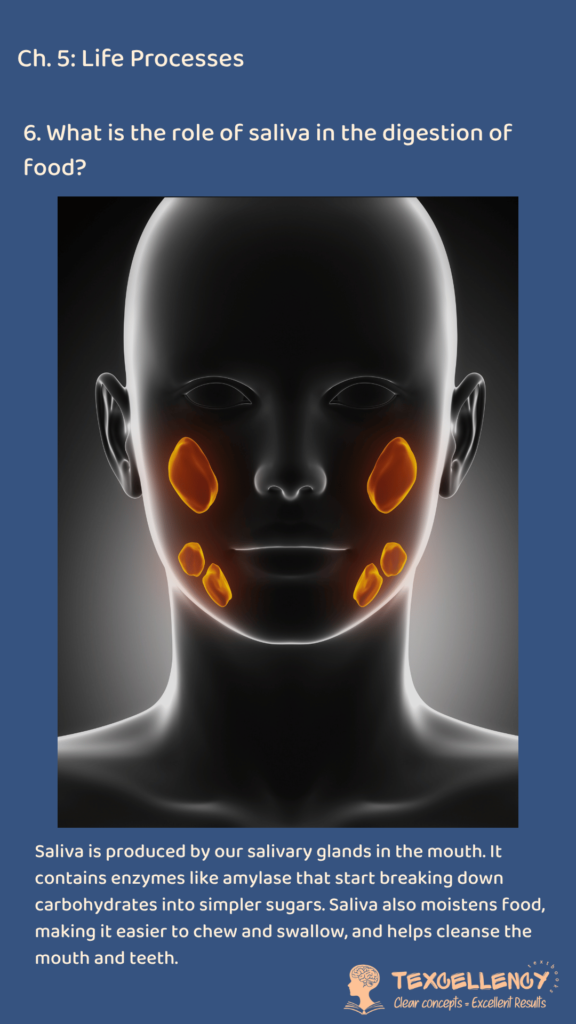
🔷 The salivary glands — there are three pairs of major salivary glands in the human mouth: The parotid glands — the largest — located in front of and below each ear (these are the ones that swell painfully during mumps infection). The submandibular glands — located along the lower jaw. The sublingual glands — the smallest — located under the tongue.
Together these three pairs produce approximately 1 to 1.5 litres of saliva per day — a remarkable volume that most people never think about. Every minute you are awake — saliva is being secreted continuously — keeping the mouth moist, protecting teeth, and preparing for the next bite.
🔵 Role 2 — Salivary Amylase: Beginning Chemical Digestion of Starch
This is the most important role of saliva from a CBSE examination standpoint — and the one most directly tested.
Saliva contains an enzyme called salivary amylase (also called ptyalin). Amylase is a carbohydrase — an enzyme that breaks down carbohydrates. Specifically, salivary amylase breaks down starch (a complex polysaccharide — a long chain of glucose molecules) into simpler sugars — primarily maltose (a disaccharide — two glucose molecules joined together).
Starch → Maltose (by salivary amylase, in the mouth)
This is why if you chew a plain roti or a piece of bread for a long time — it gradually starts tasting slightly sweet. The starch in the roti is being broken down into maltose and other sugars by salivary amylase — and your taste buds detect the sweetness. This is a live experiment you can do right now.
🔷 Why start starch digestion in the mouth? Starch molecules are enormous — far too large to be absorbed into the bloodstream. They must be broken down into individual glucose molecules (monosaccharides) before absorption can occur in the small intestine. This is a multi-step process — and starting it in the mouth with salivary amylase means by the time food reaches the small intestine, much of the preliminary breakdown is already done — saving time and enzymatic effort further down.
🔷 What happens to salivary amylase in the stomach? The stomach produces hydrochloric acid — creating a highly acidic environment (pH 1.5-3.5). Salivary amylase is denatured (destroyed) in this acidic environment and stops working. Starch digestion then pauses until the food reaches the small intestine — where pancreatic amylase takes over and completes the breakdown.
🔵 Role 3 — Maintaining Optimal pH (Chemical Environment Role)
Enzymes are extremely sensitive to pH — they work efficiently only within a narrow pH range. Salivary amylase works best at a slightly alkaline to neutral pH — approximately 6.7 to 7.0 (slightly below neutral to neutral).
Saliva itself has a pH of approximately 6.5 to 7.5 — maintaining exactly this optimal environment for salivary amylase. The bicarbonate compounds in saliva act as a buffer — resisting sudden changes in pH — keeping the mouth chemistry stable and enzyme-friendly.
🔷 Saliva also protects teeth: After eating sugary or acidic foods — bacteria in the mouth produce acids that attack tooth enamel (causing dental caries / cavities). Saliva’s buffering action neutralises these acids — protecting teeth. This is why saliva flow is critical for dental health — conditions that reduce saliva (dry mouth or xerostomia) dramatically increase the risk of tooth decay.
🔷 Saliva contains lysozyme — an antibacterial enzyme that destroys the cell walls of many bacteria entering the mouth with food — providing a first line of immune defence.
🔵 Role 4 — Mucus Forming the Bolus (Mechanical Packaging Role)
Saliva contains mucus — a thick, slippery glycoprotein. Mucus serves two roles simultaneously:
🔷 Lubricates the food mass — coats every particle of chewed food with a slippery layer — making the entire mass smooth and easy to swallow without scraping or irritating the oesophageal lining.
🔷 Binds food into a bolus — mucus acts like biological glue — binding the chewed, moistened, partially digested food particles into a cohesive soft ball called a bolus. The tongue shapes this bolus and positions it at the back of the mouth — ready for swallowing.
Why is bolus formation important? The oesophagus moves food by peristalsis — rhythmic muscle contractions that squeeze food downward toward the stomach. A well-formed, lubricated bolus moves through this peristaltic squeeze smoothly and efficiently. Poorly lubricated, dry food can cause discomfort, scratching, or even choking. Mucus is the reason you can swallow food without pain.
This is also why eating dry food rapidly without chewing properly (and therefore without adequate saliva contact) can cause the unpleasant sensation of food “sticking” in the throat — the bolus is poorly formed and inadequately lubricated.
🍚 The Idli Analogy — Understanding All Four Roles Together
Making perfect idli requires several preparation steps before it goes into the steamer:
🟢 The batter must be wetted and mixed to the right consistency — like saliva moistening food. 🟡 The batter must be fermented at the right temperature and pH — like saliva maintaining optimal pH for amylase. 🔵 Partial breakdown of complex carbohydrates during fermentation makes the idli digestible and fluffy — like salivary amylase starting starch breakdown. 🔴 The batter is shaped into round moulds before steaming — like mucus forming the bolus for smooth passage.
Skip any preparation step — and the idli is either hard, flat, sour, or indigestible. Skip any role of saliva — and digestion is compromised from the very first step.
📊 Roles of Saliva — Complete Quick Reference Table
| Role | Component of Saliva | What It Does | Why It Matters |
|---|---|---|---|
| Moistening food | Water (99.5% of saliva) | Softens and lubricates food | Enables efficient chewing and prevents choking |
| Chemical digestion of starch | Salivary amylase (ptyalin) | Breaks starch → maltose | Begins carbohydrate digestion immediately |
| Maintaining optimal pH | Bicarbonate buffer | Keeps mouth pH at 6.5-7.5 | Optimal environment for salivary amylase |
| Antibacterial protection | Lysozyme | Destroys bacterial cell walls | First immune defence of digestive system |
| Bolus formation | Mucus | Binds food into soft slippery ball | Enables smooth swallowing and peristalsis |
🩺 What Happens When Saliva is Insufficient — Real-Life Connections
🔴 Xerostomia (dry mouth) — reduced or absent saliva production. Caused by certain medications (antihistamines, antidepressants), radiation therapy for head and neck cancers, autoimmune conditions (Sjögren’s syndrome). Consequences: difficulty chewing and swallowing, inability to taste food properly, rapid dental decay, mouth infections, painful swallowing. Demonstrates how critical saliva is — its absence makes eating genuinely difficult and painful.
🔴 Dental caries (tooth decay) — insufficient saliva allows bacterial acids to attack enamel unchecked. People who breathe through their mouth chronically (which dries the mouth) have significantly higher rates of tooth decay — direct evidence of saliva’s protective role.
🔴 Poor starch digestion — people who eat too fast and swallow without chewing deprive salivary amylase of contact time with food. Starch reaches the stomach and small intestine in larger fragments — requiring more pancreatic amylase and more time — causing bloating and digestive discomfort.
🎵 Rhyme to Remember
“Saliva flows when food appears, Wetting and softening — digestion begins! Salivary amylase — breaking down starch, Into simpler sugars — right from the start! Mucus binds the food into a ball, The bolus slides down — smooth through the hall, pH just right — for enzymes to work, Lysozyme guards — no bacteria can lurk! Four roles of saliva — remember them true, Digestion Station 1 — starting it for you!”
🔤 Alliterations
“Saliva Softens, Starts digestion, and Sends food Sliding Smoothly down” “Salivary Amylase Attacks Starch — converting it to Simpler Sugars” “Mucus Makes a neat ball — the Bolus — ready for the Mouth’s exit” “pH Perfect — the right range Preserved by saliva’s buffering Power“
🧩 Mnemonic — Remember All Four Roles of Saliva
M — A — P — B → “Mouth Always Prepares the Bolus”
Moistening food • Amylase digesting starch • pH maintenance (buffer) • Bolus formation (mucus)
The sentence “Mouth Always Prepares the Bolus” perfectly describes what saliva achieves — the mouth, using all four functions of saliva, prepares the bolus before food moves on.
Or remember by the components of saliva: Water → Moistens • Amylase → Digests starch • Bicarbonate → Buffers pH • Mucus → Forms bolus • Lysozyme → Kills bacteria
✅ Exam-Ready Answer (3 marks)
Saliva is produced by three pairs of salivary glands in the mouth. It plays the following roles in digestion:
1. Moistening and lubricating food — saliva (which is 99.5% water) moistens dry food, making it soft and easy to chew and swallow.
2. Chemical digestion of starch — saliva contains the enzyme salivary amylase (ptyalin) which breaks down starch (a complex carbohydrate) into simpler sugars like maltose. This is the first step of chemical digestion — beginning in the mouth itself.
3. Bolus formation — the mucus in saliva binds the chewed food particles into a soft, slippery, rounded mass called a bolus, which can be easily swallowed and moved through the oesophagus by peristalsis.
4. Maintaining optimal pH — saliva maintains a slightly alkaline to neutral pH (6.5-7.5) in the mouth — the optimal environment for salivary amylase to function effectively. It also contains lysozyme which kills harmful bacteria entering with food.
📌 Key Points Checklist
✅ Saliva produced by 3 pairs of salivary glands — parotid, submandibular, sublingual ✅ Daily saliva production = 1 to 1.5 litres ✅ Saliva = 99.5% water + salivary amylase + mucus + bicarbonate + lysozyme ✅ Salivary amylase = ptyalin = breaks starch → maltose (in mouth) ✅ Salivary amylase works at pH 6.5-7.5 — denatured by stomach acid (pH 1.5-3.5) ✅ Mucus binds food into bolus — lubricated for smooth swallowing ✅ Bicarbonate in saliva = buffer = maintains optimal pH for amylase ✅ Lysozyme = antibacterial enzyme — first immune defence of digestive system ✅ Chewing roti slowly → tastes sweet = salivary amylase converting starch to maltose ✅ Xerostomia (dry mouth) → tooth decay + difficulty swallowing + poor digestion ✅ Digestion begins in the MOUTH — not in the stomach ✅ Salivary amylase starts starch digestion — pancreatic amylase completes it in small intestine
📚 Want ALL of Class 10 Science Explained This Way?
Every chapter. Every concept. Every NCERT question — explained with analogies, rhymes, mnemonics, and real-life examples that make sense and stay in memory long after exam day.
👉 Explore the Full Texcellency Collection 👉 Download Your FREE Book Now