
What are the necessary conditions for autotrophic nutrition and what are its by-products?
NCERT Class 10 Science | Life Processes | Texcellency Book Series
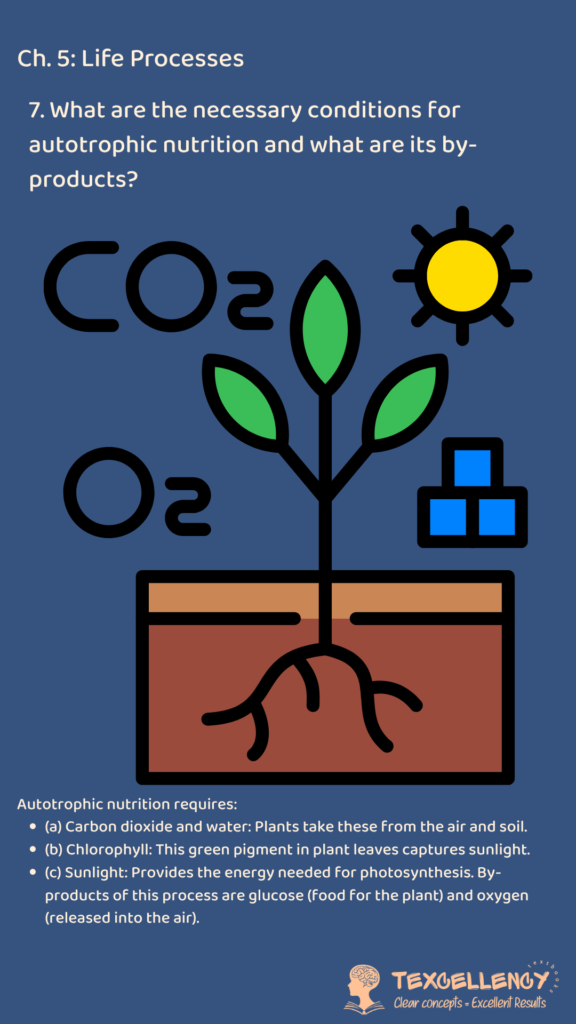
Autotrophic nutrition (photosynthesis) requires four necessary conditions: sunlight (energy source), chlorophyll (the pigment that captures sunlight), carbon dioxide (raw material from air), and water (raw material from soil). The by-products are glucose (food stored in the plant) and oxygen (released into the atmosphere as a waste product — the same oxygen all animals including humans breathe).
🌍 The Big Picture — Why Autotrophic Nutrition is the Most Important Biological Process on Earth
Before diving into conditions and by-products — appreciate what autotrophic nutrition actually achieves. It is not just “how plants make food.” It is the foundational process that makes all life on Earth possible.
Every gram of food you have ever eaten — every roti, every dal, every piece of chicken, every fruit — traces its energy back to one source: sunlight captured by a plant through autotrophic nutrition. Even the chicken ate grain. The grain was made by a plant. The plant used sunlight.
Every breath of oxygen you take — every single O₂ molecule entering your lungs right now — was produced as a by-product of autotrophic nutrition by a plant or algae somewhere on Earth.
Remove autotrophic nutrition — and within weeks, Earth’s oxygen supply begins to deplete and the entire food chain collapses. Understanding what conditions enable this process, and what it produces, is understanding the engine that runs the living world.
🔬 What Exactly is Autotrophic Nutrition?
Autotrophic nutrition is the process by which certain organisms — primarily green plants, algae, and some bacteria — manufacture their own food from simple inorganic substances using an external energy source. The word breaks down perfectly: Auto = self, Troph = nourishment — self-nourishment.
The specific process through which most autotrophs achieve this is photosynthesis — using light energy (photo = light) to synthesise (synthesis = build) organic food molecules from CO₂ and water.
The overall equation of photosynthesis:
6CO₂ + 6H₂O + Light energy → C₆H₁₂O₆ (glucose) + 6O₂
Six molecules of CO₂ + Six molecules of water + Light energy → One molecule of glucose + Six molecules of oxygen
Simple in appearance — extraordinarily complex in execution — and the foundation of all life.
☀️ The Solar Power Plant Analogy — Understanding the Complete System
Think of a green plant as a solar power plant — but instead of generating electricity, it generates food (glucose).
🟢 Solar panels = Chlorophyll — the green pigment in leaves that captures incoming sunlight and converts it into usable chemical energy. Just as solar panels only work when correctly installed and functional — photosynthesis only works when chlorophyll is present and functional.
🟡 Sunlight = Light energy — the driving force. No sunlight = no power generation. The solar plant shuts down completely at night — and photosynthesis largely stops too (though some stored intermediates continue briefly).
🔵 Raw materials pipeline 1 = Carbon dioxide (CO₂) — piped in from the atmosphere through stomata. The carbon atoms in CO₂ become the carbon skeleton of glucose. Without this raw material — nothing can be built.
🔵 Raw materials pipeline 2 = Water (H₂O) — absorbed from soil through roots, transported upward through xylem to leaves. Water is split during photosynthesis (in a step called photolysis) — its hydrogen atoms used to build glucose, its oxygen atoms released as O₂ gas.
🟠 The electricity generated = Glucose (C₆H₁₂O₆) — the plant’s food — stored as starch, used for energy, used as building blocks for growth.
🟠 Exhaust / by-product = Oxygen (O₂) — the plant’s “waste” — released through stomata into the atmosphere — coincidentally the exact gas all animals need to survive.
Remove any one input — sunlight, chlorophyll, CO₂, or water — and the plant’s food factory shuts down completely.
🏟️ The Cricket Stadium Analogy — How CO₂ Enters the Plant
Before photosynthesis can begin — CO₂ must get inside the leaf. This happens through tiny pores called stomata — and the stadium analogy makes this beautifully clear.
Imagine a large cricket stadium — like Wankhede in Mumbai — with thousands of spectators (CO₂ molecules) wanting to enter. The stadium is the leaf. The entrance gates are the stomata — tiny pores on the leaf surface. The security guards at each gate are the guard cells — specialised cells that control whether the stomata are open or closed.
🔷 When sunlight is available (daytime, photosynthesis happening) — the guard cells absorb water, swell up, and pull apart — opening the stomata wide. CO₂ floods in. O₂ exits. The match is on — photosynthesis proceeds.
🔷 At night or during drought — the guard cells lose water, shrink, and press together — closing the stomata. No CO₂ enters. Water is conserved. The stadium is locked — no match tonight.
The stadium gates (stomata) are not just entry points for CO₂ — they are the plant’s master regulators of both gas exchange and water conservation. This is why plants wilt during drought — stomata close to conserve water, CO₂ cannot enter, photosynthesis stops, energy production halts.
🔍 Each Necessary Condition — Examined in Depth
🔵 Condition 1 — Sunlight (The Energy Source)
Sunlight provides the energy that drives the entire photosynthesis reaction. Without energy — you cannot build complex molecules (glucose) from simple ones (CO₂ and water) — because building complex molecules requires energy input (it is an endothermic process).
Photosynthesis captures light energy and converts it into chemical energy — stored in the bonds of the glucose molecule. This is one of the most remarkable energy conversions in nature — electromagnetic radiation from a star 150 million km away is converted into the chemical energy in a chapati on your plate.
🔷 Light-dependent reactions — happen in the grana (stacked membrane structures) of the chloroplast — use light energy to split water (photolysis) — produce ATP and NADPH — and release oxygen as by-product.
🔷 Light-independent reactions (Calvin cycle) — happen in the stroma of the chloroplast — use the ATP and NADPH from the light reactions — along with CO₂ — to build glucose molecules.
What happens without sunlight? The light-dependent reactions stop completely. No ATP or NADPH is produced. The Calvin cycle also stops (no fuel). Photosynthesis halts entirely. This is why plants in complete darkness eventually die — they have no way to make food.
🔵 Condition 2 — Chlorophyll (The Light Catcher)
Chlorophyll is a complex organic pigment — green in colour — found in the chloroplasts of plant cells (and in some algae and cyanobacteria). It is specifically structured to absorb light energy — particularly in the red and blue wavelengths of the visible spectrum — and convert it into chemical energy to drive photosynthesis.
The reason plants look green: chlorophyll absorbs red and blue light but reflects green light — which is what our eyes detect.
Chlorophyll contains a magnesium atom at its centre — this is why magnesium is an essential mineral nutrient for plants. Magnesium-deficient plants develop chlorosis — yellowing of leaves — because without magnesium, chlorophyll cannot be synthesised, the leaves lose their green colour, and photosynthesis collapses.
🔷 Types of chlorophyll — plants contain chlorophyll-a (most active in photosynthesis), chlorophyll-b (assists chlorophyll-a), and accessory pigments like carotenoids. Together they capture a broader range of sunlight wavelengths — maximising light absorption.
What happens without chlorophyll? The plant cannot capture light energy. Even in bright sunlight — with abundant CO₂ and water — photosynthesis cannot proceed without the molecular machinery to capture the light. Variegated plants (with white patches on leaves — no chlorophyll in white areas) only photosynthesise in their green portions.
🔵 Condition 3 — Carbon Dioxide (The Carbon Raw Material)
Carbon dioxide (CO₂) is the carbon source from which glucose is built. Every carbon atom in every glucose molecule — in every grain of rice, every fruit, every piece of wood — was once CO₂ in the atmosphere, captured by a plant during photosynthesis.
CO₂ enters leaves primarily through stomata — tiny pores on the leaf surface (mostly on the underside of leaves). The concentration of CO₂ in the atmosphere is approximately 0.04% (400 parts per million) — low, but sufficient for photosynthesis. The concentration gradient — higher outside the leaf than inside (where CO₂ is being consumed) — drives CO₂ inward by diffusion.
🔷 CO₂ and climate change connection — rising atmospheric CO₂ (currently ~420 ppm, rising due to burning fossil fuels) actually increases photosynthesis rates in some plants — a phenomenon called the CO₂ fertilisation effect. However, the temperature increases associated with climate change counteract this benefit by stressing plants in other ways.
What happens without CO₂? The Calvin cycle (light-independent reactions) cannot proceed — there is no carbon to fix into glucose. The plant runs on stored reserves briefly — then starves. This is why plants in sealed airtight containers with no CO₂ exchange eventually die even in bright light.
🔵 Condition 4 — Water (The Hydrogen Source and Coolant)
Water (H₂O) serves multiple roles in autotrophic nutrition:
🔷 As a raw material — water is split during the light-dependent reactions (photolysis — photo = light, lysis = splitting) of photosynthesis. The hydrogen from water is used to reduce CO₂ and build glucose. The oxygen from water is released as the O₂ by-product. Remarkably — the oxygen you are breathing right now came from water molecules split by plants, not from CO₂.
🔷 As a transport medium — minerals dissolved in soil water are transported upward through xylem to reach leaf cells where they are needed for chlorophyll synthesis and other metabolic processes.
🔷 As a coolant — transpiration (evaporation of water through stomata) cools the leaf, preventing heat damage to photosynthetic machinery during hot sunny days.
What happens without water? Photolysis stops — no hydrogen is available to reduce CO₂ — glucose cannot be built. Additionally — without water the plant wilts, stomata close (guard cells lose turgor), CO₂ cannot enter — photosynthesis stops on multiple fronts simultaneously. Severe water stress kills plants by collapsing photosynthesis entirely.
📊 Necessary Conditions — Complete Quick Reference Table
| Condition | Source | Role in Photosynthesis | What Happens Without It |
|---|---|---|---|
| Sunlight | Sun | Energy to drive the reaction | Photosynthesis stops completely |
| Chlorophyll | Chloroplasts in leaf cells | Captures light energy | Cannot convert light to chemical energy |
| Carbon dioxide | Atmosphere (via stomata) | Carbon raw material for glucose | Calvin cycle stops — no glucose built |
| Water | Soil (via roots and xylem) | Hydrogen source — split to release O₂ | Photolysis stops — no hydrogen — no glucose |
🌟 The By-Products — What Photosynthesis Produces
🟢 By-Product 1 — Glucose (C₆H₁₂O₆)
Glucose is the primary product — the food the plant makes for itself. It is a simple sugar — a 6-carbon molecule — that stores chemical energy in its bonds. The plant uses glucose for:
🔵 Immediate energy — through its own cellular respiration 🔵 Storage as starch — excess glucose is converted to starch and stored in roots, stems, fruits, and seeds (potatoes, rice, wheat — all starch stores from autotrophic nutrition) 🔵 Building blocks — glucose is the starting material for cellulose (cell walls), proteins (combined with nitrogen from soil minerals), fats, and all other organic molecules the plant needs
Important NCERT note: Strictly speaking, glucose itself is the PRIMARY product of photosynthesis — not just a by-product. The question asks for by-products — and glucose is listed as one of them because from the perspective of the overall INPUT-OUTPUT of photosynthesis (CO₂ + water → glucose + oxygen), both glucose and oxygen are outputs. In CBSE exams — list BOTH glucose and oxygen as by-products when this question is asked.
🟢 By-Product 2 — Oxygen (O₂)
Oxygen is released as a gaseous by-product through the stomata into the atmosphere. For the plant — it is simply waste from splitting water. For every other aerobic organism on Earth — it is the essential gas without which survival is impossible.
🔵 Source of oxygen: The oxygen released comes from the splitting of water (H₂O) during photolysis — NOT from CO₂. This was a crucial discovery in the history of biology — proved by experiments using isotope-labelled water.
🔵 Scale of oxygen production: Global photosynthesis by plants, algae, and cyanobacteria produces approximately 550 billion tonnes of oxygen per year — maintaining Earth’s atmospheric oxygen at approximately 21%.
🔵 The irony of oxygen: What was originally a “toxic waste product” of early photosynthetic bacteria (which poisoned the early anaerobic atmosphere of Earth approximately 2.4 billion years ago — the Great Oxidation Event) became the essential gas upon which almost all complex life evolved to depend.
📊 By-Products Summary Table
| By-Product | Chemical Formula | Where Released | Significance |
|---|---|---|---|
| Glucose | C₆H₁₂O₆ | Stored inside plant | Primary food — energy, growth, storage |
| Oxygen | O₂ | Released through stomata | Essential for all aerobic life on Earth |
🌿 What Happens to Glucose After It is Made — Beyond the Textbook
Most textbooks stop at “glucose is produced.” But examiners love asking what happens next — and this knowledge demonstrates genuine understanding:
🔷 Converted to starch for storage — starch is insoluble (does not affect cell osmosis) and compact — ideal for long-term storage in roots (potatoes), seeds (rice, wheat), and fruits. 🔷 Used in cellular respiration — the plant itself breaks down glucose for its own ATP production. 🔷 Converted to sucrose for transport — sucrose is loaded into phloem and transported to all parts of the plant. 🔷 Used to build cellulose — the structural material of cell walls — the most abundant organic molecule on Earth. 🔷 Used to synthesise amino acids and proteins — when combined with nitrogen and other minerals absorbed from soil.
🎵 Rhyme to Remember
“Four conditions — remember them well, Sunlight and chlorophyll — hear the bell, Carbon dioxide from the air rushes in, Water from the roots — let the process begin! Chlorophyll catches the sun’s bright ray, Splits the water — in a dazzling display, CO₂ is fixed — glucose is born, Oxygen released — every night and morn! Six CO₂ and six H₂O, With light energy — makes glucose glow, Six O₂ released — to the air above, Photosynthesis — the process we love!”
🔤 Alliterations
“Sunlight Supplies the energy to Start and Sustain photosynthesis” “Chlorophyll Catches and Converts light into Chemical energy” “CO₂ Crosses into the leaf via stomata — Carbon for Constructing glucose” “Water is split — its hydrogen helps build, its oxygen exits as our breathing gas” “Oxygen Output = our Only source of breathing gas — a plant’s Ordinary waste“
🧩 Mnemonic — Never Forget the Four Conditions
S — C — C — W → “Sunlight Creates Cooking with Water”
Sunlight • Chlorophyll • Carbon dioxide • Water
The sentence “Sunlight Creates Cooking with Water” describes photosynthesis perfectly — the sun (sunlight) creates cooking (glucose manufacture) using water — and chlorophyll is the kitchen where it happens.
Or remember by inputs and outputs:
Inputs: “SCCW” → Sunlight • Chlorophyll • CO₂ • Water Outputs: “GO” → Glucose • Oxygen
“SCCW goes in — GO comes out.”
✅ Exam-Ready Answer (3 marks)
Necessary conditions for autotrophic nutrition (photosynthesis):
1. Sunlight — provides the energy needed to drive the photosynthesis reaction. Light energy is absorbed by chlorophyll and converted into chemical energy.
2. Chlorophyll — the green pigment present in chloroplasts of plant cells. It captures sunlight energy and makes it available for the photosynthesis reactions.
3. Carbon dioxide (CO₂) — enters the leaf through stomata from the atmosphere. It provides the carbon atoms that are used to build glucose molecules.
4. Water (H₂O) — absorbed from the soil through roots and transported to leaves. It is split during photosynthesis (photolysis) to provide hydrogen for glucose synthesis.
Overall equation: 6CO₂ + 6H₂O + Light energy → C₆H₁₂O₆ + 6O₂
By-products of autotrophic nutrition:
1. Glucose (C₆H₁₂O₆) — the food produced and stored by the plant. Used for energy, growth, and as building material for other organic compounds.
2. Oxygen (O₂) — released as a gaseous by-product through stomata into the atmosphere. It is produced from the splitting of water molecules and is the oxygen that all aerobic organisms breathe.
📌 Key Points Checklist
✅ Four necessary conditions: Sunlight • Chlorophyll • CO₂ • Water — all four must be present simultaneously ✅ Sunlight = energy source — drives the entire reaction — no sunlight = photosynthesis stops ✅ Chlorophyll = light catcher — green pigment in chloroplasts — contains magnesium atom ✅ Chlorophyll absorbs red and blue light — reflects green — that is why plants look green ✅ CO₂ enters through stomata by diffusion — concentration gradient drives entry ✅ Guard cells control stomata opening — open in light, close in dark/drought ✅ Water is split during photolysis — hydrogen used for glucose, oxygen released as by-product ✅ The O₂ we breathe comes from WATER split by plants — NOT from CO₂ ✅ By-products: Glucose (stored as starch) + Oxygen (released through stomata) ✅ Photosynthesis equation: 6CO₂ + 6H₂O + Light → C₆H₁₂O₆ + 6O₂ ✅ Glucose used for: energy (respiration) • storage (starch) • transport (sucrose) • structure (cellulose) • protein synthesis ✅ Global photosynthesis produces ~550 billion tonnes of O₂ per year — maintaining 21% atmospheric oxygen ✅ Magnesium deficiency → chlorosis (yellowing) → chlorophyll cannot form → photosynthesis collapses
📚 Want ALL of Class 10 Science Explained This Way?
Every chapter. Every concept. Every NCERT question — explained with analogies, rhymes, mnemonics, and real-life examples that make sense and stay in memory long after exam day.
👉 Explore the Full Texcellency Collection 👉 Download Your FREE Book Now