C1 — Chemical Reactions and Equations
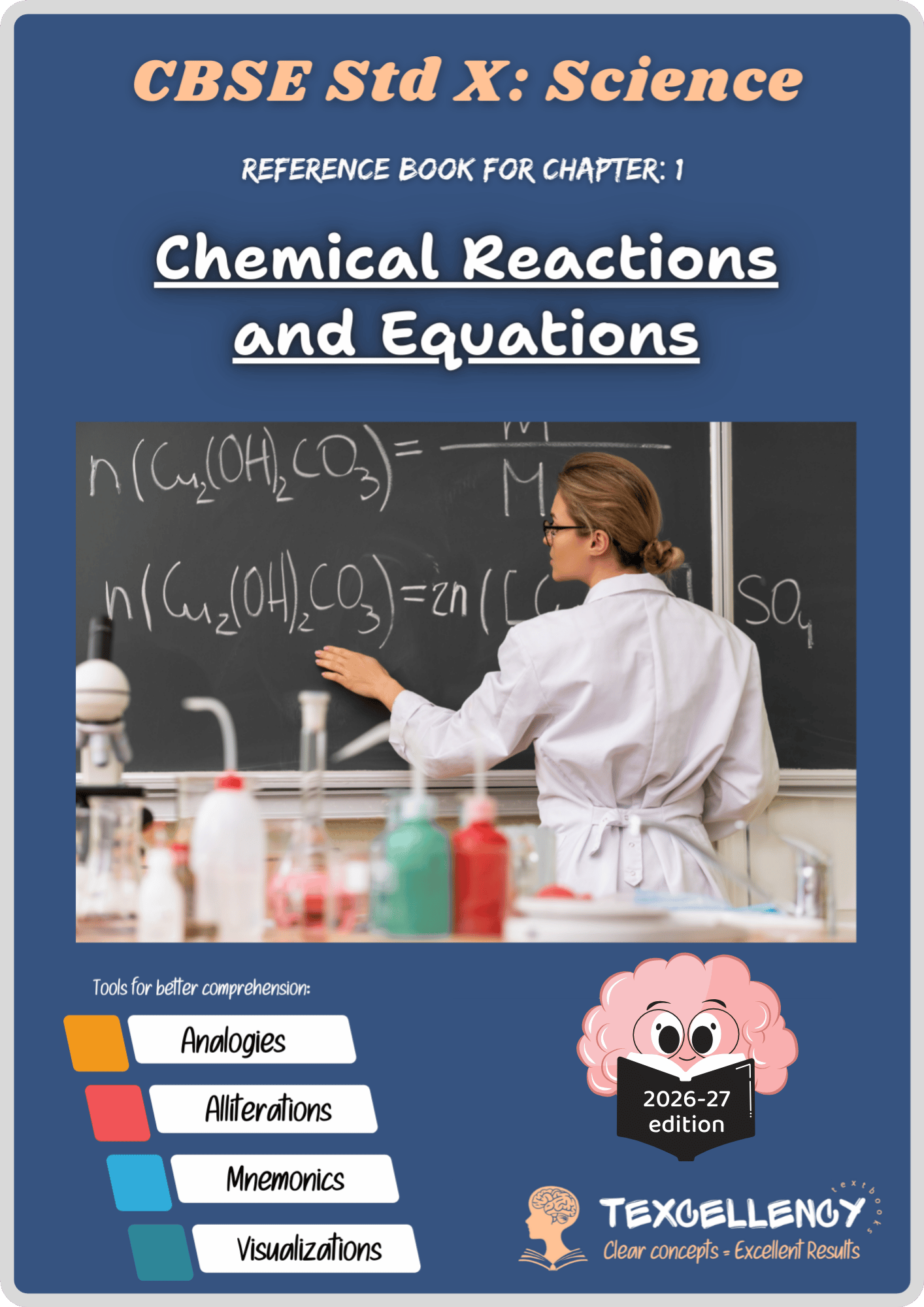
Chemical Reactions and Equations is Chapter 1 of CBSE Class 10 Science and one of the most important chapters in the entire Chemistry syllabus. This Texcellency book on Chemical Reactions and Equations is written specifically for CBSE Class 10 students who find the standard NCERT Science textbook difficult, boring, or hard to remember.
Most students struggle with Chemical Reactions and Equations because balancing equations feels like solving a puzzle without instructions, and the NCERT language makes simple concepts sound complicated. This Texcellency book fixes exactly that problem. Every concept is explained in simple, everyday language with fun analogies and real-life examples that make the chapter easy to understand and impossible to forget.
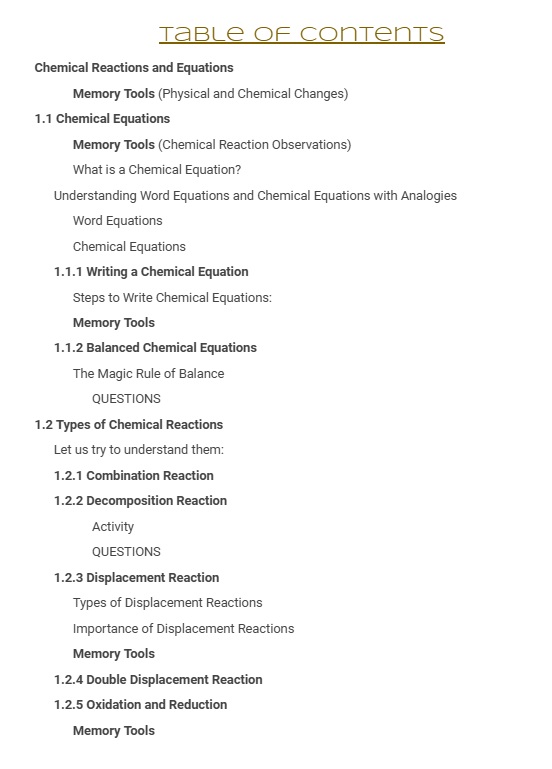
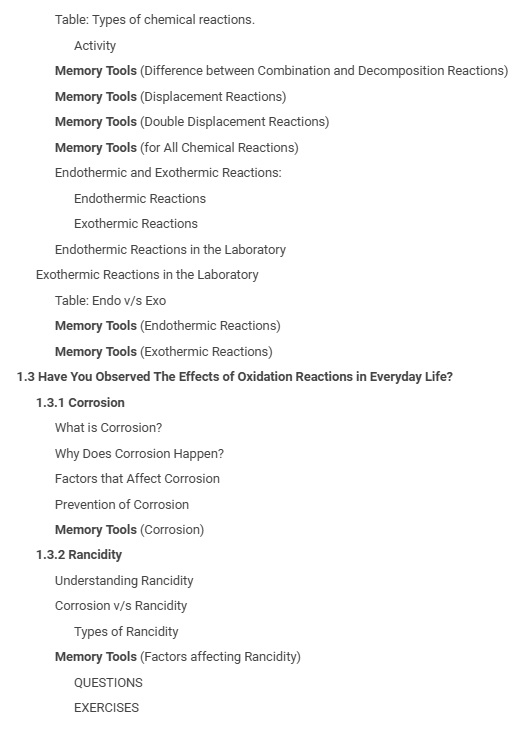
What this CBSE Class 10 Chemical Reactions and Equations book covers: Combination reactions and decomposition reactions with real-life examples. Displacement reactions and double displacement reactions explained simply. Oxidation and reduction reactions with easy memory tricks. Balancing chemical equations step by step — no confusion, no guesswork. Corrosion and rancidity explained with kitchen and everyday examples. Exothermic and endothermic reactions made crystal clear.
Why this book is better than NCERT for Class 10 students: The NCERT textbook teaches Chemical Reactions and Equations in a way that requires a teacher or tutor to explain. This Texcellency book is written so that any Class 10 student can read it independently, understand every concept on their own, and feel genuinely confident before the board exam. No tutor needed. No coaching class needed.
Who should buy this CBSE Class 10 Science book: Students who find NCERT Science difficult to understand. Students preparing for CBSE Class 10 board exams 2027. Students who want to study without depending on a tuition teacher. Parents looking for a self-study friendly supplementary science book. Students who want to score well in Chemical Reactions and Equations without stress.
Based on the latest CBSE 2026-27 syllabus — every topic, every concept, and every question type in this book is aligned to the current CBSE Class 10 Science board exam pattern including competency-based questions and application-based questions.
Also available as part of the complete CBSE Class 10 Science Books Bundle — all 13 chapters at just ₹999.
🔷 C2 — Acids, Bases and Salts
Acids, Bases and Salts is Chapter 2 of CBSE Class 10 Science and a chapter that confuses thousands of students every year. The reactions, the pH scale, the indicators, the salt formations — it all starts to blur together when explained in dry textbook language. This Texcellency book on Acids, Bases and Salts is designed to make every single concept in this chapter completely clear, logical, and easy to remember for CBSE Class 10 students.
If your child has ever asked “Why does an acid react with a metal but a base does not?” or “What exactly is a neutral salt?” — this book answers every such question with simple, conversational explanations that feel like a friendly teacher sitting right next to you.
What this CBSE Class 10 Acids Bases and Salts book covers: Properties of acids and bases with real-life examples from home and kitchen. How acids and bases react with metals, metal oxides and carbonates. The pH scale explained simply — what it means and why it matters. Indicators like litmus, phenolphthalein and methyl orange — when and why they change colour. Formation of common salts like sodium chloride, sodium hydroxide and baking soda. Neutralisation reactions made easy with everyday analogies.
Why this book is better than NCERT for Class 10 students: Standard NCERT explanations of Acids Bases and Salts require students to memorise long reaction chains without truly understanding why they happen. This Texcellency book builds understanding from the ground up — using rhymes, analogies, and step-by-step logic so students genuinely grasp the chapter instead of just memorising it.
Who should buy this book: CBSE Class 10 students struggling with Chemistry concepts. Students preparing independently for the 2027 board exams. Parents looking for a student-friendly alternative to NCERT for Class 10 Science. Students who want to reduce or eliminate tuition dependency.
Based on the latest CBSE 2026-27 syllabus — completely aligned to the current CBSE Class 10 Science exam pattern including MCQs, assertion-reasoning, and competency-based questions.
Also available as part of the complete CBSE Class 10 Science Books Bundle — all 13 chapters at just ₹999.
🔷 C3 — Metals and Non-Metals
Metals and Non-Metals is Chapter 3 of CBSE Class 10 Science and one of the highest-scoring chapters in the board exam — if a student understands it properly. The reactivity series, ionic bonding, corrosion, extraction of metals — these topics carry significant marks every year. This Texcellency book on Metals and Non-Metals makes every one of these concepts genuinely easy to understand for CBSE Class 10 students.
What this CBSE Class 10 Metals and Non-Metals book covers: Physical and chemical properties of metals and non-metals with clear comparisons. How metals react with oxygen, water, acids and other metal salts — explained with logic, not just memorisation. The reactivity series — what it is, why it matters, and how to use it in exam questions. Ionic bond formation between metals and non-metals — simplified with visual analogies. Extraction of metals from ores — the entire process made step by step simple. Corrosion, rusting, and prevention methods explained with real-life examples. Alloys and their everyday applications.
Why this book works better than NCERT for Class 10: Students often memorise the reactivity series without understanding why metals behave differently. This Texcellency book explains the logic behind every reaction, every property, and every process — so students can answer any board exam question confidently, even the application-based and competency-based questions that CBSE has been increasing every year.
Who should buy this book: CBSE Class 10 students finding Chemistry difficult. Students wanting to self-study without a tutor. Parents looking for a clear, engaging supplementary science book for their child. Students targeting 90+ marks in the CBSE Science board exam 2027.
Based on the latest CBSE 2026-27 syllabus. Also available as part of the complete CBSE Class 10 Science Books Bundle — all 13 chapters at just ₹999.
🔷 C4 — Carbon and Its Compounds
Carbon and its Compounds is Chapter 4 of CBSE Class 10 Science and one of the most interesting yet most misunderstood chapters in the entire syllabus. Organic chemistry begins here — covalent bonds, hydrocarbons, ethanol, ethanoic acid, soaps and detergents — and most students find it overwhelming because the NCERT textbook jumps into complex terminology without building a proper foundation. This Texcellency book on Carbon and its Compounds builds that foundation from scratch, in simple language that any Class 10 student can follow independently.
What this CBSE Class 10 Carbon and its Compounds book covers: Why carbon forms so many compounds — the concept of covalent bonding explained simply. Hydrocarbons — saturated and unsaturated — with clear structural diagrams explained in words. Homologous series and functional groups — what they are and why they matter. Ethanol and ethanoic acid — properties, uses and reactions explained with everyday examples. Soaps and detergents — how they work and why, with the science made genuinely interesting. Nomenclature of carbon compounds — naming rules made logical and easy to remember.
Why this book makes Carbon and its Compounds easy: This is a chapter where NCERT language often loses students completely. Texcellency rewrites every concept using analogies from daily life — making abstract ideas like covalent bonding and functional groups feel logical and real. Students who read this book report that Carbon and its Compounds becomes one of their favourite chapters.
Who should buy this book: Class 10 CBSE students preparing for board exams 2027. Students who find organic chemistry confusing. Parents looking for a simple, self-study friendly science book. Students wanting to study without tuitions.
Based on the latest CBSE 2026-27 syllabus. Also available as part of the complete CBSE Class 10 Science Books Bundle — all 13 chapters at just ₹999.
🔷 C5 — Life Processes
Life Processes is Chapter 5 of CBSE Class 10 Science and the first Biology chapter in the syllabus — and it is one of the most marks-heavy chapters in the board exam. Nutrition, respiration, transportation, excretion — four major life processes, each with complex systems, diagrams, and terminology. This Texcellency book on Life Processes breaks down every one of these processes into clear, simple, logical explanations that CBSE Class 10 students can read, understand, and remember without a teacher.
What this CBSE Class 10 Life Processes book covers: Autotrophic and heterotrophic nutrition — the difference explained with real-life examples. The human digestive system — every organ, every enzyme, every step explained simply. Photosynthesis — the complete process made visual and easy to understand. Aerobic and anaerobic respiration — why they differ and when each happens. Human respiratory system — breathing mechanism explained step by step. Transportation in humans — the heart, blood, blood vessels, and circulation made clear. Transportation in plants — xylem, phloem, osmosis, transpiration explained logically. Excretion in humans — kidneys, nephrons, urine formation — simplified with analogies. Excretion in plants — how plants get rid of waste in their own quiet way.
Why this book transforms how students understand Biology: Life Processes is a chapter where students either truly understand the systems or just blindly memorise diagrams. This Texcellency book builds real understanding — using the kind of analogies and storytelling that make a biology class genuinely engaging. Students who understand Life Processes deeply score much better in the board exam because CBSE increasingly asks application-based and case-based questions from this chapter.
Who should buy this book: CBSE Class 10 students struggling with Biology. Students who want to understand rather than memorise. Parents whose children find science boring or difficult. Students preparing independently for CBSE board exams 2027.
Based on the latest CBSE 2026-27 syllabus. Also available as part of the complete CBSE Class 10 Science Books Bundle — all 13 chapters at just ₹999.
🔷 C6 — Control and Coordination
Control and Coordination is Chapter 6 of CBSE Class 10 Science — a fascinating Biology chapter that explains how the human body and plants sense, respond, and stay in balance. The nervous system, the brain, reflex actions, hormones, and how plants respond to stimuli — this chapter is rich with concepts that students find confusing when read from NCERT. This Texcellency book on Control and Coordination makes the entire chapter logical, visual, and genuinely easy to understand for any CBSE Class 10 student.
What this CBSE Class 10 Control and Coordination book covers: The nervous system — neurons, nerve impulses, and how signals travel in the body — explained simply. The human brain — cerebrum, cerebellum, medulla — each part’s function made clear and memorable. Reflex action and reflex arc — explained with real examples like touching a hot object. How sense organs send signals to the brain — the complete pathway simplified. Hormones in animals — endocrine glands, adrenaline, insulin, thyroxine — what each does and why. Plant hormones — auxins, gibberellins, cytokinins, abscisic acid — explained with plant behaviour examples. Tropic movements in plants — phototropism, geotropism, hydrotropism — made visual and logical.
Why this book works for Class 10 students: Control and Coordination involves a lot of interconnected systems and students often get lost in the terminology. This Texcellency book creates a clear mental map of the entire chapter — so students can answer any question, including the increasingly common competency-based and assertion-reasoning questions in CBSE board exams.
Based on the latest CBSE 2026-27 syllabus. Also available as part of the complete CBSE Class 10 Science Books Bundle — all 13 chapters at just ₹999.
🔷 C7 — How Do Organisms Reproduce
How do Organisms Reproduce is Chapter 7 of CBSE Class 10 Science — a Biology chapter that covers one of the most fundamental processes of life. Asexual reproduction, sexual reproduction in plants and animals, human reproductive systems, and the concept of DNA copying — this chapter is detailed, diagram-heavy, and carries significant marks in the board exam. This Texcellency book explains every concept clearly, sensitively, and scientifically so that CBSE Class 10 students can study the chapter confidently and independently.
What this CBSE Class 10 How do Organisms Reproduce book covers: Why reproduction is essential for survival of species — the concept explained logically. Asexual reproduction methods — fission, budding, fragmentation, spore formation, vegetative propagation — all explained with examples. Sexual reproduction in flowering plants — pollination, fertilisation, seed formation — made visual and clear. Male and female reproductive systems in humans — structure and function explained simply and scientifically. Menstruation and fertilisation in humans — explained clearly for exam purposes. Contraception methods — as covered in CBSE syllabus. Sexually transmitted infections as per CBSE curriculum. Importance of DNA copying in reproduction — connecting Biology to the bigger picture.
Why this book makes the chapter easier: This is a chapter many students feel awkward studying from textbooks. Texcellency handles the topic with scientific clarity and the right level of detail — helping students focus purely on exam preparation without confusion or discomfort.
Based on the latest CBSE 2026-27 syllabus. Also available as part of the complete CBSE Class 10 Science Books Bundle — all 13 chapters at just ₹999.
🔷 C8 — Heredity
Heredity is Chapter 8 of CBSE Class 10 Science — a Biology chapter that explains how characteristics pass from parents to offspring, how evolution works, and why living species are so diverse. Mendel’s laws, dominant and recessive traits, sex determination, evolution, and the origin of life — this chapter requires logical thinking and clear concept-building. This Texcellency book on Heredity makes Mendel’s experiments, genetic ratios, and evolutionary concepts genuinely understandable for every CBSE Class 10 student.
What this CBSE Class 10 Heredity book covers: Gregor Mendel’s experiments with pea plants — the logic explained step by step. Dominant and recessive traits — what they mean and how to work with them in exam questions. Monohybrid and dihybrid crosses — Punnett squares explained simply. Sex determination in humans — XX and XY chromosomes made clear. Heredity and variation — why children resemble parents but are not identical. Evolution — from acquired traits to natural selection — explained with logical examples. Speciation — how new species form — simplified. Evolution and classification — the connection made clear. Human evolution — key milestones explained concisely.
Why this book helps students score better: Heredity questions in CBSE board exams are often tricky because students memorise Mendel’s ratios without understanding the logic. Texcellency builds the logic first — so students can solve any Punnett square problem and answer any evolution question with genuine confidence.
Based on the latest CBSE 2026-27 syllabus. Also available as part of the complete CBSE Class 10 Science Books Bundle — all 13 chapters at just ₹999.
🔷 C9 — Light: Reflection and Refraction
Light Reflection and Refraction is Chapter 9 of CBSE Class 10 Science — one of the most important Physics chapters in the syllabus and a chapter that consistently carries heavy marks in the board exam. Mirrors, lenses, ray diagrams, mirror formula, lens formula, magnification — this chapter requires both conceptual clarity and numerical problem-solving ability. This Texcellency book on Light Reflection and Refraction builds both skills in CBSE Class 10 students through simple explanations, logical examples, and step-by-step numerical methods.
What this CBSE Class 10 Light Reflection and Refraction book covers: Laws of reflection — explained simply with clear diagrams in words. Plane mirrors, concave mirrors, and convex mirrors — differences, uses, and image formation explained logically. Ray diagrams for mirrors — how to draw them correctly for every object position. Mirror formula and magnification — how to use them without confusion. Refraction of light — why it happens, explained with the bent straw analogy and more. Refractive index — what it means, how to calculate it. Convex lenses and concave lenses — image formation explained for every case. Lens formula and magnification for lenses — step-by-step numerical solving. Power of a lens — the concept and formula made simple.
Why this book is essential for CBSE Class 10 Physics: Light is one of those chapters where students either love Physics or lose confidence in it completely. Texcellency makes every concept click — from understanding why a spoon looks bent in water to solving complex mirror formula numericals correctly in the board exam.
Based on the latest CBSE 2026-27 syllabus. Also available as part of the complete CBSE Class 10 Science Books Bundle — all 13 chapters at just ₹999.
🔷 C10 — Human Eye and Colourful World
Human Eye and Colourful World is Chapter 10 of CBSE Class 10 Science — a beautiful Physics chapter that connects the science of light to the experience of seeing. The human eye, defects of vision, the rainbow, the blue sky, the red sunset — this chapter explains the science behind things students see every single day. This Texcellency book on Human Eye and Colourful World makes every concept in this chapter feel like a fascinating discovery rather than a difficult lesson.
What this CBSE Class 10 Human Eye and Colourful World book covers: The structure of the human eye — each part and its function explained clearly. How the eye focuses light — the concept of accommodation explained simply. Defects of vision — myopia, hypermetropia, presbyopia, and astigmatism — what causes each and how spectacles correct them. Refraction through a glass prism — explained with step-by-step logic. Dispersion of white light and the formation of a rainbow — the science behind nature’s most beautiful phenomenon. Atmospheric refraction — why stars twinkle and planets do not. Scattering of light — why the sky is blue and why sunsets are red — explained in a way students will never forget.
Why students love this chapter with Texcellency: Human Eye and Colourful World is actually one of the most enjoyable chapters in the CBSE Class 10 Science syllabus — and Texcellency makes it even more engaging by connecting every concept to real-world observations students already have. This builds genuine curiosity and deep understanding simultaneously.
Based on the latest CBSE 2026-27 syllabus. Also available as part of the complete CBSE Class 10 Science Books Bundle — all 13 chapters at just ₹999.
🔷 C11 — Electricity
Electricity is Chapter 11 of CBSE Class 10 Science — the single most numerical-heavy chapter in the entire syllabus and one of the highest-scoring chapters for students who understand it well. Electric current, potential difference, resistance, Ohm’s Law, series and parallel circuits, electrical power, household wiring — this chapter is packed with concepts and formulas that require clear understanding to solve correctly. This Texcellency book on Electricity builds that understanding from zero, in simple language with step-by-step numerical solutions.
What this CBSE Class 10 Electricity book covers: Electric current and what it actually means — explained with water flow analogy. Electric potential and potential difference — the concept made simple and logical. Resistance and factors affecting resistance — explained clearly. Ohm’s Law — the formula, its meaning, and how to use it in every type of board exam question. Resistors in series — how to calculate total resistance and current. Resistors in parallel — how to calculate total resistance, current, and voltage. Electric power and electric energy — formulas explained with real-life electricity bill examples. Heating effect of electric current — Joule’s law explained simply. Domestic electric circuits — how household wiring works and why safety devices are needed.
Why this book is essential for scoring in Physics: Electricity is a chapter where students lose marks not because they do not know the concepts but because they do not understand how to apply the formulas correctly. Texcellency gives students a clear, logical framework for solving every type of numerical problem that appears in CBSE board exams — from simple Ohm’s Law questions to complex circuit diagrams.
Based on the latest CBSE 2026-27 syllabus. Also available as part of the complete CBSE Class 10 Science Books Bundle — all 13 chapters at just ₹999.
🔷 C12 — Magnetic Effects of Electric Current
Magnetic Effects of Electric Current is Chapter 12 of CBSE Class 10 Science — a Physics chapter that connects electricity and magnetism in ways that explain how motors, generators, and most modern technology actually work. This Texcellency book on Magnetic Effects of Electric Current makes concepts like Fleming’s Left Hand Rule, electromagnetic induction, and AC versus DC current easy to understand for every CBSE Class 10 student — without needing a physics tutor to explain it.
What this CBSE Class 10 Magnetic Effects of Electric Current book covers: Magnetic field and field lines — what they are and how to visualise them. Magnetic field due to a current-carrying conductor — explained step by step. Right Hand Thumb Rule — when to use it and how to apply it correctly. Force on a current-carrying conductor in a magnetic field — the concept and its applications. Fleming’s Left Hand Rule — explained clearly with real-world motor examples. Electric motor — how it works, why it works, and its uses. Electromagnetic induction — the concept that powers the modern world, made simple. Fleming’s Right Hand Rule and its application to generators. Electric generator — AC generator and DC generator explained with clear logic. Domestic electric circuits — earthing, fuse, MCB — why they are essential for safety.
Why this chapter is important and why Texcellency helps: Magnetic Effects of Electric Current is a chapter that builds directly on the Electricity chapter and prepares students for higher Physics in Class 11 and 12. Texcellency ensures students build a solid, logical foundation here — making both their Class 10 board exam and their future studies much easier.
Based on the latest CBSE 2026-27 syllabus. Also available as part of the complete CBSE Class 10 Science Books Bundle — all 13 chapters at just ₹999.
🔷 C13 — Our Environment
Our Environment is Chapter 13 of CBSE Class 10 Science — the final chapter of the syllabus and one that connects all of Science to the real world students live in. Ecosystems, food chains, food webs, biodegradable and non-biodegradable waste, ozone layer depletion, waste management — this chapter is highly relevant to everyday life and carries consistent marks in the CBSE board exam. This Texcellency book on Our Environment makes every concept clear, memorable, and exam-ready.
What this CBSE Class 10 Our Environment book covers: Ecosystem — what it is, how it works, and the balance that keeps it alive. Producers, consumers, and decomposers — their roles explained with vivid real-life examples. Food chains and food webs — how energy flows through living systems. Trophic levels and the 10 percent energy flow rule — explained with logic and memorable examples. Biodegradable and non-biodegradable substances — the difference and why it matters for the environment. Ozone layer — what it is, why it matters, and what causes its depletion. Ozone-depleting substances like CFCs — the science and the real-world impact. Waste management and environmental degradation — practical understanding for exam and life.
Why this chapter matters beyond the exam: Our Environment is the one chapter in CBSE Class 10 Science that students can connect to every news headline about climate, pollution, and sustainability. Texcellency makes this chapter both exam-ready and genuinely eye-opening — students who read this book come away understanding the environment better, not just scoring better.
Based on the latest CBSE 2026-27 syllabus. Also available as part of the complete CBSE Class 10 Science Books Bundle — all 13 chapters at just ₹999.
⭕ After pasting all 13 descriptions: Re-run Rank Math SEO Analyzer on each product page. Scores should jump to 55-70/100 immediately. The remaining gap to 75+ will close once you also get 2-3 customer reviews with star ratings on each product.