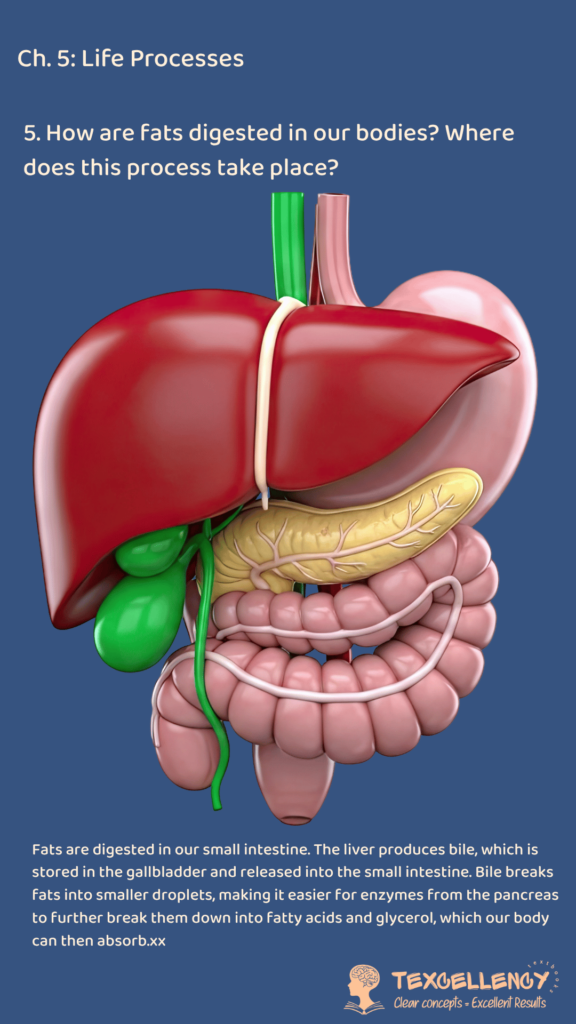
How are fats digested in our bodies? Where does this process take place?
NCERT Class 10 Science | Life Processes | Texcellency Book Series
🔷 Featured Answer
Fats are digested almost entirely in the small intestine — specifically in the duodenum (the first section of the small intestine). The process involves two key steps: first, bile juice produced by the liver emulsifies fat (breaks large fat globules into tiny fat droplets) — increasing surface area for enzyme action. Then pancreatic lipase (and intestinal lipase) breaks these fat droplets down into fatty acids and glycerol — the final absorbable products of fat digestion. Unlike carbohydrates and proteins whose digestion begins in the mouth and stomach respectively, fat digestion happens almost exclusively in the small intestine.
🏭 The Big Picture — Why Fat Digestion is Different from Everything Else
Carbohydrates (starch) — digestion starts in the mouth (salivary amylase). Proteins — digestion starts in the stomach (pepsin). But fats? They largely pass through the mouth and stomach completely undigested and arrive at the small intestine intact.
Why? Because fat digestion requires a two-step process that is only possible in the small intestine — and the small intestine is the only place both the right chemicals (bile + lipase) are simultaneously available.
But there is a more fundamental problem. Fats are hydrophobic — they do not mix with water. Digestive juices, blood, and indeed the entire internal environment of the body is water-based. You cannot dissolve a fat globule in water any more than you can dissolve a spoonful of ghee in a glass of water — it simply floats as one large blob.
Large fat blobs are almost impossible for lipase enzymes to attack. Enzymes work on surfaces — the larger and fewer the fat globules, the less surface area is available for lipase to act on. If fat arrived at the small intestine as one large blob — digestion would be impossibly slow.
This is exactly the problem bile solves. And once bile solves it — lipase can do its job efficiently. The two-step choreography of fat digestion is one of the most elegant solutions in human biochemistry.
🧼 The Washing Powder Analogy — The Clearest Way to Understand Emulsification
You have seen what happens when you put a greasy plate under plain water — the oil just sits there in large blobs, unaffected. But add a little washing powder or dish soap — and suddenly the oil breaks into millions of tiny droplets that are easily washed away. The soap does not dissolve the oil — it just breaks the large oil mass into tiny droplets, dramatically increasing surface area so water can wash each droplet away.
Bile juice is the body’s biological dish soap — and emulsification is its washing action.
🟢 Large fat globule entering the small intestine = greasy plate entering the sink 🟡 Bile salts in bile juice = dish soap / washing powder 🔵 Emulsification = the breaking of large fat globule into millions of tiny fat droplets 🔴 Lipase (pancreatic enzyme) = the water itself — now able to attack each tiny droplet efficiently because so much more surface is exposed
Without bile — fat stays as large globules — lipase cannot work efficiently — fat digestion is severely impaired. This is exactly what happens in people whose gallbladder has been removed — they must eat low-fat diets because their fat digestion is compromised.
🔬 The Complete Step-by-Step Mechanism of Fat Digestion
🔷 Step 1 — Fat Arrives at the Small Intestine Largely Undigested
Fat (in the form of triglycerides — three fatty acid chains attached to a glycerol backbone) enters the mouth as part of food — ghee, oil, butter, meat, nuts, dairy. The mouth does nothing significant to fat — there is no fat-digesting enzyme in saliva. The stomach secretes a small amount of gastric lipase — which begins very minor fat digestion — but the strongly acidic stomach environment is not ideal for lipase, and most fat passes through largely intact.
Fat enters the duodenum (first section of small intestine) as large, churned fat globules mixed with stomach acid — a partially digested, acidic food mixture called chyme.
🔷 Step 2 — Bile Juice is Released into the Duodenum (Emulsification)
The arrival of fat in the duodenum triggers the release of a hormone called cholecystokinin (CCK) — which signals the gallbladder to contract and release bile juice into the duodenum through the bile duct.
Bile juice is produced continuously by the liver — one of its most important digestive functions. It is stored and concentrated in the gallbladder (a small pear-shaped sac attached to the underside of the liver) between meals. Each meal triggers its release.
🔷 What is bile juice made of? Bile is not an enzyme — it contains no digestive enzymes. Instead it contains: Bile salts (sodium taurocholate and sodium glycocholate) — the active emulsifying agents Bile pigments (bilirubin and biliverdin) — yellow-green pigments produced from the breakdown of old red blood cells — give bile its characteristic greenish-yellow colour and give faeces its brown colour Cholesterol, water, bicarbonate — various other components
🔷 How do bile salts cause emulsification? Bile salts are amphipathic molecules — they have one end that is attracted to water (hydrophilic) and one end attracted to fat (hydrophobic). They insert their fat-loving end into fat globules while their water-loving end faces outward into the watery intestinal fluid. This breaks surface tension — causing large fat globules to shatter into millions of tiny fat droplets (approximately 1 micrometre in diameter). This process is called emulsification and the result is called an emulsion.
🔷 What does emulsification achieve? One large fat globule (say 1 mm diameter) has a certain surface area. Break it into millions of 1-micrometre droplets — and the total surface area increases approximately 1,000 times. Lipase enzymes can now attack 1,000 times more fat surface simultaneously — fat digestion speed increases dramatically.
🔷 Bile also neutralises stomach acid: Chyme arriving from the stomach is highly acidic (pH 1.5-3.5). Pancreatic enzymes including lipase work best at a slightly alkaline pH (7-8). Bile’s bicarbonate content neutralises the stomach acid — raising the pH of the duodenal contents to the alkaline range — creating the ideal environment for pancreatic enzymes to function.
🔷 Step 3 — Pancreatic Lipase Breaks Down Emulsified Fat
Once bile has emulsified fat into tiny droplets — pancreatic lipase (released by the pancreas into the duodenum via the pancreatic duct) goes to work. Lipase is the enzyme that actually digests (chemically breaks down) fat.
Lipase attacks each tiny fat droplet — breaking the chemical bonds of triglycerides — splitting each triglyceride molecule into: 2 Fatty acid molecules + 1 Monoglyceride (or fully to 3 Fatty acids + 1 Glycerol)
Triglyceride → Fatty acids + Glycerol (by pancreatic lipase, in small intestine)
Fatty acids and glycerol are small, water-soluble molecules that can be absorbed across the intestinal wall into the bloodstream (or more specifically into the lymphatic system via specialised vessels called lacteals in the villi).
🔷 Step 4 — Absorption of Fatty Acids and Glycerol
Unlike glucose and amino acids (which are absorbed directly into blood capillaries in the villi) — fatty acids and glycerol are absorbed into the lacteals — lymphatic vessels inside each villus of the small intestine. They travel through the lymphatic system (as a milky fluid called chyle) before eventually entering the bloodstream.
Inside intestinal cells — fatty acids and glycerol are reassembled into triglycerides — packaged with proteins into particles called chylomicrons — and released into the lacteals for lymphatic transport.
🏙️ The Ghee in Sabzi Analogy — Understanding the Whole Journey
Think of making your morning sabzi with a large dollop of ghee.
The ghee (fat) enters your mouth → teeth chew, saliva adds nothing useful to it → stomach churns it but barely touches it chemically → arrives in duodenum as large fat blobs.
Now imagine the duodenum as a well-equipped community kitchen with two specialist workers:
🟢 Worker 1 — the Detergent Specialist (Bile salts) rushes in first — grabs the large ghee blob — uses emulsifying action to shatter it into millions of tiny droplets. “I cannot digest this — but I can prepare it for digestion. Here — now it has 1,000 times more surface area.”
🔵 Worker 2 — the Scissor Specialist (Lipase) arrives immediately after — now has 1,000 times more fat surface to work on — snips every fat molecule into fatty acids and glycerol at high speed. “Thank you for the preparation — now I can finish the job.”
🔴 The delivery system (lacteals in villi) collects the fatty acids and glycerol — packages them — dispatches them through the lymphatic highway to the bloodstream.
Both workers are essential. Remove either one — fat digestion fails.
🩺 What Happens When Fat Digestion Goes Wrong — Real-Life Connections
🔴 Gallstones — bile salts and cholesterol can crystallise inside the gallbladder — forming gallstones. These block bile flow — fat reaches the small intestine but cannot be emulsified — lipase cannot work efficiently — fat passes undigested into the large intestine — causing steatorrhoea (fatty, pale, foul-smelling stools that float). Severe abdominal pain (biliary colic) when gallstones block the bile duct. Treatment: gallbladder removal (cholecystectomy).
🔴 Gallbladder removal — after cholecystectomy, bile drips continuously from the liver into the duodenum (no gallbladder to store it) instead of being released in concentrated bursts at mealtimes. Fat digestion becomes less efficient — particularly for large fatty meals. Patients must adopt low-fat diets permanently.
🔴 Pancreatitis — inflammation of the pancreas reduces or stops lipase production. Fat digestion severely impaired. Steatorrhoea results. Patients placed on very low-fat diets and given oral lipase supplements.
🔴 Liver disease (cirrhosis) — severely reduced bile production — fat digestion compromised — fat-soluble vitamins (A, D, E, K) cannot be absorbed — leading to deficiency diseases.
📊 Fat Digestion — Complete Step-by-Step Summary Table
| Step | Location | Agent | What Happens |
|---|---|---|---|
| 1 | Mouth | None significant | Fat passes through undigested |
| 2 | Stomach | Gastric lipase (minor) | Very minor fat digestion begins |
| 3 | Duodenum | Bile salts (from liver/gallbladder) | Emulsification — large fat → tiny droplets |
| 4 | Duodenum | Pancreatic lipase | Triglycerides → fatty acids + glycerol |
| 5 | Small intestine villi | Lacteals (lymphatic vessels) | Fatty acids + glycerol absorbed into lymph |
| 6 | Bloodstream | Chylomicrons via lymph | Fat transported to body cells |
🎵 Rhyme to Remember
“Fat arrives in the small intestine’s door, Large and greasy — hard to explore, Bile juice arrives — the detergent friend, Emulsifies fat — from end to end! Tiny fat droplets — a million appear, Pancreatic lipase — the scissor is here! Snips triglycerides — with chemical flair, Fatty acids and glycerol — floating in air, Lacteals absorb them — lymph carries the load, Fat digestion complete — down the lymphatic road!”
🔤 Alliterations
“Bile Breaks Big fat globules into tiny Bits — Boosting lipase’s efficiency” “Lipase Lovingly cuts Large triglycerides into Little fatty acids” “Emulsification Enormously Expands fat surface area for Enzyme action” “Lacteals Lift fatty acids and glycerol into the Lymphatic system” “Gallbladder Guards and releases bile — the fat digestion Gatekeeper“
🧩 Mnemonic — Remember the Complete Fat Digestion Sequence
B — E — L — A → “Bile Emulsifies — Lipase Attacks”
Bile juice released → Emulsification of fat globules → Lipase breaks triglycerides → Absorption via lacteals
This four-word phrase encodes the entire fat digestion story in sequence — and the word “BELA” (a common Indian name) makes it memorable and personal.
Or remember the two key players and their jobs: “Bile = Breaks it up (physically) • Lipase = Breaks it down (chemically)”
Physical preparation first (bile). Chemical digestion second (lipase). This sequence is non-negotiable — reverse the order and fat digestion fails.
✅ Exam-Ready Answer (3 marks)
Where fat digestion takes place: Fat digestion occurs primarily in the small intestine (specifically the duodenum).
How fats are digested:
1. Emulsification by bile juice — Bile juice, produced by the liver and stored in the gallbladder, is released into the duodenum when fat enters. Bile salts in bile juice emulsify fat — breaking large fat globules into millions of tiny fat droplets. This dramatically increases the surface area available for enzyme action. (Note: Bile is not an enzyme — it does not chemically digest fat. It only physically breaks it into smaller droplets.)
2. Chemical digestion by lipase — Pancreatic lipase, secreted by the pancreas into the duodenum, breaks down the emulsified fat droplets (triglycerides) into fatty acids and glycerol — the final products of fat digestion.
3. Absorption — Fatty acids and glycerol are absorbed into the lacteals (lymphatic vessels) in the villi of the small intestine, and transported through the lymphatic system into the bloodstream.
📌 Key Points Checklist
✅ Fat digestion occurs almost entirely in the small intestine (duodenum) ✅ No significant fat digestion in mouth — no fat-digesting enzyme in saliva ✅ Very minor fat digestion by gastric lipase in stomach ✅ Bile produced by LIVER — stored in GALLBLADDER — released into duodenum ✅ Bile is NOT an enzyme — it emulsifies fat physically (does not chemically digest it) ✅ Emulsification = breaking large fat globules into tiny droplets — increases surface area ~1000x ✅ Pancreatic lipase = the actual fat-digesting enzyme — acts on emulsified fat droplets ✅ Triglycerides → Fatty acids + Glycerol (by lipase) ✅ Fatty acids and glycerol absorbed into lacteals (lymphatic vessels in villi) — NOT blood capillaries ✅ Fat-soluble vitamins (A, D, E, K) also require bile for absorption ✅ Gallstones block bile flow → fat not emulsified → steatorrhoea (fat in stools) ✅ Bile also neutralises stomach acid → creates alkaline pH for pancreatic enzymes to work ✅ Bile pigments (bilirubin) give bile its colour and faeces their brown colour
📚 Want ALL of Class 10 Science Explained This Way?
Every chapter. Every concept. Every NCERT question — explained with analogies, rhymes, mnemonics, and real-life examples that make sense and stay in memory long after exam day.
👉 Explore the Full Texcellency Collection 👉 Download Your FREE Book Now