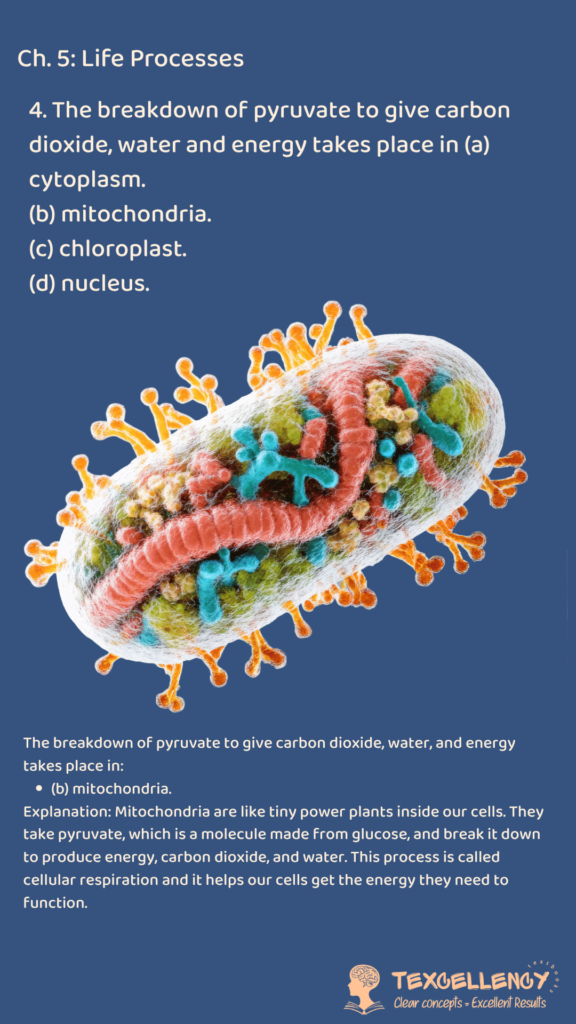
4. The breakdown of pyruvate to give carbon dioxide, water and energy takes place in (a) cytoplasm. (b) mitochondria. (c) chloroplast. (d) nucleus.
NCERT Class 10 Science | Life Processes | Texcellency Book Series
🔷 Featured Answer
Answer: (b) Mitochondria
The breakdown of pyruvate to give carbon dioxide, water, and energy (ATP) takes place in the mitochondria — the double-membrane bound organelle found in the cytoplasm of cells. Pyruvate produced during glycolysis in the cytoplasm is transported into the mitochondria where it is completely oxidised through the Krebs cycle and Electron Transport Chain — releasing CO₂, water, and 34-36 ATP molecules. This is why mitochondria are called the powerhouse of the cell.
🏭 The Big Picture — The Two-Stage Energy Factory
Before understanding why mitochondria is the correct answer — understand the complete journey of energy production in a cell. It happens in two distinct stages in two distinct locations:
Stage 1 — Glycolysis (in the cytoplasm): Glucose (6-carbon) is broken down into pyruvate (3-carbon) — in the cytoplasm. No oxygen needed. Produces only 2 ATP. This is Stage 1 of cellular respiration — and it happens OUTSIDE the mitochondria.
Stage 2 — Pyruvate Oxidation (in the mitochondria): Pyruvate enters the mitochondria — and is completely broken down into CO₂ + H₂O + 34-36 ATP. This is Stage 2 — the powerhouse stage — and it is what this question is testing. This ONLY happens INSIDE the mitochondria.
The question specifically asks about Stage 2 — the breakdown of pyruvate to give CO₂, water, and energy. That is mitochondria. Only mitochondria. Every time.
🍳 The Chai-Making Analogy — Two Stages, Two Locations
Making a perfect cup of Indian chai happens in two clear stages:
🟢 Stage 1 — Outside on the kitchen counter (cytoplasm): You measure out the tea leaves, crush the ginger, measure the milk and water, get everything ready. This preparation work happens outside on the counter — giving you the intermediate product: the raw mixture (= pyruvate). A little energy was spent preparing — but the main energy release is yet to come.
🔵 Stage 2 — On the gas stove (mitochondria): You put everything on the stove — apply heat — and the mixture undergoes the actual cooking reaction. Steam rises (CO₂ released), water boils away (water produced), and the glorious energy of flavour and aroma is released (ATP). The stove is where the real energy transformation happens.
The kitchen counter (cytoplasm) does the preparation. The stove (mitochondria) does the actual energy release. The question asks where the energy release happens — the stove — the mitochondria.
⚡ The Power Plant Analogy — Why Mitochondria is the Powerhouse
Mitochondria = Coal-fired power plant of the cell.
Raw fuel (pyruvate) arrives at the plant from the preprocessing facility (cytoplasm/glycolysis). Inside the plant — the fuel is completely combusted (oxidised through Krebs cycle and ETC). Three outputs: exhaust gases (CO₂ — released and exhaled), steam/water (H₂O — produced and excreted), and electricity (ATP — the energy currency of the cell).
The power plant does not just convert fuel — it converts it with maximum efficiency — producing 34-36 ATP from each pyruvate pair. This is why cells with high energy demands — heart muscle cells, liver cells, neurons — are packed with the most mitochondria. The more mitochondria — the more ATP production capacity — the more energy available.
A cell with no mitochondria cannot break down pyruvate completely — it is a city with no power plant.
🔬 What Happens Inside the Mitochondria — The Mechanism
This is the detail that separates a 2-mark answer from a 5-mark answer.
🔷 Step 1 — Pyruvate Enters the Mitochondrial Matrix
Pyruvate produced in the cytoplasm crosses the double membrane of the mitochondria and enters the innermost space called the mitochondrial matrix. Here it undergoes pyruvate decarboxylation — a preparatory reaction where one carbon is removed as CO₂ and pyruvate (3-carbon) is converted to Acetyl-CoA (2-carbon) — which enters the Krebs cycle. (For CBSE Class 10 — it is sufficient to say pyruvate enters mitochondria and is broken down there.)
🔷 Step 2 — Krebs Cycle (Citric Acid Cycle) in the Matrix
Acetyl-CoA enters a circular series of chemical reactions called the Krebs cycle (also called the Citric Acid Cycle). In each turn of the cycle: 🔵 Carbon atoms are released as CO₂ (this is the CO₂ you exhale) 🔵 Hydrogen atoms are picked up by carrier molecules (NADH and FADH₂) 🔵 A small amount of ATP is produced directly
The Krebs cycle turns twice for each glucose molecule (once per pyruvate, and there are two pyruvates per glucose).
🔷 Step 3 — Electron Transport Chain (Inner Mitochondrial Membrane)
The hydrogen-carrying molecules (NADH and FADH₂) from the Krebs cycle deliver their hydrogen atoms to the inner mitochondrial membrane — where the Electron Transport Chain (ETC) is located. Here: 🔵 Electrons pass through a series of protein complexes — releasing energy at each step 🔵 This energy is used to pump hydrogen ions across the membrane — creating a gradient 🔵 Hydrogen ions flow back through a protein called ATP synthase — spinning it like a turbine — generating 34-36 ATP molecules 🔵 At the end of the chain — electrons combine with oxygen and hydrogen ions to form water (H₂O)
This is where oxygen is consumed and water is produced — the oxygen you inhale becomes the water produced in your cells during respiration.
🔷 Grand Total — Aerobic Respiration ATP Count
Glycolysis (cytoplasm) = 2 ATP Krebs cycle (mitochondrial matrix) = 2 ATP Electron Transport Chain (inner mitochondrial membrane) = 34 ATP Total = 36-38 ATP per glucose molecule
The mitochondria contribute 36 of these 38 ATP. The cytoplasm contributes only 2. This is why the mitochondria — not the cytoplasm — is the true energy factory of the cell.
🏏 The IPL Cricket Match Analogy — Understanding All Four Options
Think of a full IPL match day at a stadium. Different things happen in different locations — and confusing locations leads to wrong answers.
🔵 Cytoplasm = The team bus — where players (glucose) are prepared and broken down into playing units (pyruvate) before reaching the stadium. Glycolysis happens here. Basic preparation. Some energy (2 ATP) generated. But the real match has not begun.
🔵 Mitochondria = The main cricket stadium — where the actual match (complete pyruvate breakdown) is played. Full energy release. CO₂ released (cheering crowds exhale!). Water produced (the players sweat). Maximum ATP (runs scored = energy produced). This is where the question’s answer lives.
🟢 Chloroplast = The solar panels on the stadium roof — completely different function — they capture light energy and build glucose — photosynthesis. The chloroplast MAKES glucose — it does not break it down. If the question asked where photosynthesis occurs — chloroplast. But pyruvate breakdown? Never chloroplast.
🔴 Nucleus = The team management office — contains the DNA (the instruction manual), controls what proteins are made, manages genetic information. The nucleus is the command centre — it does not do any energy production. No metabolic reactions happen here. The nucleus tells the cell what to do — it does not do the doing.
📊 All Four Options — Why Three Are Wrong and One Is Right
| Organelle | Location in Cell | Actual Function | Does Pyruvate Breakdown Here? |
|---|---|---|---|
| Mitochondria ✅ | Cytoplasm (floating in it) | Aerobic respiration — complete oxidation of pyruvate → CO₂ + H₂O + ATP | YES — correct answer |
| Cytoplasm ❌ | Throughout cell | Glycolysis — glucose → pyruvate (Stage 1 only) | NO — only glycolysis happens here |
| Chloroplast ❌ | Cytoplasm (plant cells only) | Photosynthesis — CO₂ + H₂O → glucose + O₂ | NO — opposite process (building, not breaking) |
| Nucleus ❌ | Centre of cell | DNA storage, gene expression, cell division control | NO — no energy metabolism here |
🔑 The Most Common Mistake — Why Students Choose Cytoplasm
Many students choose cytoplasm because they remember that respiration begins in the cytoplasm (glycolysis). This is correct — but glycolysis produces pyruvate — it does not break pyruvate down. The question specifically asks about breaking DOWN pyruvate — which only happens in the mitochondria. The cytoplasm hands pyruvate to the mitochondria — it does not finish the job itself.
Cytoplasm = Makes pyruvate (from glucose). Mitochondria = Breaks pyruvate (into CO₂ + H₂O + energy). Two different steps. Two different locations. Never confuse them.
🔑 Why Chloroplast is a Trap Answer
Chloroplast and mitochondria are both double-membrane organelles found in the cytoplasm — and both are involved in energy-related processes. This makes chloroplast a favourite wrong answer for inattentive students.
The critical difference: Chloroplast uses CO₂ and water to BUILD glucose (photosynthesis — requires energy input = endothermic). Mitochondria uses oxygen to BREAK pyruvate into CO₂ and water (respiration — releases energy = exothermic). They are exact opposites in terms of inputs and outputs.
If you confuse them — remember: “Chloroplast = Chef (making food). Mitochondria = Engine (burning fuel).” Chefs build. Engines burn. The question asks about burning — so mitochondria.
🎵 Rhyme to Remember
“Glucose breaks to pyruvate — in the cytoplasm’s space, Two small ATP molecules — starting the energy race, But pyruvate then travels — to mitochondria’s door, CO₂ and water — produced at its core, Krebs cycle turns — electrons flow fast, Thirty-six ATP — powerhouse unsurpassed! Cytoplasm starts — mitochondria completes, The powerhouse of the cell — where energy meets!”
🔤 Alliterations
“Mitochondria Makes Maximum energy — the Master powerhouse of the cell” “Pyruvate Passes from cytoplasm to mitochondria — Powering the cell’s Performance” “Cytoplasm Creates pyruvate — Mitochondria Consumes it Completely” “Chloroplast Creates glucose — Mitochondria Consumes it — Complete opposites” “Nucleus Never does energy production — it is the kNowledge centre only“
🧩 Mnemonic — Remember All Four Organelles and Their Functions
C — M — C — N → “Cooks Make Crispy Naan”
Cytoplasm = glycolysis (Cooks the glucose into pyruvate) • Mitochondria = pyruvate breakdown (Makes the final energy) • Chloroplast = photosynthesis (Creates glucose from sunlight) • Nucleus = genetic control (manages instructions like a Naan recipe book)
And for the specific answer — remember the two-word phrase: “Pyruvate → Powerhouse” — pyruvate goes to the powerhouse (mitochondria) for complete breakdown.
✅ Exam-Ready Answer (1-2 marks)
Answer: (b) Mitochondria
The breakdown of pyruvate to give carbon dioxide, water, and energy takes place in the mitochondria.
Pyruvate is first produced from glucose during glycolysis in the cytoplasm (producing only 2 ATP). This pyruvate then enters the mitochondria where it is completely oxidised through the Krebs cycle and Electron Transport Chain — releasing carbon dioxide, water, and a large amount of energy (34-36 ATP). This complete aerobic breakdown of pyruvate in the mitochondria is why mitochondria are called the powerhouse of the cell.
The other options are incorrect because: the cytoplasm only converts glucose to pyruvate (glycolysis) but cannot complete pyruvate breakdown; the chloroplast performs photosynthesis (the opposite process — building glucose); and the nucleus controls genetic functions and does not perform energy metabolism.
📌 Key Points Checklist
✅ Answer = Mitochondria — where pyruvate is completely broken down into CO₂ + H₂O + ATP ✅ Glycolysis happens in CYTOPLASM — produces pyruvate + only 2 ATP — no oxygen needed ✅ Pyruvate then moves from cytoplasm → mitochondria for complete oxidation ✅ Mitochondria = double-membrane organelle = “powerhouse of the cell” ✅ Inside mitochondria: Krebs cycle (matrix) + Electron Transport Chain (inner membrane) ✅ Products of pyruvate breakdown in mitochondria: CO₂ (exhaled) + H₂O (produced) + 34-36 ATP ✅ Total ATP from complete glucose oxidation = 36-38 ATP ✅ Cytoplasm contributes 2 ATP • Mitochondria contributes 34-36 ATP ✅ Chloroplast = photosynthesis = BUILDS glucose — opposite of mitochondria ✅ Nucleus = DNA storage and gene expression = NO energy metabolism ✅ Most common mistake: choosing cytoplasm — remember cytoplasm MAKES pyruvate, mitochondria BREAKS it ✅ Cells with highest energy needs (heart muscle, neurons) have the most mitochondria
📚 Want ALL of Class 10 Science Explained This Way?
Every chapter. Every concept. Every NCERT question — explained with analogies, rhymes, mnemonics, and real-life examples that make sense and stay in memory long after exam day.
👉 Explore the Full Texcellency Collection 👉 Download Your FREE Book Now