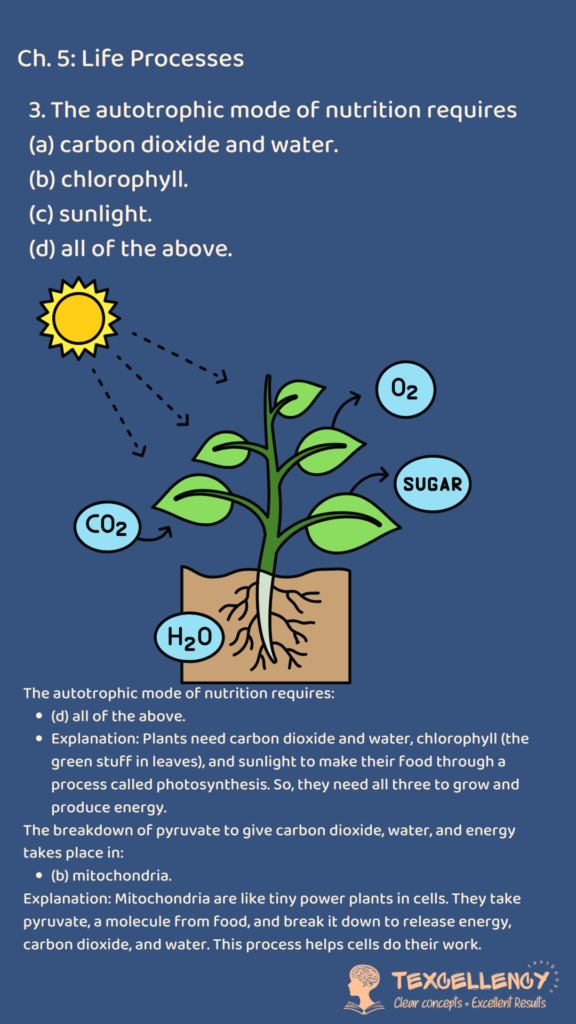
3. The autotrophic mode of nutrition requires (a) carbon dioxide and water. (b) chlorophyll. (c) sunlight. (d) all of the above.
NCERT Class 10 Science | Life Processes | Texcellency Book Series
🔷 Featured Answer
Answer: (d) All of the Above
The autotrophic mode of nutrition — photosynthesis — requires all four components simultaneously: carbon dioxide and water (raw materials), chlorophyll (the light-capturing pigment), and sunlight (the energy source). Remove any single one — and photosynthesis stops completely. Options (a), (b), and (c) are each partially correct — but none is complete on its own. Only option (d) captures the full picture. This is why “all of the above” is the only correct answer — and understanding WHY each component is non-negotiable is what makes this answer stick permanently.
🏭 The Big Picture — Why This Question Has Only One Possible Answer
This question is deceptively simple. Most students mark (d) quickly and move on. But the real learning — and the real exam value — lies in understanding why each of options (a), (b), and (c) alone is insufficient. An examiner who asks a follow-up question like “what would happen if only chlorophyll were present but no sunlight?” expects a student who truly understands the system — not just someone who memorised the answer.
Think of autotrophic nutrition as a recipe with four non-negotiable ingredients. A recipe for dal tadka requires dal, water, spices, and a stove. Ask “what does dal tadka require?” — the answer is all four — not just the dal, not just the spices. Remove any one — and the dish cannot be made. Remove CO₂ or water or chlorophyll or sunlight — and photosynthesis cannot happen. Period.
🍳 The Four-Burner Gas Stove Analogy — All Four Must Be On
Imagine a professional kitchen with a four-burner gas stove where all four burners must be lit simultaneously to cook a particular dish. Each burner has a specific role:
🟡 Burner 1 — Sunlight = the gas supply itself — the primary energy source that powers the entire operation. No gas = no flame = nothing happens.
🟢 Burner 2 — Chlorophyll = the ignition system — the spark that captures the gas energy and converts it into usable cooking heat. Gas without ignition = wasted energy that never becomes useful.
🔵 Burner 3 — Carbon Dioxide = the main ingredient going into the pot — the carbon skeleton from which glucose is built. No ingredient = nothing to cook = no food produced.
🔵 Burner 4 — Water = the second main ingredient — the hydrogen source — split apart to provide the hydrogen atoms that combine with carbon to build glucose. Also the liquid medium in which all reactions occur.
All four burners must be on simultaneously. Options (a), (b), and (c) represent individual burners — each necessary but none sufficient alone. Option (d) says all four burners together — which is the only configuration that produces food.
🔍 Each Option — Examined in Full Depth
🔵 Option (a) — Carbon Dioxide and Water: NECESSARY BUT INSUFFICIENT ALONE
Carbon dioxide (CO₂) and water (H₂O) are the two raw materials of photosynthesis — the actual ingredients from which glucose is built. Every carbon atom in every glucose molecule came from CO₂. Every hydrogen atom in glucose came from water.
🔷 Carbon dioxide enters the leaf through tiny pores called stomata — primarily on the underside of leaves. The concentration of CO₂ in the atmosphere (~420 ppm currently) is low but sufficient. Inside the leaf, CO₂ concentration is always lower than outside (because it is being consumed continuously) — so it diffuses in by concentration gradient. The carbon in CO₂ is “fixed” into organic molecules during the Calvin cycle — becoming the carbon backbone of glucose.
🔷 Water is absorbed from the soil by roots — travels upward through xylem vessels to leaves. In the leaves, water is split during the light-dependent reactions of photosynthesis — a process called photolysis (photo = light, lysis = splitting). The hydrogen from water is used to build glucose. The oxygen from water is released as the O₂ gas we breathe. This is a remarkable fact worth remembering — the oxygen in every breath you take came from water molecules split by plants, not from CO₂.
Why is (a) alone insufficient? Because even with abundant CO₂ and water available — if there is no chlorophyll to capture light energy and no sunlight to provide that energy — the Calvin cycle has no ATP or NADPH to run on — glucose cannot be built. CO₂ and water are the ingredients — but without energy and the machinery to use it, the ingredients just sit there unused.
🔵 Option (b) — Chlorophyll: NECESSARY BUT INSUFFICIENT ALONE
Chlorophyll is the green pigment found in the chloroplasts of plant cells. It is the molecular machine that captures light energy and converts it into the chemical energy (ATP and NADPH) that drives photosynthesis. Without chlorophyll — light energy is absorbed, reflected, or transmitted by leaf tissues — but never captured for use.
🔷 How chlorophyll works: Chlorophyll molecules contain a porphyrin ring with a magnesium atom at the centre. When a photon of light hits the chlorophyll molecule — it excites an electron to a higher energy state. This excited electron is then passed along a chain of molecules — releasing energy at each step — which is captured as ATP. This light-harvesting process is the foundation of all photosynthesis.
🔷 Why chlorophyll is green: Chlorophyll absorbs light strongly in the red (650-700 nm) and blue (400-500 nm) wavelengths — but reflects and transmits green wavelengths. Our eyes detect the reflected green — making plants look green. This is also why plants grown under only green light grow poorly — they cannot absorb it efficiently.
🔷 Types of chlorophyll: Plants have chlorophyll-a (most active), chlorophyll-b (accessory), and carotenoids (orange-yellow pigments that capture additional wavelengths). Together they maximise the range of sunlight wavelengths captured.
🔷 Chlorophyll needs magnesium: Magnesium is the central atom of the chlorophyll molecule. Magnesium-deficient plants cannot synthesise chlorophyll — leaves turn yellow (chlorosis) — photosynthesis collapses. This is why magnesium fertilisers are essential for healthy green crops.
Why is (b) alone insufficient? Chlorophyll is the machine — but a machine needs raw materials (CO₂ and water) to process and energy (sunlight) to run on. Chlorophyll alone, in a dark room with no CO₂ or water, does absolutely nothing.
🔵 Option (c) — Sunlight: NECESSARY BUT INSUFFICIENT ALONE
Sunlight is the energy source that drives the entire photosynthesis reaction. Photosynthesis is an endothermic (energy-absorbing) process — it requires a continuous input of energy to build complex glucose molecules from simple CO₂ and water. That energy comes from sunlight.
🔷 Light-dependent reactions: Sunlight strikes chlorophyll → excites electrons → drives the splitting of water (photolysis) → releases O₂ → produces ATP and NADPH. These reactions happen in the thylakoid membranes of the chloroplast. They absolutely require light — they stop instantly in darkness.
🔷 Light-independent reactions (Calvin cycle): Use the ATP and NADPH from light reactions to fix CO₂ into glucose. These can technically continue briefly in darkness — using stored ATP and NADPH — but once those stores are exhausted (within seconds to minutes), they also stop.
🔷 Light intensity matters: Too little light = slow photosynthesis. Optimal light = maximum photosynthesis. Too much light = photoinhibition (excess light energy damages chlorophyll). Plants have evolved various mechanisms to track sunlight (heliotropism) and regulate light absorption to stay within the optimal range.
🔷 Light wavelength matters: Not all sunlight wavelengths are equally useful. Red and blue light are most efficiently captured by chlorophyll. Green light is mostly reflected (which is why plants are green). This is why grow-lights for indoor plants use specifically red and blue LEDs — not white light.
Why is (c) alone insufficient? Sunlight provides the energy — but energy without raw materials (CO₂ and water) and a machine to use it (chlorophyll) produces nothing. Light hitting a leaf with no chlorophyll or no CO₂ just heats the leaf slightly. No glucose is produced.
🏗️ Why ALL FOUR Must Work Together — The Non-Negotiable System
The photosynthesis equation makes the non-negotiable nature of all four components immediately clear:
6CO₂ + 6H₂O + Light energy → (Chlorophyll) → C₆H₁₂O₆ + 6O₂
🔵 CO₂ appears on the left side — it is consumed. Remove it — no glucose on the right side. 🔵 H₂O appears on the left side — it is consumed. Remove it — no glucose, no O₂ on the right side. 🔵 Light energy appears on the left side — it drives the reaction. Remove it — reaction cannot proceed. 🔵 Chlorophyll appears above the arrow — it is the catalyst and light harvester. Remove it — light energy cannot be captured — reaction cannot proceed even with the other three present.
Every single left-side component must be present for the right-side products to appear. This is why the answer is always (d) — all of the above — no exceptions, no partial credit.
🌿 What Happens When Each Component is Removed — Proof That All Four Are Essential
🔴 Remove CO₂ → Calvin cycle stops — no carbon to fix into glucose — plant starves. This is what happens when stomata close during drought — CO₂ cannot enter — photosynthesis halts even in bright sunlight with water available.
🔴 Remove water → Photolysis stops — no hydrogen for glucose — no O₂ released. Plant wilts, stomata close, CO₂ entry also blocked. Multiple systems collapse simultaneously.
🔴 Remove chlorophyll → Light energy not captured — ATP not produced — everything stops. Variegated leaves (white patches) photosynthesise only in green portions. Albino plants (no chlorophyll) die as seedlings once seed food reserves are exhausted.
🔴 Remove sunlight → Light reactions stop — no ATP or NADPH produced — Calvin cycle stops within minutes. Plants in complete darkness rely on stored starch briefly — then starve. This is why deep-forest floor plants have evolved enormous leaf areas to capture every available photon.
📊 All Four Options — Complete Analysis Table
| Option | Component | Role in Photosynthesis | Sufficient Alone? | Why Not Sufficient Alone |
|---|---|---|---|---|
| (a) CO₂ + Water | Raw materials | Carbon and hydrogen source for glucose | ❌ No | No energy to drive reaction without sunlight + chlorophyll |
| (b) Chlorophyll | Light-harvesting pigment | Captures light → converts to chemical energy | ❌ No | Needs light to capture and raw materials to process |
| (c) Sunlight | Energy source | Powers all photosynthesis reactions | ❌ No | Needs chlorophyll to capture it and raw materials to process |
| (d) All of the above | All four together | Complete photosynthesis system | ✅ YES | All components present — photosynthesis proceeds |
🎵 Rhyme to Remember
“Carbon dioxide — the carbon to build, Water provides — the hydrogen filled, Chlorophyll catches — the sunlight so bright, Converts it to energy — chemical light! Remove just one — the whole system falls, All four together — photosynthesis calls! CO₂ and water — the raw materials two, Chlorophyll and sunlight — make the process come true, All of the above — the only right say, Four non-negotiables — making glucose each day!”
🔤 Alliterations
“CO₂ Comes in through stomata — Carbon for Constructing glucose” “Chlorophyll Catches and Converts sunlight into Chemical energy” “Sunlight Supplies the energy to Start the photosynthesis System” “Water Works as raw material — split to release Wonderful oxygen” “All four Acting together — Autotrophic nutrition Achieved“
🧩 Mnemonic — Never Pick a Wrong Option Again
“SCWC” = “Sunlight Cooks With CO₂”
Sunlight • Chlorophyll • Water • CO₂ — all four required together
The sentence “Sunlight Cooks With CO₂” encodes all four components — and “cooks” reminds you that photosynthesis is the plant’s way of cooking its own food (autotrophic = self-cooking).
And the MCQ trap-avoidance rule: whenever you see options (a), (b), and (c) each describing one necessary component of a multi-component biological process — and option (d) says “all of the above” — the answer is almost always (d). Biological processes rarely work with just one input.
✅ Exam-Ready Answer (2 marks)
Answer: (d) All of the above
The autotrophic mode of nutrition (photosynthesis) requires all of the following simultaneously:
1. Carbon dioxide and water — the raw materials. CO₂ is taken in from the air through stomata. Water is absorbed from the soil through roots. They provide the carbon, hydrogen, and oxygen atoms from which glucose is built.
2. Chlorophyll — the green pigment in chloroplasts that captures light energy and converts it into chemical energy (ATP and NADPH) to drive photosynthesis.
3. Sunlight — the energy source that powers the entire photosynthesis process. Without light, the energy-requiring reactions of photosynthesis cannot occur.
All four components are non-negotiable — removing any single one stops photosynthesis completely. Therefore the correct answer is (d) all of the above.
Photosynthesis equation: 6CO₂ + 6H₂O + Light energy → (Chlorophyll) → C₆H₁₂O₆ + 6O₂
📌 Key Points Checklist
✅ Answer = (d) All of the above — all four components are non-negotiable ✅ CO₂ = raw material = enters through stomata = provides carbon skeleton of glucose ✅ Water = raw material = absorbed by roots = split during photolysis → releases O₂ ✅ The O₂ we breathe comes from water split by plants — NOT from CO₂ ✅ Chlorophyll = green pigment = in chloroplasts = captures red and blue light ✅ Chlorophyll reflects green light — that is why plants look green ✅ Chlorophyll needs magnesium — Mg deficiency → chlorosis (yellowing) → photosynthesis stops ✅ Sunlight = energy source = drives light-dependent reactions = produces ATP and NADPH ✅ Remove CO₂ → Calvin cycle stops → no glucose ✅ Remove water → photolysis stops → no O₂, no hydrogen for glucose ✅ Remove chlorophyll → light not captured → all reactions stop ✅ Remove sunlight → light reactions stop → no ATP → Calvin cycle stops ✅ Equation: 6CO₂ + 6H₂O + Light → C₆H₁₂O₆ + 6O₂ (chlorophyll as catalyst) ✅ MCQ tip: when (a)(b)(c) are each one necessary component of a system — answer is always (d)
📚 Want ALL of Class 10 Science Explained This Way?
Every chapter. Every concept. Every NCERT question — explained with analogies, rhymes, mnemonics, and real-life examples that make sense and stay in memory long after exam day.
👉 Explore the Full Texcellency Collection 👉 Download Your FREE Book Now