
How Are the Lungs Designed in Human Beings to Maximise the Area for Exchange of Gases? — NCERT Class 10 Science
NCERT Class 10 Science | Life Processes | Texcellency Book Series
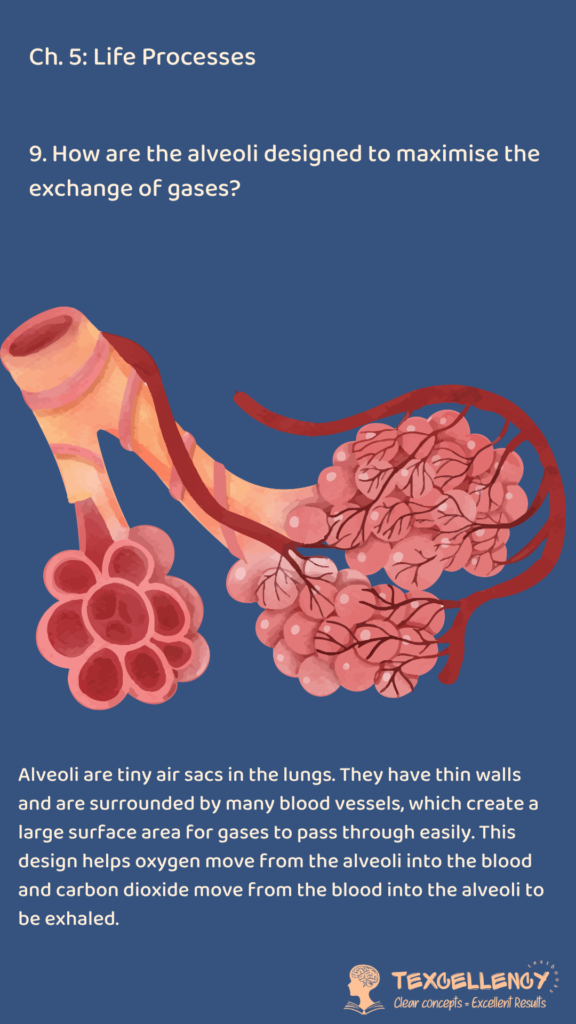
The lungs are filled with approximately 300 to 400 million tiny balloon-like air sacs called alveoli. These alveoli collectively create an enormous surface area of about 70–80 square metres — roughly the size of a tennis court — packed inside the chest. Each alveolus is surrounded by a dense network of capillaries, has walls just one cell thick, and is richly supplied with blood — making gas exchange extraordinarily fast and efficient despite the lungs fitting inside a chest cavity the size of two fists.
🤔 The Core Problem — Why Does Gas Exchange Need Such a Large Area?
Your body has approximately 37 trillion cells. Every single one of them needs a continuous supply of oxygen and a continuous removal of carbon dioxide — every second of your life. Even when you are asleep.
Now consider this: gas exchange happens by diffusion — a passive process where molecules move from high concentration to low concentration across a membrane. Diffusion is efficient over tiny distances but extremely slow over large distances. The larger the surface area available for diffusion — the faster and more total gas can be exchanged per breath.
Here is the design challenge nature solved brilliantly: fit the maximum possible surface area for gas exchange inside the minimum possible space inside the human chest. You cannot have lungs the size of a basketball court. But you need the exchange area OF a basketball court. How?
The answer: fold everything. Divide everything into the smallest possible units. Pack millions of them together. This is exactly what alveoli do.
🏗️ The Complete Design of the Lungs — Every Feature That Maximises Gas Exchange
🔵 Feature 1 — The Branching Airways (Bronchial Tree)
Air enters through the nose and mouth → travels down the trachea (windpipe) → splits into two bronchi (one for each lung) → each bronchus branches into smaller bronchioles → bronchioles keep branching into smaller and smaller tubes → finally ending in clusters of alveoli at the very tips.
This branching system — called the bronchial tree because it looks exactly like an upside-down tree — ensures that air is delivered to every single alveolus in both lungs simultaneously. No alveolus is left waiting. All 300-400 million of them fill with fresh air in a single breath.
🔵 Feature 2 — The Alveoli (The Most Important Feature)
Alveoli (singular: alveolus) are tiny, hollow, balloon-like air sacs at the end of the smallest bronchioles. Each alveolus is roughly 0.2 mm in diameter — about the width of a human hair. Individually tiny. But collectively — 300 to 400 million of them in two lungs — they create a total surface area of 70 to 80 square metres.
For comparison: the outer surface of your skin is about 1.7 square metres. Your lungs — packed inside your chest — have a gas exchange surface area 40 to 50 times larger than your entire body surface. This is the engineering genius of alveoli.
🎾 The Tennis Court Analogy — The Number That Blows Every Student’s Mind
Your chest cavity is roughly the size of a medium-sized suitcase — perhaps 40 cm × 30 cm × 20 cm. Yet the total gas exchange surface area packed inside it is approximately 70 square metres — the size of a full singles tennis court.
How? By subdivision. Imagine taking one large room and dividing it into thousands of smaller rooms — each division creates new wall surface area. Keep dividing — keep creating more surface. Alveoli are nature’s way of subdividing the lung space into the maximum possible number of tiny units — each adding its own surface to the total.
If your lungs were one large hollow balloon instead of 400 million tiny alveoli — the surface area would be only about 0.01 square metres — 7,000 times less than the alveolar design. You would suffocate immediately.
🔵 Feature 3 — Ultra-Thin Walls (One Cell Thick)
Each alveolus has walls that are just one cell thick — called the respiratory epithelium. One cell. That is thinner than the thinnest tissue paper you have ever held.
Why does this matter? Because diffusion speed depends on the thickness of the membrane the gas must cross. The thinner the membrane — the faster diffusion occurs. With walls just one cell thick — oxygen crosses from the alveolar air into the blood in a fraction of a second — almost instantly.
The total diffusion distance from air inside the alveolus to haemoglobin inside the RBC in the capillary is less than 0.5 micrometres — 0.0005 mm. This is the biological equivalent of leaving a door wide open rather than trying to push air through a wall.
🔵 Feature 4 — Dense Capillary Network Surrounding Every Alveolus
Each alveolus is completely wrapped in a dense mesh of capillaries — the tiniest blood vessels in the body. These capillaries are so small that red blood cells must pass through them single file — one at a time — pressed right against the capillary wall, which is itself pressed right against the alveolar wall.
This means every red blood cell passing by gets maximum exposure to the alveolar air for gas exchange. No red blood cell races past without exchanging gases. The contact is intimate, complete, and perfectly designed.
The capillary network is so dense around each alveolus that the alveolus is essentially dipped in blood — with blood on one side and air on the other, separated by nothing more than two one-cell-thick walls fused together.
🔵 Feature 5 — Rich Blood Supply (Constant Maintenance of Concentration Gradient)
Gas exchange by diffusion requires a concentration gradient — oxygen must always be at higher concentration in the alveolus than in the blood, and CO₂ must always be higher in the blood than in the alveolus — for diffusion to keep happening.
The rich, constantly flowing blood supply ensures this gradient is always maintained. Fresh deoxygenated blood (low O₂, high CO₂) constantly arrives at the alveoli from the right side of the heart. Oxygenated blood (high O₂, low CO₂) constantly leaves. The gradient never collapses. Gas exchange never stops.
🔵 Feature 6 — Moist Inner Surface of Alveoli
The inner surface of each alveolus is coated with a thin layer of moisture. Gases must dissolve in this moisture before they can diffuse across the membrane — and the moist surface ensures this dissolution happens instantly. The moisture also contains a substance called surfactant — which reduces surface tension and prevents the tiny alveoli from collapsing when you breathe out. Without surfactant — alveoli would stick shut after each exhalation and never reopen.
🏭 The Call Centre Analogy — Understanding the Complete Design
Imagine designing a customer service call centre that must handle 37 trillion customer calls simultaneously — but must fit inside a small office building.
The solution: do not have a few large call rooms — have millions of tiny individual cubicles, each handling one call at a time. Pack them as densely as possible. Give each cubicle its own direct phone line (capillary). Keep the cubicle walls as thin as possible so agents hear customers instantly (thin alveolar walls). Ensure the phone lines are always busy with fresh calls (constant blood flow maintaining concentration gradient). And connect all cubicles to the same central switchboard (bronchial tree) so all receive information simultaneously.
This is the alveolar design. Millions of tiny units. Dense packing. Thin walls. Rich connections. Constant fresh supply. Maximum throughput in minimum space.
📊 Lung Design Features — Quick Reference Table
| Design Feature | How It Maximises Gas Exchange |
|---|---|
| 300-400 million alveoli | Creates 70-80 m² total surface area |
| Alveolar walls one cell thick | Minimises diffusion distance — exchange in milliseconds |
| Dense capillary network | Every RBC gets maximum contact with alveolar air |
| Constant blood flow | Maintains concentration gradient always |
| Branching bronchial tree | Delivers air to all alveoli simultaneously |
| Moist inner surface + surfactant | Enables gas dissolution, prevents alveolar collapse |
🩺 What Happens When This Design Fails — Real-Life Connections
🔴 Emphysema (common in smokers) — alveolar walls break down, multiple alveoli merge into one large air space. Total surface area collapses dramatically. Less surface area = less gas exchange = chronic breathlessness even at rest. Irreversible and progressive. This is the direct consequence of destroying the alveolar design.
🔴 Pneumonia — alveoli fill with fluid and pus instead of air. The concentration gradient collapses — there is no fresh air in the alveoli for oxygen to diffuse from. Gas exchange stops in affected areas. Severe pneumonia = severe oxygen deprivation.
🔴 Premature babies — born before sufficient surfactant is produced. Alveoli collapse after every breath and cannot reopen. Called Respiratory Distress Syndrome — treated by giving artificial surfactant immediately after birth.
🎵 Rhyme to Remember
“Millions of alveoli — tiny and round, Packed in the lungs without a sound, Seventy square metres — a tennis court wide, All folded neatly — deep inside! Walls one cell thin — gases rush through, Capillaries wrapped — exchanging brand new, Oxygen in — CO₂ out, That is what breathing is all about!”
🔤 Alliterations
“Alveoli Amazingly Amplify the surface Area for gas exchange” “Capillaries Closely Cradle each alveolus for Complete gas Contact” “Thin walls = Tiny distance = Tremendously fast gas Transfer” “Millions of Miniature air sacs Maximise exchange in Minimum space“
🧩 Mnemonic — Remember All Six Design Features
A — T — C — B — M — S → “A Tennis Court Beats My Small chest”
Alveoli (millions of them) • Thin walls (one cell thick) • Capillary network (dense, surrounding each alveolus) • Bronchial tree (delivers air to all) • Moist surface (enables gas dissolution) • Surfactant (prevents collapse)
The mnemonic itself reminds you of the tennis court size comparison — the most memorable fact about alveoli design.
✅ Exam-Ready Answer (3–4 marks)
The lungs are designed in the following ways to maximise the surface area for gas exchange:
1. Alveoli — The lungs contain 300 to 400 million tiny balloon-like air sacs called alveoli. Collectively, they provide a total surface area of about 70-80 square metres — roughly the size of a tennis court — packed inside the chest cavity.
2. Thin walls — Each alveolus has walls just one cell thick, minimising the distance gases must diffuse across — enabling extremely rapid gas exchange.
3. Rich capillary network — Each alveolus is surrounded by a dense network of blood capillaries. This ensures maximum contact between blood and alveolar air, and maintains the concentration gradient needed for efficient diffusion.
4. Moist inner surface — The moist lining of alveoli enables gases to dissolve quickly before diffusing across the membrane.
These features together ensure that the maximum amount of oxygen can enter the blood and the maximum amount of CO₂ can be removed in the shortest possible time with each breath.
📌 Key Points Checklist
✅ Lungs contain 300-400 million alveoli — tiny balloon-like air sacs ✅ Total alveolar surface area = 70-80 square metres = size of a tennis court ✅ Alveolar walls = one cell thick = minimum diffusion distance ✅ Each alveolus wrapped in dense capillary network = maximum blood-air contact ✅ Constant blood flow = concentration gradient always maintained ✅ Bronchial tree delivers air to all alveoli simultaneously ✅ Moist inner surface enables gas dissolution before diffusion ✅ Surfactant prevents alveoli from collapsing after exhalation ✅ Emphysema destroys alveolar walls → surface area collapses → breathlessness ✅ Premature babies lack surfactant → alveoli collapse → Respiratory Distress Syndrome ✅ If lungs were one large balloon instead of millions of alveoli → surface area 7,000 times less
📚 Want ALL of Class 10 Science Explained This Way?
Every chapter. Every concept. Every NCERT question — explained with analogies, rhymes, mnemonics, and real-life examples that make sense and stay in memory long after exam day.
👉 Explore the Full Texcellency Collection 👉 Download Your FREE Book Now
“A good textbook is like a smart GPS — it doesn’t just give you the destination, it tells you every turn along the way, in simple language you actually understand.”