
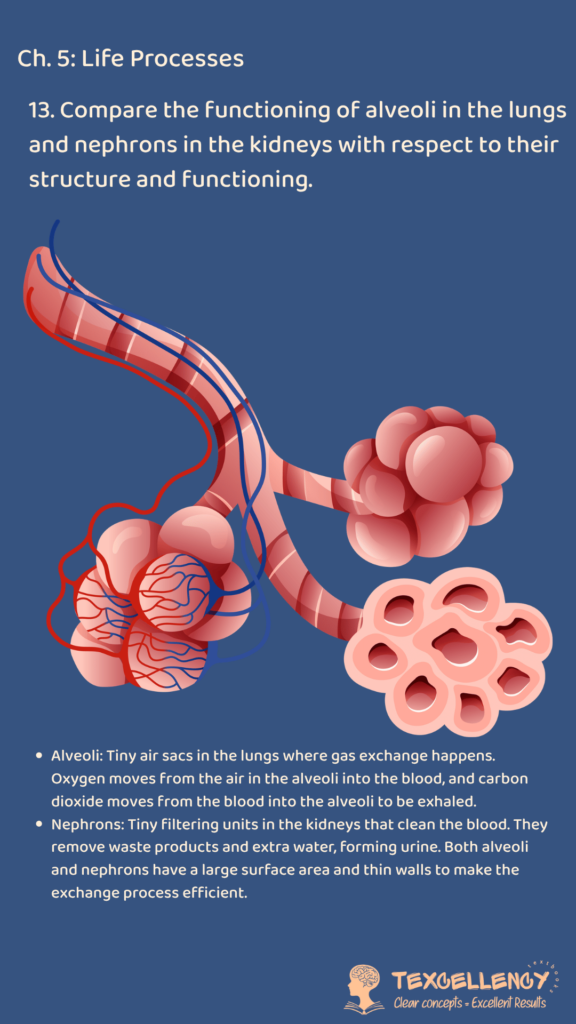
Compare the Functioning of Alveoli in the Lungs and Nephrons in the Kidneys with Respect to Their Structure and Functioning — NCERT Class 10 Science
NCERT Class 10 Science | Chapter 6 — Life Processes | Texcellency Book Series
Both alveoli and nephrons are microscopic functional units packed in large numbers inside their respective organs — both have thin walls, rich blood supply, and large collective surface area — both serve as exchange interfaces between blood and an external medium. Alveoli exchange gases (oxygen in, CO₂ out) between blood and air. Nephrons filter waste and excess water from blood and produce urine. Same design philosophy — different substances — different organs.
🏭 The Big Picture — Nature’s Favourite Design Strategy: Miniaturise and Multiply
Before we compare, understand why this question is so fascinating. Nature uses the same engineering principle in two completely different organs for two completely different jobs:
If you need to exchange large quantities of material between blood and an external medium — do not build one large exchange surface. Instead, build millions of tiny exchange units, each perfectly designed for rapid transfer, and pack them together.
🫁 In the lungs — this problem is: “exchange as much gas as possible per breath.” Solution: 300-400 million alveoli — total surface area 70-80 square metres.
🫘 In the kidneys — this problem is: “filter as much blood waste as possible per minute.” Solution: approximately 1 million nephrons per kidney — 2 million total — filtering the entire blood volume every 45-50 minutes.
Same solution. Different context. This is why these two structures are compared.
🫁 Part 1 — Alveoli: The Lung’s Gas Exchange Units
🏗️ Structure of Alveoli
An alveolus is a tiny hollow, balloon-like air sac — approximately 0.2 mm in diameter — located at the very end of the smallest bronchioles in the lung. It looks like a bunch of grapes at the end of a vine stem — the bronchiole is the stem, and the cluster of alveoli are the grapes.
🔵 Shape — round, hollow, balloon-like sac 🔵 Wall thickness — just one cell thick (squamous epithelium) — the thinnest possible biological wall 🔵 Inner surface — moist, coated with surfactant (prevents collapse after exhalation) 🔵 Blood supply — completely wrapped in a dense mesh of pulmonary capillaries — walls of capillary and alveolus are fused together 🔵 Number — 300-400 million per pair of lungs 🔵 Total surface area — 70-80 square metres
⚙️ How Alveoli Function
🔷 Step 1 — You breathe in. Fresh air (high O₂, low CO₂) fills the alveoli. 🔷 Step 2 — Deoxygenated blood (low O₂, high CO₂) arrives from the right side of the heart through pulmonary capillaries surrounding the alveoli. 🔷 Step 3 — Concentration gradient drives exchange: O₂ diffuses from alveolus (high concentration) → into blood (low concentration). CO₂ diffuses from blood (high concentration) → into alveolus (low concentration). 🔷 Step 4 — Oxygenated blood leaves toward the left side of the heart for distribution to the body. 🔷 Step 5 — CO₂-rich air in the alveolus is exhaled.
The entire exchange takes less than one second — enabled by one-cell-thick walls and the intimate capillary contact.
🫘 Part 2 — Nephrons: The Kidney’s Filtration Units
🏗️ Structure of Nephrons
A nephron is a microscopic tube — the basic structural and functional unit of the kidney. Each nephron is about 3 cm long when stretched out — but is tightly coiled to fit within the kidney tissue. There are approximately 1 million nephrons in each kidney — 2 million total.
Each nephron has two main parts:
🔵 Bowman’s Capsule — a cup-shaped structure at the beginning of the nephron. Inside it sits a knot of capillaries called the glomerulus (meaning “little ball of yarn” in Latin). Blood is forced under pressure from the glomerular capillaries into the Bowman’s capsule — like squeezing a sponge — filtering out water, glucose, urea, salts, and other small molecules. Large molecules (proteins, blood cells) stay in the blood — they are too big to squeeze through.
🔵 Renal Tubule — the long, coiled tube that follows the Bowman’s capsule. It has three sections: The Proximal Convoluted Tubule (PCT) — reabsorbs all glucose, most water, and useful salts back into the blood. Whatever the body needs — reclaimed here. The Loop of Henle — a deep U-shaped loop that dips into the inner kidney tissue. Further concentrates the filtrate by reabsorbing more water. Creates a concentration gradient that allows maximum water recovery. The Distal Convoluted Tubule (DCT) — fine-tunes the composition — reabsorbs more water and salts as needed, secretes additional waste into the filtrate.
🔵 Collecting Duct — multiple nephrons drain into a collecting duct, which carries the final urine — concentrated, waste-rich — toward the renal pelvis, ureter, and ultimately the urinary bladder.
⚙️ How Nephrons Function
🔷 Step 1 — Filtration: Blood enters the glomerulus under high pressure. Water, glucose, urea, salts, amino acids — everything small — is filtered out into the Bowman’s capsule. This filtered liquid is called the glomerular filtrate. 🔷 Step 2 — Reabsorption: As filtrate moves through the renal tubule — glucose (100%), most water (99%), useful salts — are reabsorbed back into the blood capillaries surrounding the tubule. The body does not waste what it needs. 🔷 Step 3 — Secretion: Additional waste products — certain drugs, excess ions — are actively secreted from the blood into the tubule to be eliminated. 🔷 Step 4 — Urine formation: What remains after reabsorption and secretion — concentrated urea, excess salts, water — flows as urine into the collecting duct → renal pelvis → ureter → bladder → excreted.
Each kidney filters approximately 125 ml of blood per minute — producing about 180 litres of filtrate per day — of which 178.5 litres is reabsorbed and only 1.5 litres becomes urine.
🏙️ The Two-Department Office Building Analogy
Think of the body as an office building generating two types of waste that must be handled differently:
Gaseous waste (CO₂) — goes to the ventilation department (lungs). The ventilation system constantly cycles fresh air through the building, picking up CO₂ and releasing it outside through ventilation ducts (exhalation). The alveoli are the tiny exchange vents — millions of them — ensuring every corner of the blood gets fresh air contact.
Liquid waste (urea, excess salts, water) — goes to the water treatment and filtration department (kidneys). Dirty water (blood) is pumped through millions of tiny filters (nephrons), cleaned thoroughly, useful materials reclaimed, concentrated waste discharged (urine). The nephrons are the filtration units — millions of them — ensuring thorough cleaning of the entire blood supply multiple times a day.
Same building. Two departments. Two waste streams. Two sets of microscopic units. Same design principle.
🔬 The Similarities — What Makes This Comparison So Elegant
This is the heart of the question — and what examiners most want to see:
🟢 Both are microscopic functional units — individually tiny, but collectively powerful because they exist in millions.
🟢 Both have thin walls — alveolar walls are one cell thick. The walls of the Bowman’s capsule and renal tubule are also extremely thin — enabling rapid diffusion and filtration.
🟢 Both are richly supplied with capillaries — alveoli are wrapped in pulmonary capillaries. Nephrons are surrounded by peritubular capillaries (and the glomerulus IS a capillary knot). Blood is always immediately available for exchange in both cases.
🟢 Both rely on concentration gradients and pressure — alveoli use concentration gradient for gas diffusion. Nephrons use blood pressure for initial filtration and concentration gradients for reabsorption.
🟢 Both serve as exchange interfaces between blood and an external medium — alveoli exchange between blood and air. Nephrons exchange between blood and the filtrate that eventually becomes urine.
🟢 Both are packed in large numbers to maximise total surface area — 300-400 million alveoli give 70-80 m² surface area. 2 million nephrons give enormous total tubular length for reabsorption — if all renal tubules were laid end to end they would stretch over 80 km.
🟢 Both serve the purpose of maintaining blood composition — alveoli maintain O₂ and CO₂ levels. Nephrons maintain water, salt, and waste levels.
📊 Alveoli vs Nephrons — The Master Comparison Table
| Feature | Alveoli | Nephrons |
|---|---|---|
| Location | Lungs | Kidneys |
| Shape | Round, hollow air sac | Long coiled tube with cup-shaped beginning |
| Number | 300-400 million (both lungs) | 2 million (both kidneys) |
| Wall thickness | One cell thick | Very thin (one to few cells) |
| Blood supply | Pulmonary capillaries | Glomerular + peritubular capillaries |
| Function | Gas exchange — O₂ in, CO₂ out | Blood filtration — removes urea, excess water, salts |
| Substance exchanged | Gases (O₂ and CO₂) | Liquids (water, urea, glucose, salts) |
| External medium | Air (inside alveolus) | Filtrate (inside tubule) |
| Mechanism | Diffusion along concentration gradient | Filtration (pressure) + Reabsorption + Secretion |
| End product | Exhaled air (CO₂ removed) | Urine (waste concentrated) |
| Organ system | Respiratory system | Excretory system |
🎵 Rhyme to Remember
“Alveoli in the lung — tiny sacs of air, Gas exchange happens — right in there, Oxygen in, CO₂ out, Thin walls and capillaries all about! Nephrons in the kidney — filters so fine, Filtration, reabsorption — all in a line, Urea and waste — removed with care, Both tiny units — the body’s finest pair! Same design — different job to do, Millions of units — working brand new!”
🔤 Alliterations
“Alveoli and nephrons — both Microscopic, both Mighty, both Multiply to Maximise function” “Alveoli Allow gas exchange — Attracting oxygen and expelling CO₂” “Nephrons Never miss a chance to filter, reabsorb, and remove waste” “Thin walls, rich capillaries — the Twin traits of both structures“
🧩 Mnemonic — Remember the Key Similarities
Both share “TWIN-C”: Thin walls • Wrapped in capillaries • Interface between blood and external medium • Numerous (millions) • Concentration gradient driven
And remember their difference with: “Alveoli = Air exchange. Nephrons = Nastiness removed (waste removed)”
✅ Exam-Ready Answer (4–5 marks)
Similarities between Alveoli and Nephrons: 1. Both are microscopic functional units present in millions — providing large collective surface area. 2. Both have extremely thin walls — enabling rapid exchange between blood and the external medium. 3. Both are richly supplied with blood capillaries — maintaining concentration gradients for efficient exchange. 4. Both serve as interfaces between blood and an external medium — alveoli between blood and air, nephrons between blood and filtrate. 5. Both function to maintain the correct composition of blood.
Differences:
Alveoli: Located in the lungs. Tiny balloon-like air sacs. Exchange gases — oxygen diffuses into blood, CO₂ diffuses out. Mechanism is diffusion along concentration gradient. End result — oxygenated blood and exhaled CO₂.
Nephrons: Located in the kidneys. Long coiled tubular structures with a cup-shaped Bowman’s capsule containing the glomerulus. Filter blood under pressure — remove urea, excess water, salts. Useful substances are reabsorbed. End result — clean blood and urine containing concentrated waste.
📌 Key Points Checklist
✅ Both alveoli and nephrons = microscopic functional units = packed in millions ✅ Both have thin walls + rich capillary supply = efficient exchange ✅ Alveoli = gas exchange (O₂ in, CO₂ out) = diffusion = respiratory system ✅ Nephrons = blood filtration = filtration + reabsorption + secretion = excretory system ✅ Alveoli interface = blood ↔ air • Nephrons interface = blood ↔ filtrate ✅ 300-400 million alveoli → 70-80 m² surface area ✅ 2 million nephrons → 80 km of total tubular length if stretched out ✅ Nephron parts: Bowman’s capsule + glomerulus → PCT → Loop of Henle → DCT → collecting duct ✅ Kidneys filter 180 litres of filtrate/day → reabsorb 178.5 litres → only 1.5 litres becomes urine ✅ Both maintain blood composition — alveoli maintain gas levels, nephrons maintain waste and water levels
📚 Want ALL of Class 10 Science Explained This Way?
Every chapter. Every concept. Every NCERT question — explained with analogies, rhymes, mnemonics, and real-life examples that make sense and stay in memory long after exam day.
👉 Explore the Full Texcellency Collection 👉 Download Your FREE Book Now
“A good textbook is like a smart GPS — it doesn’t just give you the destination, it tells you every turn along the way, in simple language you actually understand.”