
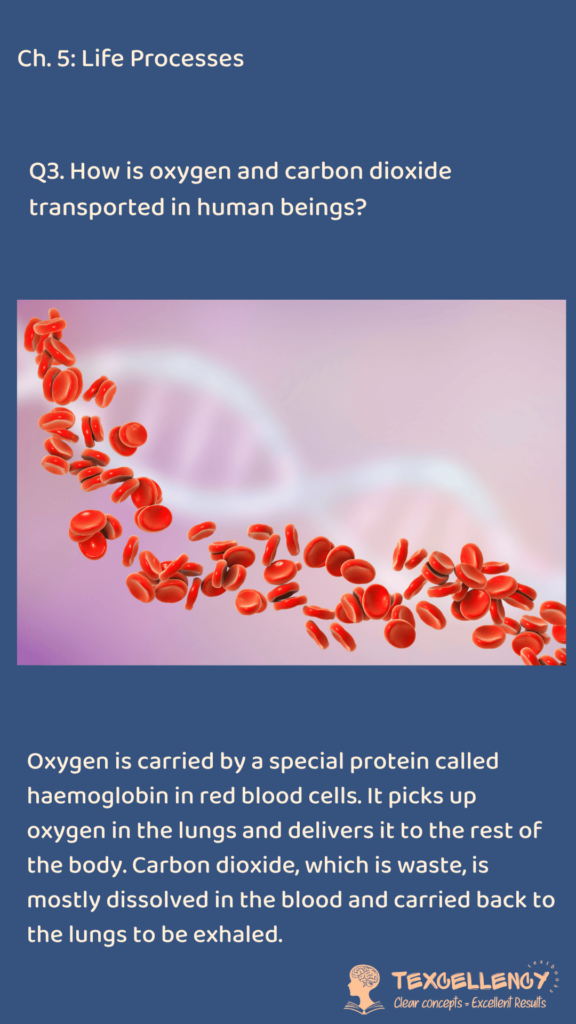
How is Oxygen and Carbon Dioxide Transported in Human Beings? — NCERT Class 10 Science
NCERT Class 10 Science | Chapter 6 — Life Processes | Texcellency Book Series
🎯 The One-Line Answer Google Loves
Oxygen is transported bound to haemoglobin in red blood cells (RBCs) — from the lungs to all body cells. Carbon dioxide is transported mainly dissolved in blood plasma (and partly as bicarbonate ions) — from body cells back to the lungs for exhalation. Both travel through the same highway — the circulatory system — but in opposite directions and by different methods.
🚌 The Big Picture — Why Transportation of Gases is Needed
Every single cell in your body — from the tip of your big toe to the neurons in your brain — needs oxygen to produce energy. And every cell produces carbon dioxide as a waste product of that energy production.
Your lungs are the only place where fresh oxygen enters the body and carbon dioxide exits. But most of your 37 trillion cells are nowhere near your lungs. The cell in your foot is nearly 1.5 metres away from your lungs. If oxygen had to simply diffuse from your lungs to your toe — at the slow speed of diffusion — it would take years. Your body would be dead long before the oxygen arrived.
This is exactly why a dedicated, high-speed transport system exists — your circulatory system — with blood as the transport vehicle. Blood picks up oxygen at the lungs, races it to every cell in the body, collects the carbon dioxide waste, and races back to the lungs — completing one full circuit in about 60 seconds.
🔴 Part 1 — How is Oxygen Transported?
🚗 The Taxi Analogy — Understanding Haemoglobin
Imagine oxygen molecules as passengers needing to travel from Mumbai airport (lungs) to thousands of destinations across the city (body cells). They cannot walk — they need taxis. Haemoglobin is the taxi. Red blood cells are the taxi fleet. Blood vessels are the roads.
Haemoglobin is a special iron-containing protein found in red blood cells (RBCs). It is what makes blood red. Each haemoglobin molecule has four iron atoms — and each iron atom can carry one oxygen molecule. So each haemoglobin can carry four oxygen molecules simultaneously.
Here is the complete step-by-step journey of oxygen:
🔷 Step 1 — Oxygen enters the lungs: You breathe in. Air rushes into the lungs, fills the tiny air sacs called alveoli. The walls of alveoli are extremely thin — just one cell thick — and are surrounded by a dense network of capillaries (tiny blood vessels).
🔷 Step 2 — Oxygen crosses from alveoli into blood: The concentration of oxygen in the alveoli is HIGH. The concentration of oxygen in the blood arriving at the lungs (deoxygenated blood) is LOW. Oxygen moves by diffusion — from high concentration to low — crossing the thin alveolar wall into the capillaries. This takes a fraction of a second because the walls are only one cell thick.
🔷 Step 3 — Haemoglobin grabs the oxygen: Inside the capillary, oxygen immediately binds to haemoglobin in the red blood cells — forming oxyhaemoglobin (HbO₂). This binding is reversible — haemoglobin can grab oxygen and release it depending on conditions.
Haemoglobin + O₂ → Oxyhaemoglobin (at lungs — high oxygen concentration)
🔷 Step 4 — Blood carries oxyhaemoglobin to body cells: The oxygenated blood — now bright red (because oxyhaemoglobin is bright red) — travels from the lungs to the heart, which pumps it through arteries to every organ and tissue in the body.
🔷 Step 5 — Haemoglobin releases oxygen at body cells: At the body cells — the concentration of oxygen is LOW (cells are constantly using it up). The concentration of CO₂ is HIGH (cells are producing it). In this low-oxygen, high-CO₂ environment — oxyhaemoglobin becomes unstable and releases its oxygen — which diffuses into the cells.
Oxyhaemoglobin → Haemoglobin + O₂ (at body cells — low oxygen concentration)
The oxygen enters the cell and is used in cellular respiration to produce ATP (energy).
🔵 Key fact about haemoglobin: It has a very high affinity for oxygen — it can pick up oxygen very efficiently even when oxygen concentration is relatively low. This is what makes it such a brilliant transporter. Simple dissolving of oxygen in blood plasma would carry only about 1.5% of the oxygen the body needs. Haemoglobin increases this capacity by about 70 times.
🔵 Part 2 — How is Carbon Dioxide Transported?
🚛 The Waste Disposal Truck Analogy
If oxygen is the taxi bringing supplies — carbon dioxide is the garbage truck collecting waste. Every cell produces CO₂ as a byproduct of cellular respiration. This waste must be collected and removed — or it would acidify the blood and kill cells.
CO₂ is transported from body cells to the lungs by three methods — and this is where most textbooks let students down by only mentioning one:
🔴 Method 1 — Dissolved in blood plasma (70-75%) Most CO₂ — approximately 70-75% — is transported dissolved in the blood plasma as bicarbonate ions (HCO₃⁻). Here is how: CO₂ enters red blood cells from body tissue → inside the RBC, CO₂ reacts with water (H₂O) in the presence of an enzyme called carbonic anhydrase → forms carbonic acid (H₂CO₃) → which immediately breaks down into bicarbonate ions (HCO₃⁻) and hydrogen ions (H⁺) → the bicarbonate ions move out of the RBC into the plasma → and are carried dissolved in plasma all the way to the lungs. At the lungs, the whole reaction reverses — bicarbonate converts back to CO₂ — which diffuses into the alveoli and is exhaled.
CO₂ + H₂O → H₂CO₃ → HCO₃⁻ + H⁺ (at body cells) HCO₃⁻ + H⁺ → H₂CO₃ → CO₂ + H₂O (at lungs — then CO₂ is exhaled)
🔴 Method 2 — Bound to haemoglobin (20-25%) About 20-25% of CO₂ binds directly to haemoglobin — but NOT to the iron atom (that is where oxygen binds). CO₂ binds to the protein part of haemoglobin — forming carbaminohaemoglobin. This binding is also reversible — CO₂ is released at the lungs and exhaled.
🔴 Method 3 — Dissolved directly in plasma (5-8%) A small amount of CO₂ — about 5-8% — simply dissolves directly in the blood plasma and is carried in dissolved form. This is the method most students think is the only method — but it is actually the smallest contributor.
For NCERT Class 10 exam purposes: The key points are — oxygen is transported by haemoglobin in RBCs, and carbon dioxide is transported mainly dissolved in plasma (as bicarbonate). These two points will get you full marks.
🏙️ The Mumbai Courier Network Analogy — The Complete Picture
Think of the circulatory system as a massive city courier network:
Oxygen courier service: Courier (haemoglobin) picks up packages (oxygen) from the airport (lungs), loads them onto courier vans (RBCs), drives them through city roads (blood vessels), and delivers them door to door to every office and home (body cells). Empty van returns to airport for the next load.
CO₂ waste collection service: Simultaneously — waste collection trucks (plasma with bicarbonate) go to every office and home (body cells), collect waste (CO₂ converted to bicarbonate), carry it through the same road network (blood vessels) back to the airport (lungs), where waste is reprocessed and disposed of (exhaled as CO₂).
Same road. Two different services. Running simultaneously. In opposite directions. Never colliding. This is the elegance of the double circulatory system — oxygenated and deoxygenated blood kept completely separate by the heart’s four chambers.
📊 Oxygen vs CO₂ Transport — Complete Comparison Table
| Feature | Oxygen Transport | CO₂ Transport |
|---|---|---|
| Primary carrier | Haemoglobin in RBCs | Bicarbonate ions in plasma (70-75%) |
| Secondary carrier | — | Carbaminohaemoglobin (20-25%) |
| Tertiary carrier | — | Dissolved directly in plasma (5-8%) |
| Direction | Lungs → Body cells | Body cells → Lungs |
| Form when transported | Oxyhaemoglobin (HbO₂) | Bicarbonate ions (HCO₃⁻) |
| Blood colour | Bright red (oxygenated) | Dark red (deoxygenated) |
| Blood vessel used | Arteries (away from heart) | Veins (toward heart) |
⚡ Why Can’t Oxygen Simply Dissolve in Plasma Like CO₂?
Excellent exam question. Oxygen is poorly soluble in water (plasma). If oxygen relied only on dissolving in plasma — blood could carry only about 0.3 ml of oxygen per 100 ml of blood. The body needs about 250 ml of oxygen per minute at rest. This would require an impossibly large volume of blood circulating at an impossibly fast speed.
Haemoglobin solves this problem elegantly — 100 ml of blood carrying haemoglobin can transport about 20 ml of oxygen — nearly 70 times more than plasma alone could carry.
CO₂, on the other hand, is much more soluble in water — about 20 times more soluble than oxygen. This is why CO₂ can be efficiently transported dissolved in plasma (as bicarbonate), while oxygen cannot.
Oxygen needs haemoglobin. CO₂ does not. Nature’s elegant solution to two different solubility problems.
🩺 Real-Life Connection — What Happens When This System Fails
🔴 Anaemia — when haemoglobin levels are too low (due to iron deficiency, blood loss, or destruction of RBCs). Less haemoglobin = less oxygen carrying capacity = cells starved of oxygen = persistent fatigue, breathlessness, pale skin. The body has oxygen in the lungs — but not enough taxis to carry it to the cells.
🔴 Carbon monoxide poisoning — CO (from vehicle exhaust, burning fuels) binds to haemoglobin 250 times more strongly than oxygen — and does not let go. Haemoglobin taxis get permanently hijacked by CO — can no longer carry oxygen — cells die from oxygen deprivation. This is why carbon monoxide is so deadly even in small quantities.
🔴 High altitude sickness — at high altitudes, atmospheric oxygen pressure is lower — haemoglobin cannot pick up as much oxygen at the lungs — body cells are oxygen-deprived — causing headache, nausea, fatigue. The body adapts over time by producing more RBCs and haemoglobin — which is why high-altitude athletes have a natural performance advantage when they compete at lower altitudes.
🎵 Rhyme to Remember
“Oxygen rides on haemoglobin’s back, From lungs to cells — along the track, Becomes oxyhaemoglobin — bright and red, Delivers O₂ — keeps all cells fed! Carbon dioxide takes the plasma way, As bicarbonate — it flows all day, Back to the lungs — where it turns to gas, Exhaled outside — through the respiratory pass!”
🔤 Alliterations
“Haemoglobin Hungrily Holds oxygen — Handing it to cells” “CO₂ Cleverly Converts to bicarbonate and Cruises in plasma” “Red blood cells Race oxygen Round the body Rapidly” “Plasma Provides the Path for CO₂ to Pass back to lungs“
🧩 Mnemonic — Never Forget the Key Points
For Oxygen: “HiRB” → Haemoglobin in Red blood cells carries oxygen from lungs to Body cells
For CO₂: “BPH” → Bicarbonate in Plasma (main) + Haemoglobin (carbaminohaemoglobin, minor) → back to lungs
Or remember the contrast: “Oxygen HOLDS on (to haemoglobin) — CO₂ DISSOLVES (in plasma)”
✅ Exam-Ready Answer (3–4 marks)
Transport of Oxygen: Oxygen is transported in the blood by a special iron-containing protein called haemoglobin, present in red blood cells (RBCs). In the lungs, haemoglobin binds with oxygen to form oxyhaemoglobin. This oxygenated blood is carried by arteries to all body cells. At the cells, where oxygen concentration is low and CO₂ is high, oxyhaemoglobin releases oxygen, which diffuses into the cells for cellular respiration.
Transport of Carbon Dioxide: Carbon dioxide produced by cells is transported back to the lungs mainly in three ways: 1. As bicarbonate ions (HCO₃⁻) dissolved in blood plasma — about 70-75% (most important). 2. Bound to haemoglobin as carbaminohaemoglobin — about 20-25%. 3. Dissolved directly in blood plasma — about 5-8%.
At the lungs, CO₂ is released from bicarbonate and carbaminohaemoglobin and exhaled. Haemoglobin then picks up fresh oxygen and the cycle repeats.
📌 Key Points Checklist
✅ Oxygen transport = haemoglobin in RBCs = forms oxyhaemoglobin = bright red blood ✅ Haemoglobin has 4 iron atoms = can carry 4 oxygen molecules per molecule ✅ Haemoglobin increases oxygen-carrying capacity 70x compared to plasma alone ✅ CO₂ transport = mainly as bicarbonate ions in plasma (70-75%) ✅ CO₂ also transported as carbaminohaemoglobin (20-25%) and dissolved in plasma (5-8%) ✅ Oxygen travels in arteries (lungs → body) • CO₂ travels in veins (body → lungs) ✅ Oxygenated blood = bright red • Deoxygenated blood = dark red (NOT blue — a common myth) ✅ Anaemia = low haemoglobin = less oxygen carrying capacity = fatigue ✅ Carbon monoxide hijacks haemoglobin 250x more strongly than oxygen = deadly ✅ CO₂ more soluble in water than O₂ — that is why CO₂ can dissolve in plasma but O₂ cannot
📚 Want ALL of Class 10 Science Explained This Way?
Every chapter. Every concept. Every NCERT question — explained with analogies, rhymes, mnemonics, and real-life examples that make sense and stay in memory long after exam day.
👉 Explore the Full Texcellency Collection 👉 Download Your FREE Book Now
“A good textbook is like a smart GPS — it doesn’t just give you the destination, it tells you every turn along the way, in simple language you actually understand.”