Compare and Contrast Nervous and Hormonal Mechanisms for Control and Coordination in Animals — NCERT Class 10 Science
NCERT Class 10 Science | Chapter 7 — Control and Coordination | Texcellency Book Series
🏙️ Big Picture First — Why Animals Need BOTH Systems
Think of running your body like running a big city. Some situations need instant emergency response — a fire breaks out, police must reach in minutes. Other situations need slow, steady, long-term management — building new roads, planning population growth, managing water supply for the whole city.
One type of system cannot handle both jobs.
That is exactly why your body has two coordination systems — the nervous system for instant responses, and the hormonal (endocrine) system for slow, steady, long-term control. Neither is superior — both are essential.
⚡ The Core Answer — What Each System Does
Nervous System carries electrical signals through neurons from the brain/spinal cord to target organs. The response is instant, short-lived, and very specific — only the targeted organ responds.
Hormonal System releases chemical messengers called hormones directly into the bloodstream. These travel slowly to target organs. The response is slow, long-lasting, and widespread — often affecting multiple organs at the same time.
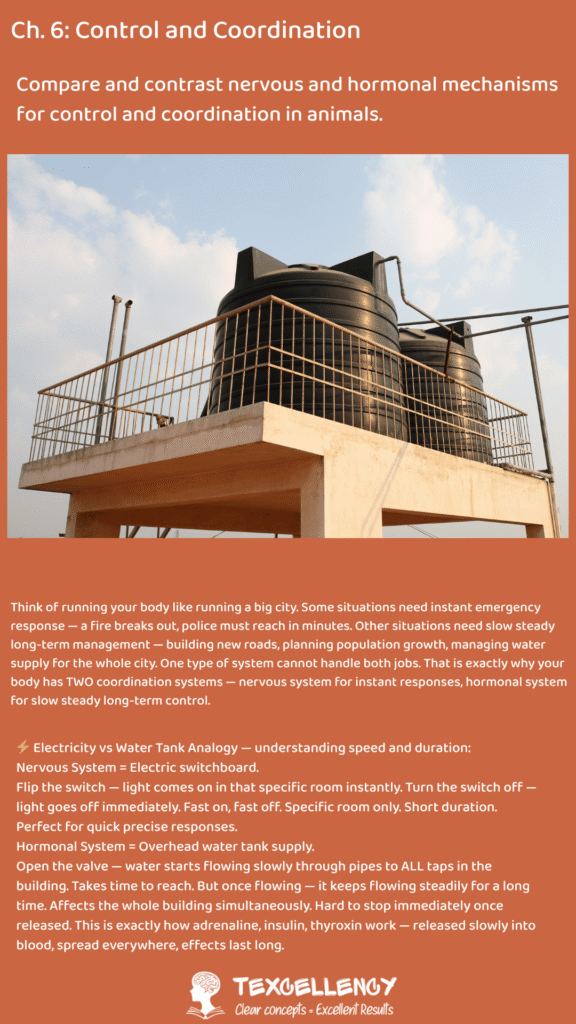
🔌 The Electricity vs. Water Tank Analogy
Nervous System = Electric switchboard in your home. Flip the switch — light comes on in that specific room instantly. Turn the switch off — light goes off immediately. Fast on, fast off. Specific room only. Short duration. Perfect for quick, precise responses — like pulling your hand away from a hot pan.
Hormonal System = Overhead water tank supply. Open the valve — water starts flowing slowly through pipes to ALL taps in the building. Takes time to reach. But once flowing — it keeps flowing steadily for a long time. Affects the whole building simultaneously. Hard to stop immediately once released.
This is exactly how adrenaline, insulin, thyroxine work — released slowly into blood, spread everywhere, effects last long — like puberty, growth, metabolism regulation.
📊 Side-by-Side Comparison Table
| Feature | Nervous System | Hormonal System |
|---|---|---|
| Messenger | Electrical impulse | Chemical (hormone) |
| Speed | Very fast (milliseconds) | Slow (minutes to hours) |
| Path | Neurons (nerve fibres) | Bloodstream |
| Duration of effect | Short-lived | Long-lasting |
| Target | Specific organ/muscle | Widespread / multiple organs |
| Control centre | Brain & Spinal Cord | Endocrine glands |
| Example | Reflex action, blinking | Puberty, growth, blood sugar control |
| Reversible? | Immediately reversible | Gradually reversible |
🎯 Real-Life Examples That Make It Crystal Clear
🔵 Nervous System in action: You accidentally touch a hot tawa. Before your brain even processes pain — your hand pulls back. That’s a reflex arc. Electrical signal → spinal cord → muscle. Done in milliseconds. This is the nervous system.
🔶 Hormonal System in action: You are standing at the edge of a stage about to give a speech. Your adrenal glands release adrenaline into your blood. Heart beats faster, breathing quickens, palms sweat, muscles are on high alert. This did not happen in a millisecond — it built up over seconds and stayed for several minutes. That is the hormonal system.
🧠 Cricket Match Analogy — for students who love cricket
Nervous System = The wicketkeeper. The moment the ball leaves the bowler’s hand — instant decision — dive left or right — split-second reaction — done. Fast. Specific. Brief.
Hormonal System = The team coach. Does not play on the field. Gives instructions that slowly shape the team’s overall strategy, fitness, and confidence over weeks and months. Widespread, long-lasting influence on the entire team.
🎵 Rhyme to Remember
“Nerves are fast like lightning’s spark, Hormones travel in the dark — Through the blood they slowly creep, But their effects run long and deep!”
🔤 Alliterations
“Nerves are Nimble, Narrow, and Now” → Fast, specific, immediate “Hormones are Hazy, Huge, and Hours-long” → Slow, widespread, lasting
🧩 Mnemonic — “FSSL vs SWLL”
Nervous = FSSL → Fast • Specific • Short-lived • Signals (electrical) Hormonal = SWLL → Slow • Widespread • Long-lasting • Liquid (blood-carried)
Remember it as: “Fast Signals, Slow Liquid” — nervous uses fast signals, hormonal uses slow liquid (blood).
✅ One-Line Exam Answer (for 2-mark questions)
The nervous system uses electrical impulses through neurons for fast, short, specific responses. The hormonal system uses chemicals (hormones) through blood for slow, widespread, long-lasting responses. Both work together to maintain coordination in animals.
🔁 How They Work Together — The Full Story
The nervous and hormonal systems are not rivals — they are teammates. In fact, the hypothalamus in the brain directly controls the pituitary gland — showing how the nervous system can command the hormonal system. During a crisis — say a dog chases you — your nervous system triggers instant running, while simultaneously your hormonal system releases adrenaline to sustain that high-alert state for several minutes after you’ve stopped running.
Fast first responder (nervous) + Slow sustained support (hormonal) = Complete coordination.
📌 Key Points Checklist
✅ Nervous system — electrical signals — neurons — fast — specific — short ✅ Hormonal system — chemical signals — blood — slow — widespread — long ✅ Nervous system controlled by brain and spinal cord ✅ Hormonal system controlled by endocrine glands (pituitary, thyroid, adrenal, pancreas) ✅ Both systems work together — not independently ✅ Example hormones: Adrenaline (emergency response) • Insulin (blood sugar) • Thyroxine (metabolism) • Growth hormone (growth)
📚 Want to Understand ALL of Class 10 Science This Way?
This is just one question from Chapter 7. The Texcellency Book Series explains every single concept in Class 10 Science using analogies, rhymes, mnemonics, and real-life examples — exactly like what you just read above.
No more rote learning. No more forgetting answers the night before the exam.
👉 Explore the Full Texcellency Collection 👉 Download Your FREE Book Now
“A good textbook is like a smart GPS — it doesn’t just give you the destination, it tells you every turn along the way, in simple language you actually understand.”