What is the Need for a System of Control and Coordination in an Organism? — NCERT Class 10 Science
NCERT Class 10 Science | Chapter 7 — Control and Coordination | Texcellency Book Series
🎯 The One-Line Answer Google Loves
Every living organism has millions of processes happening simultaneously — digestion, breathing, heartbeat, movement, temperature regulation, hormone release. Without a system to control and coordinate all of these, the organism cannot survive. The nervous system and hormonal system together form this control and coordination system.
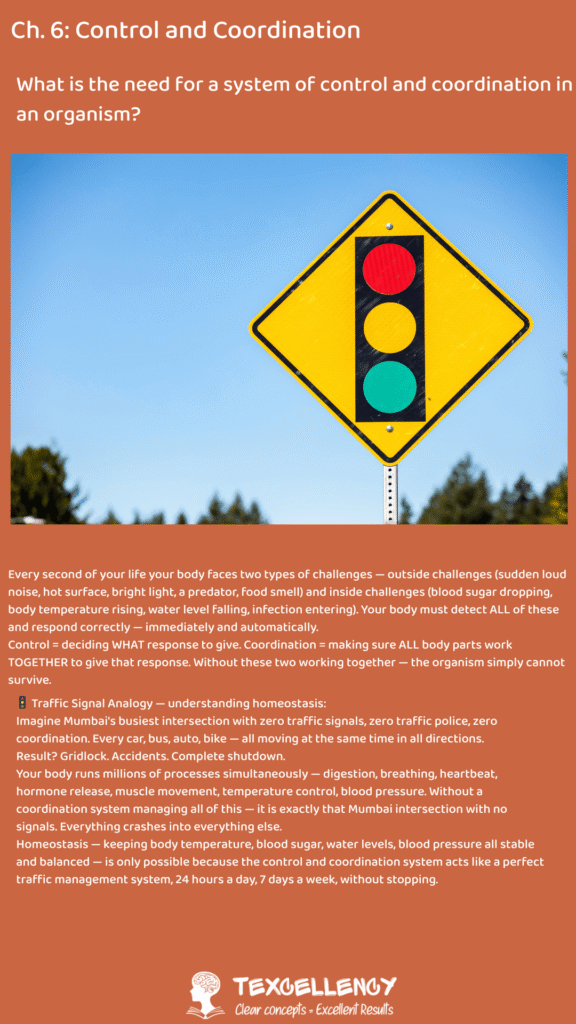
🏙️ The Mumbai Traffic Signal Analogy — Understanding Why Coordination is Non-Negotiable
Imagine Mumbai’s busiest intersection — Dadar or Kurla — with zero traffic signals, zero traffic police, zero rules. Every car, bus, auto, bike — all moving at the same time in all directions simultaneously.
Result? Gridlock. Accidents. Complete shutdown. Nobody goes anywhere.
Now think of your body. At this very moment your body is simultaneously:
- Digesting the food you ate • Pumping blood through 60,000 km of blood vessels • Maintaining your body temperature at exactly 37°C • Adjusting your blood pressure • Releasing the right hormones in the right amounts • Contracting and relaxing hundreds of muscles • Processing everything your eyes and ears are sensing right now
Without a coordination system managing ALL of this — it is exactly that Mumbai intersection with no signals. Everything crashes into everything else.
The control and coordination system is that traffic management system — working 24 hours a day, 7 days a week, without a single pause, not even when you are asleep.
🏭 The Factory Manager Analogy — Understanding Control
Think of your body as a large factory with thousands of workers and machines running simultaneously. Without a factory manager giving instructions, monitoring output, and responding to problems — the factory would collapse within hours.
Your brain is the factory manager. The nervous system is the intercom network — instant messages to specific departments. The hormonal system is the company-wide memo — slower, but reaching every department, shaping long-term strategy.
Without this management system — no organ knows when to work, how much to work, when to stop.
🔍 Breaking It Down — What Exactly Does Control and Coordination Do?
🔵 1. Response to Stimuli — When you touch something hot, your hand pulls back before your brain even registers pain. This is a reflex arc — the spinal cord coordinates an instant protective response. Without coordination, your hand would stay on the hot surface.
🔵 2. Homeostasis — Your body temperature must stay near 37°C. Blood sugar must stay within a narrow range. Blood pressure must be regulated. Too high or too low — and organs start failing. The coordination system constantly monitors and corrects all these values. This process of maintaining internal stability is called homeostasis.
🔵 3. Voluntary Movement — You decide to pick up a pen. Your brain sends precise electrical signals to exactly the right muscles in exactly the right sequence. Without coordination, you could not perform even the simplest movement.
🔵 4. Growth and Development — During puberty, growth hormones coordinate changes across the entire body — height, voice, muscle development — not just one organ. Without hormonal coordination, growth would be chaotic and incomplete.
🔵 5. Survival Responses — You see a dog running towards you. Instantly — adrenaline is released, heart rate increases, muscles tense up, breathing quickens — your body is ready to run or fight. This fight-or-flight response is the coordination system protecting your life in real time.
🎸 The Orchestra Analogy — The Most Beautiful Way to Understand Coordination
Imagine a symphony orchestra with 100 musicians — violins, tabla, flute, drums, all playing different instruments. Each musician is highly skilled individually. But without a conductor standing in the centre — keeping time, signalling each section, ensuring everyone plays at the right moment — it would be noise, not music.
Your body is that orchestra.
- Each organ is a skilled musician — heart, lungs, liver, kidneys — all capable individually.
- The nervous system is the conductor’s baton — precise, instant signals.
- The hormonal system is the musical score — the long-term plan everyone follows.
- Together they produce the symphony of life — seamless, continuous, beautiful.
Remove the conductor (control and coordination system) — and 100 skilled musicians produce only chaos.
📊 What Happens WITHOUT Control and Coordination — Quick Comparison
| Situation | With Coordination | Without Coordination |
|---|---|---|
| Touch hot object | Hand pulls back instantly (reflex) | Hand stays — severe burn |
| Blood sugar rises | Insulin released — sugar absorbed | Sugar stays high — diabetes-like damage |
| Body temperature rises | Sweating begins — temperature drops | Overheating — organ damage |
| Danger approaches | Fight-or-flight response activated | No protective response — death risk |
| Exercise begins | Heart rate increases — more oxygen delivered | Muscles starve of oxygen — collapse |
🎵 Rhyme to Remember
“Without control, the body goes wrong, No signal to tell where each part belongs — The heart would race and muscles would freeze, Temperature rise with the slightest breeze! But with coordination — systems align, Every organ works in perfect design!”
🔤 Alliterations
“Coordination Creates Calm, Controlled, Continuous living” “No Nervous Network = No Normal functioning” “Hormones Help Homeostasis Happen”
🧩 Mnemonic — “RHGVS”
The 5 key needs for control and coordination: R → Response to stimuli • H → Homeostasis • G → Growth regulation • V → Voluntary movement • S → Survival responses
Remember as: “Really Healthy Giants Volunteering for Science”
✅ Exam-Ready Answer (3–4 marks)
Living organisms carry out millions of processes simultaneously — digestion, respiration, movement, growth, temperature regulation. A system of control and coordination is needed because:
1. To respond quickly to stimuli in the environment (e.g. withdrawing hand from hot objects via reflex action). 2. To maintain homeostasis — keeping internal conditions like body temperature, blood sugar, and blood pressure stable. 3. To coordinate voluntary movements — ensuring the right muscles contract at the right time. 4. To regulate growth and development through hormonal coordination. 5. To trigger survival responses (fight-or-flight) in dangerous situations.
In animals, this is achieved by the nervous system (fast, electrical, specific) and the hormonal/endocrine system (slow, chemical, widespread), working together.
📌 Key Points Checklist
✅ Organisms perform millions of processes simultaneously — all need coordination ✅ Without coordination → organs work randomly → organism cannot survive ✅ Nervous system handles fast, specific, short-term responses ✅ Hormonal system handles slow, widespread, long-term regulation ✅ Homeostasis = maintaining stable internal conditions = key function of coordination ✅ Reflex actions = fastest form of nervous coordination (via spinal cord, not brain) ✅ Fight-or-flight = adrenaline-driven hormonal coordination for survival
📚 Want ALL of Class 10 Science Explained This Way?
Every chapter. Every concept. Every NCERT question — explained with analogies, rhymes, mnemonics, and real-life examples that actually make sense.
No rote learning. No last-minute panic. No forgetting answers in the exam hall.
👉 Explore the Full Texcellency Collection 👉 Download Your FREE Book Now
“A good textbook is like a smart GPS — it doesn’t just give you the destination, it tells you every turn along the way, in simple language you actually understand.”