How Does Chemical Coordination Occur in Plants? — NCERT Class 10 Science
NCERT Class 10 Science | Chapter 7 — Control and Coordination | Texcellency Book Series
🎯 The One-Line Answer Google Loves
Plants have no brain, no nerves, and no nervous system. They coordinate their activities using chemical messengers called phytohormones (plant hormones). These are produced in one part of the plant, travel through its tissues to other parts, and give instructions — grow here, stop there, ripen now, save water. This is chemical coordination in plants.
🧠 The Big Difference — Plants vs Animals
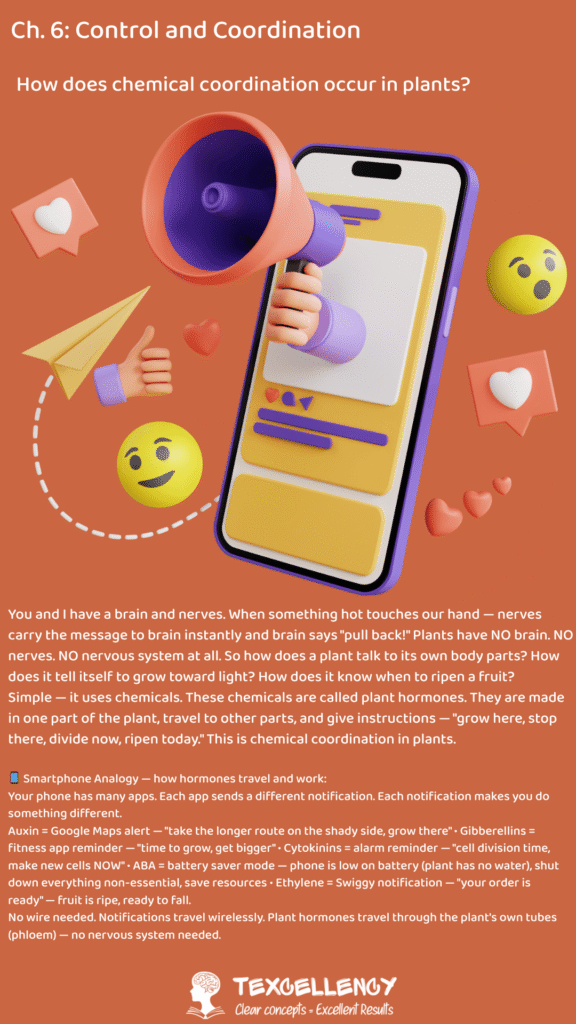
You and I have a brain. When something hot touches our hand — nerves carry the message to the brain instantly and the brain says “pull back!” The whole process takes milliseconds.
Plants have no brain. No nerves. No nervous system at all.
So how does a plant tell its roots to grow downward and its stem to grow upward? How does it know to bend toward light? How does it know when to ripen a fruit, or when to shed its leaves in winter? How does it survive a drought?
The answer is beautifully simple — it uses chemicals. Produced in one part of the plant, these chemicals travel slowly through the plant’s own conducting tissues and deliver instructions to target cells. No wires needed. No brain needed. Just the right chemical, in the right concentration, reaching the right place.
📱 The Smartphone Notification Analogy — Understanding How Plant Hormones Work
Your phone has many apps. Each app sends a different notification. Each notification makes you do something different — and you respond accordingly.
Plant hormones work exactly the same way. Each hormone is a different notification — each triggers a different response in the plant.
🟢 Auxin = Google Maps alert — “the light is coming from that side, grow longer on the shady side so the plant bends toward light.” Auxin causes cell elongation. More auxin on the shady side = more growth on that side = plant bends toward light. This is called phototropism.
🟡 Gibberellins = Fitness app reminder — “time to grow, get bigger, get taller.” Gibberellins promote stem elongation, seed germination, and flowering. They are like the plant’s growth booster.
🔵 Cytokinins = Alarm reminder — “cell division time, make new cells NOW.” Cytokinins promote cell division, delay ageing of leaves, and keep the plant young and fresh. They are produced mainly in roots and travel upward.
🔴 Abscisic Acid (ABA) = Battery saver mode — the phone is low on battery (the plant is losing water in drought), so shut down everything non-essential, conserve resources. ABA is the stress hormone. It causes stomata to close (reducing water loss), inhibits growth, and prepares the plant for unfavourable conditions. It is sometimes called the “stress hormone” or “inhibitor.”
🟠 Ethylene = Swiggy delivery notification — “your order is ready, come and get it.” Ethylene signals that the fruit is ripe and ready. It promotes fruit ripening and is responsible for why fruits placed near other ripe fruits ripen faster. It is the only plant hormone that is a gas.
🌱 How Do These Hormones Actually Travel?
This is the part most textbooks gloss over — but it is important and often asked in exams.
Plant hormones are produced in specific tissues — tips of shoots and roots, young leaves, seeds, ripening fruits. From there they travel through the plant’s phloem (the food-conducting tubes) or sometimes move cell to cell. They do not travel through nerves because plants have no nerves. The movement is slow — but it is targeted and effective.
The concentration of the hormone matters as much as its presence. Too little auxin = no effect. Right amount = cell elongation. Too much = growth actually inhibited. This concentration-dependent behaviour makes plant hormone coordination surprisingly sophisticated.
🏡 The Colony WhatsApp Group Analogy — for the concept of coordination without a central brain
Imagine a housing colony WhatsApp group. There is no one boss. But when someone posts “water supply will be cut tomorrow morning” — everyone in the colony independently adjusts their own behaviour — fills buckets, postpones washing, postpones watering plants. Coordinated response. No central controller. Just one chemical message — read and acted upon by everyone.
Plant hormone coordination works exactly like this. One hormone released by one group of cells — travels through the plant — every cell that has the right receptor for that hormone reads the message and responds. No brain. No central controller. Pure chemical democracy.
📊 Plant Hormones — Quick Reference Table
| Hormone | Produced In | Main Function | Memory Hook |
|---|---|---|---|
| Auxin | Shoot tip | Cell elongation, phototropism, geotropism | “Auxin = Aage badhna (move forward/bend)” |
| Gibberellin | Young leaves, seeds | Stem elongation, germination, flowering | “Gibberellin = Giant growth” |
| Cytokinin | Roots | Cell division, delays leaf ageing | “Cytokinin = Cell division Kin” |
| Abscisic Acid (ABA) | Leaves, roots | Stomata closure, stress response, growth inhibition | “ABA = Always Brakes Applied” |
| Ethylene | Ripening fruits | Fruit ripening, leaf fall | “Ethylene = Eager to ripen” |
🌿 Tropisms — When Chemical Coordination Produces Visible Movement
When chemical coordination causes a plant to grow in a particular direction in response to a stimulus — that directional growth is called a tropism. Tropisms are the most visible evidence of chemical coordination in plants.
🔵 Phototropism — growth toward or away from light. Auxin accumulates on the shady side → that side grows longer → plant bends toward light. (Stems show positive phototropism. Roots show negative phototropism.)
🔵 Geotropism — growth in response to gravity. Roots grow downward toward gravity (positive geotropism). Stems grow upward away from gravity (negative geotropism).
🔵 Hydrotropism — roots grow toward water. Roots always find moisture — chemical signals guide this directional growth.
🔵 Thigmotropism — growth in response to touch. Tendrils of a climbing plant wrap around a support — auxin redistributes on the side away from contact, causing that side to grow faster, making the tendril curl and grip.
🎵 Rhyme to Remember the 5 Plant Hormones
“Auxin bends the plant toward light, Gibberellin makes it grow upright, Cytokinin keeps the cells dividing, ABA keeps the stomata hiding, Ethylene says — the fruit is ripe, Five hormones — each a different type!”
🔤 Alliterations
“Auxin Always Assists the plant in Advancing toward light” “Gibberellins Give plants their Grand height” “Cytokinins Create and Cultivate new Cells” “Abscisic Acid Always Applies the Brakes” “Ethylene Enthusiastically announces ripEning“
🧩 Mnemonic — Remember All 5 Hormones
A G C A E → “A Good Chemist Always Experiments” Auxin • Gibberellin • Cytokinin • Abscisic Acid • Ethylene
Or remember by their jobs: “Bend — Grow — Divide — Brake — Ripen” Auxin bends • Gibberellin grows • Cytokinin divides • ABA brakes • Ethylene ripens
✅ Exam-Ready Answer (3–4 marks)
Plants have no nervous system. They achieve coordination through phytohormones (plant hormones) — chemicals produced in one part of the plant that travel to other parts and regulate growth and responses.
The five main plant hormones are: 1. Auxin — promotes cell elongation; responsible for phototropism and geotropism. 2. Gibberellins — promote stem elongation, seed germination, and flowering. 3. Cytokinins — promote cell division and delay ageing of leaves. 4. Abscisic Acid (ABA) — inhibits growth, causes stomata to close during water stress; called the stress hormone. 5. Ethylene — a gaseous hormone that promotes fruit ripening and leaf fall.
These hormones travel through the plant’s phloem and coordinate responses to light, gravity, water, touch, and environmental stress — without any nervous system.
📌 Key Points Checklist
✅ Plants have no nervous system — coordination is purely chemical ✅ Plant hormones = phytohormones — chemical messengers ✅ Produced in one part, travel to another, act on target cells ✅ Concentration matters — same hormone can promote or inhibit depending on concentration ✅ Auxin → cell elongation → phototropism, geotropism ✅ Gibberellin → growth, germination, flowering ✅ Cytokinin → cell division, anti-ageing in leaves ✅ ABA → stress response, stomata closure, growth inhibition ✅ Ethylene → fruit ripening, leaf fall — only gaseous plant hormone ✅ Tropisms = directional growth due to chemical coordination
📚 Want ALL of Class 10 Science Explained This Way?
Every chapter. Every concept. Every NCERT question — explained with analogies, rhymes, mnemonics, and real-life examples that actually make sense and actually stay in memory.
No rote learning. No last-minute panic. No blanking out in the exam hall.
👉 Explore the Full Texcellency Collection 👉 Download Your FREE Book Now
“A good textbook is like a smart GPS — it doesn’t just give you the destination, it tells you every turn along the way, in simple language you actually understand.”