
First — understand both movements separately and clearly:
Mimosa pudica (touch-me-not) movement:
You touch the leaf — within seconds the leaflets fold up and the whole leaf droops down. Looks almost magical. But the science is beautifully simple — no brain, no nerves, no muscles involved whatsoever. What happens is this — the cells at the base of each leaflet (called pulvinus cells) are normally full of water — they are firm and inflated — this is called turgor pressure — and this pressure keeps the leaflets open and upright. The moment you touch the plant — these cells rapidly pump water out — they lose turgor pressure — become soft and flaccid — and the leaflets immediately fold and droop. This type of movement — triggered by touch, non-directional, based purely on water pressure change — is called Thigmonasty. And importantly — after some time the cells pump water back in, turgor pressure returns and leaflets open again. Completely reversible.
Movement in our legs:
Your brain decides to take a step. Electrical signal travels from brain through spinal cord through motor neurons all the way to leg muscles. The quadriceps (front thigh muscles) contract — pulling the leg forward. Simultaneously the hamstrings (back thigh muscles) relax — allowing that forward movement. These two muscle groups work as antagonistic pairs — when one contracts the other relaxes — like a perfectly coordinated push-pull system. Powerful, fast, precisely directional, completely nerve controlled.
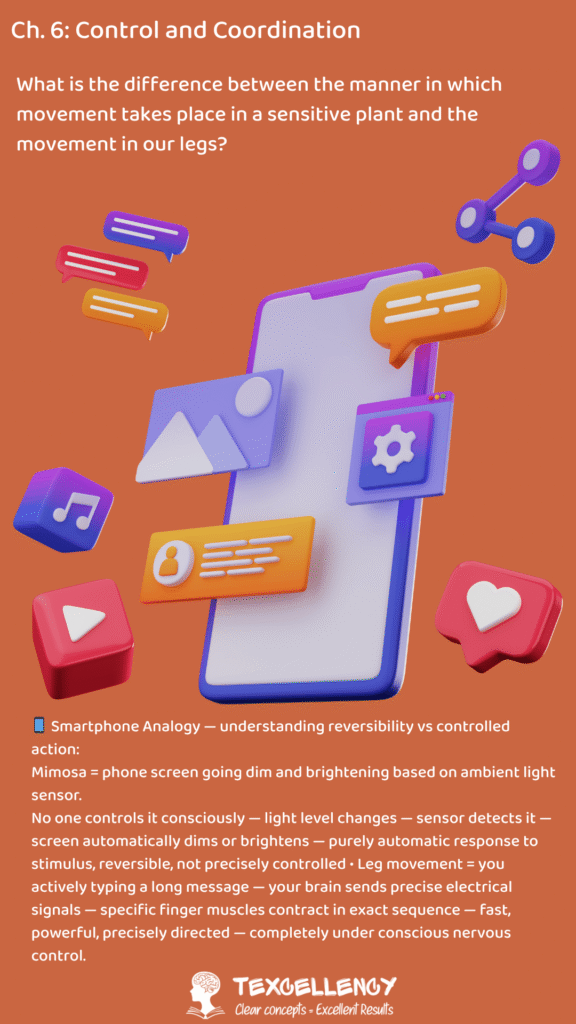
📱 Smartphone Analogy — understanding reversibility vs controlled action:
Mimosa = phone screen going dim and brightening based on ambient light sensor.
No one controls it consciously — light level changes — sensor detects it — screen automatically dims or brightens — purely automatic response to stimulus, reversible, not precisely controlled • Leg movement = you actively typing a long message — your brain sends precise electrical signals — specific finger muscles contract in exact sequence — fast, powerful, precisely directed — completely under conscious nervous control.
▶️ Sensitive Plant Movement — The Science: Touch the leaf → cells at the base (pulvinus cells) rapidly lose water → turgor pressure drops → leaflets fold and droop. This is called Thigmonasty. No brain. No nerves. Pure water pressure game. Completely reversible — cells pump water back in after some time and leaflets reopen.
▶️ Leg Movement — The Science: Brain sends electrical signal → travels via spinal cord → reaches leg muscles via motor neurons → quadriceps contract, hamstrings relax (antagonistic pair action) → leg moves forward. Fast, powerful, precisely directional, fully under nervous control.
🔶 The Analogy That Makes It Stick — Smartphone vs. GPS: 🌿 Sensitive Plant = Phone screen that auto-dims when light drops. No one controls it consciously — it’s just a automatic response to a stimulus. Reversible and non-directional. 🦵 Leg Movement = You actively typing a message. Brain decides, fingers obey — precise electrical signals, specific muscles fire in exact sequence. Fully conscious, directional, powerful.
✅ Quick Comparison Table:
| Feature | Sensitive Plant | Human Leg |
|---|---|---|
| Trigger | Touch (stimulus) | Brain signal |
| Mechanism | Water pressure (turgor) | Nerve + Muscle |
| Type | Thigmonasty | Voluntary movement |
| Speed | Seconds | Milliseconds |
| Reversible? | Yes | Yes (relaxes after) |
| Nerves involved? | ❌ No | ✅ Yes |
| Muscles involved? | ❌ No | ✅ Yes |
🔴 Mnemonic to Remember: “Plants PUSH water, Legs PULL nerves” 🌿 Plant = Pressure (water turgor) • 🦵 Leg = Nerves + Muscles = NM = “Now Move!” (brain command)
⭕ Rhyme to Remember: “The plant folds up when you give it a touch, No nerves, no muscles — water does the clutch! But legs need signals from the brain each day, Nerves fire, muscles pull — and we walk away!”