
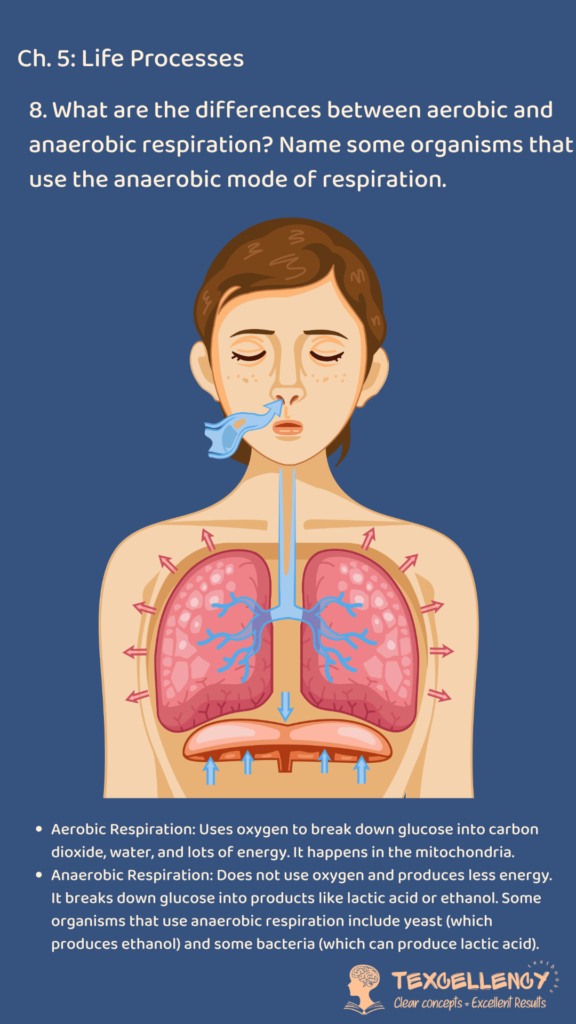
What are the differences between aerobic and anaerobic respiration? Name some organisms that use the anaerobic mode of respiration.
NCERT Class 10 Science | Life Processes | Texcellency Book Series
Aerobic respiration uses oxygen to break down glucose completely into carbon dioxide and water — releasing large amounts of energy (36-38 ATP molecules). Anaerobic respiration occurs without oxygen — breaking down glucose partially into either lactic acid (in animal muscle cells) or ethanol and CO₂ (in yeast and some bacteria) — releasing far less energy (only 2 ATP molecules). Organisms using anaerobic respiration include yeast, many bacteria, and human muscle cells during intense exercise.
🏭 The Big Picture — Same Goal, Two Very Different Paths
Every living cell has one fundamental energy need — produce ATP (Adenosine Triphosphate) — the chemical energy currency that powers everything from muscle contraction to nerve signals to protein synthesis. The raw material for this ATP production is glucose — obtained from food.
The question is: how does the cell convert glucose into ATP?
The answer depends entirely on whether oxygen is available.
🔵 Oxygen available? → Use aerobic respiration — complete breakdown — maximum ATP. 🔵 Oxygen absent or insufficient? → Use anaerobic respiration — partial breakdown — minimum ATP — survival mode.
Both pathways begin with the same first step — glycolysis — the breakdown of glucose (a 6-carbon molecule) into pyruvate (a 3-carbon molecule) in the cytoplasm. This happens in both aerobic and anaerobic respiration. It is what happens to pyruvate AFTER glycolysis that creates the fundamental difference between the two.
🚆 The High-Speed Train vs Bullock Cart Analogy — The One That Makes It Unforgettable
Aerobic respiration = Vande Bharat Express (high-speed train). Sleek, modern, oxygen-powered, engineered for maximum efficiency. Carries 36-38 passengers (ATP molecules) per trip. Covers enormous distances at 300 km/h. Runs smoothly, produces clean exhaust (CO₂ and water). The preferred mode — whenever oxygen (the fuel) is available.
Anaerobic respiration = Bullock cart. Ancient, slow, no oxygen needed — just glucose and sheer biological necessity. Carries only 2 passengers (ATP molecules) per trip. Moves painfully slowly. Produces messy byproducts (lactic acid or ethanol). Not the preferred mode — but the only option when the train (oxygen) is not available.
The destination is the same for both — produce ATP to keep the cell alive. But the efficiency, speed, and cleanliness of the journey are worlds apart.
🔴 The key insight: Anaerobic respiration is not a broken version of aerobic — it is an ancient backup system that evolved long before oxygen existed in Earth’s atmosphere. Many organisms alive today — yeast, certain bacteria — have never needed aerobic respiration and thrive entirely on this backup system.
☀️ The Solar Power vs Thermal Power Analogy — For Understanding Efficiency
Aerobic respiration = Solar power plant. Clean, efficient, produces maximum energy output per unit of input (glucose). Byproducts are harmless — CO₂ and water. Requires the right conditions — oxygen, like sunlight, must be available. The preferred, sustainable option.
Anaerobic respiration = Old coal-fired thermal power plant. Less efficient — same amount of fuel (glucose) produces a fraction of the energy. Produces waste byproducts (lactic acid or ethanol) that can cause problems if they accumulate. Does not require oxygen. Still functions — but at significant cost in efficiency and byproduct accumulation.
Same raw material (glucose). Same end goal (ATP). Vastly different efficiency. Vastly different byproducts.
🔬 The Complete Step-by-Step Mechanism — Both Pathways
🔷 Step 1 — Glycolysis (Common to BOTH — happens in Cytoplasm)
Glucose (C₆H₁₂O₆) — a 6-carbon molecule — is broken down into two molecules of pyruvate (C₃H₄O₃) — each a 3-carbon molecule. This happens in the cytoplasm of the cell. A small amount of ATP (2 molecules) and NADH is produced. No oxygen is needed for this step — it is entirely anaerobic. This is why both aerobic and anaerobic respiration share this first step.
Glucose → 2 Pyruvate + 2 ATP + 2 NADH (in cytoplasm — no oxygen needed)
🔷 Step 2A — Aerobic Pathway (Pyruvate enters Mitochondria — Oxygen Present)
When oxygen is available — pyruvate is transported from the cytoplasm into the mitochondria — the powerhouse of the cell. Inside the mitochondria — pyruvate is completely broken down through a series of reactions (Krebs cycle + Electron Transport Chain) into CO₂ and water — releasing enormous amounts of energy trapped as 36-38 ATP molecules per original glucose molecule.
Complete aerobic equation: C₆H₁₂O₆ + 6O₂ → 6CO₂ + 6H₂O + 36-38 ATP
Location: Cytoplasm (glycolysis) + Mitochondria (Krebs cycle + ETC) Byproducts: CO₂ (exhaled) and H₂O (used or excreted) — both harmless
🔷 Step 2B — Anaerobic Pathway (Pyruvate stays in Cytoplasm — No Oxygen)
When oxygen is unavailable — pyruvate cannot enter the mitochondria productively. Instead it is processed in the cytoplasm itself — through one of two pathways depending on the organism:
🔴 In yeast and some bacteria — Alcoholic Fermentation: Pyruvate → Ethanol (C₂H₅OH) + Carbon dioxide (CO₂) + 2 ATP
This is the fermentation pathway — the same process used to make bread (yeast produces CO₂ that makes dough rise), wine, beer, and idli-dosa batter. The ethanol is a byproduct — in bread-making it evaporates during baking. In brewing — it remains as alcohol.
Anaerobic equation (yeast): C₆H₁₂O₆ → 2C₂H₅OH + 2CO₂ + 2 ATP
🔴 In human muscle cells during intense exercise — Lactic Acid Fermentation: Pyruvate → Lactic Acid (C₃H₆O₃) + 2 ATP
When you sprint at full speed — your muscles demand more oxygen than your blood can deliver fast enough. Muscle cells switch to anaerobic respiration — converting pyruvate to lactic acid. This generates just enough ATP to keep muscles contracting — but lactic acid accumulates in the muscle tissue — causing the burning sensation and cramps you feel after intense exercise. When you stop and breathe deeply — the lactic acid is gradually oxidised back to CO₂ and water once oxygen is replenished.
Anaerobic equation (muscle cells): C₆H₁₂O₆ → 2C₃H₆O₃ + 2 ATP
🍞 The Idli-Dosa Batter Analogy — Anaerobic Respiration in Daily Indian Life
Every Indian kitchen uses anaerobic respiration daily — without knowing it.
When you soak rice and urad dal and grind them into batter — then leave the batter to ferment overnight — the bacteria and yeast naturally present in the batter perform anaerobic respiration. They break down the carbohydrates in the batter — producing CO₂ (which makes the batter rise and become fluffy) and lactic acid (which gives idli and dosa their characteristic slight sourness).
The next morning — the batter has doubled in volume. The fluffy idli you eat — is literally the product of anaerobic respiration by millions of microorganisms working overnight in your kitchen.
Same process — different kitchen — whether it is your अम्मा’s idli batter in Chennai or a yeast vat in a Mumbai brewery.
🏃 The 100-Metre Sprint Analogy — Anaerobic in Human Muscles
Picture Neeraj Chopra sprinting for 100 metres at absolute maximum speed. In those 10 seconds — his muscles are contracting so violently and so rapidly that his bloodstream simply cannot deliver oxygen fast enough to meet demand. His muscle cells switch instantly to anaerobic respiration — converting pyruvate to lactic acid — generating just enough ATP to keep those muscles firing.
The moment he crosses the finish line — he bends over, breathing heavily (paying back the “oxygen debt”) — the body now using all that extra oxygen to break down the accumulated lactic acid. The burning sensation in his thighs? That is lactic acid accumulation. The deep breathing after? That is the body clearing it.
Anaerobic respiration in human muscles is not a failure — it is a brilliant short-term emergency energy system. Without it — no sprinting, no sudden bursts of power, no explosive athletic movement would be possible.
🌾 Organisms That Use Anaerobic Respiration — Comprehensive List
🔵 Obligate Anaerobes (Only Anaerobic — Die in Presence of Oxygen)
🔷 Clostridium tetani — the bacterium causing tetanus. Lives deep in soil and wounds where oxygen cannot reach. Produces powerful toxins anaerobically. Tetanus vaccination protects against this.
🔷 Clostridium botulinum — produces botulinum toxin (the most potent toxin known) anaerobically in improperly sealed food cans. Causes botulism — a serious, potentially fatal food poisoning.
🔷 Methanogenic bacteria — found in swamps, marshes, and the guts of cattle. Produce methane (CH₄) as their anaerobic byproduct — the primary component of biogas. Basis of the biogas plants common in rural India.
🔵 Facultative Anaerobes (Can Use Both — Switch Based on Oxygen Availability)
🔷 Yeast (Saccharomyces cerevisiae) — the most important organism for this topic. When oxygen is present — yeast does aerobic respiration. When oxygen is absent — it switches to alcoholic fermentation, producing ethanol and CO₂. This flexibility makes yeast invaluable in:
- Bread making — CO₂ from fermentation makes dough rise
- Wine and beer brewing — ethanol is the desired product
- Idli-dosa fermentation — alongside bacteria
🔷 E. coli (Escherichia coli) — normally lives in human intestines (facultative anaerobe). Performs aerobic respiration when oxygen is available, switches to anaerobic when it is not. Most strains are harmless or beneficial — some strains cause food poisoning.
🔷 Lactobacillus bacteria — produce lactic acid anaerobically from milk sugars. Used in making curd (दही), yogurt, cheese, and fermented pickles. The souring of milk left overnight in Indian kitchens is lactic acid fermentation by Lactobacillus.
🔵 Organisms That Use Anaerobic Respiration in Specific Conditions
🔷 Human muscle cells — switch to lactic acid fermentation during intense exercise when oxygen demand exceeds supply. Normal aerobic respiration resumes when exercise stops and oxygen is replenished.
🔷 Plant roots during waterlogging — when soil is waterlogged, roots cannot access oxygen. Root cells temporarily switch to anaerobic respiration — producing small amounts of ethanol. Prolonged waterlogging is toxic to most plants for this reason.
🔷 Parasitic worms (helminths) — tapeworms living in the intestines use anaerobic respiration since the intestinal environment has very little oxygen.
📊 Aerobic vs Anaerobic — The Master Comparison Table
| Feature | Aerobic Respiration | Anaerobic Respiration |
|---|---|---|
| Oxygen required | Yes — essential | No — absent or insufficient |
| Site of reaction | Cytoplasm + Mitochondria | Cytoplasm only |
| Glucose breakdown | Complete | Incomplete |
| ATP produced | 36-38 ATP | 2 ATP only |
| Byproducts | CO₂ + H₂O (harmless) | Lactic acid OR Ethanol + CO₂ |
| Energy released | Large amount | Small amount |
| Efficiency | Very high | Very low |
| Duration sustainable | Indefinitely | Only short term |
| Examples in nature | Most animals and plants | Yeast, bacteria, muscle cells during sprint |
| Real-life application | Normal breathing, daily activity | Brewing, bread-making, curd, biogas |
🎵 Rhyme to Remember
“Aerobic uses oxygen — breaks glucose all the way, CO₂ and water — products of the day, Thirty-six to thirty-eight ATP — powerful and bright, Mitochondria is the site — where it burns just right! Anaerobic has no oxygen — only two ATP, Yeast makes ethanol and CO₂ — for bread and brewery, Muscles make lactic acid — when sprinting at full pace, Burning cramps remind you — of this anaerobic race! Same start — pyruvate — different roads ahead, Aerobic train or bullock cart — choose the path instead!”
🔤 Alliterations
“Aerobic = Always uses oxygen, Always produces ATP Abundantly” “Anaerobic = Avoids oxygen, Achieves only 2 ATP, Accumulates byproducts” “Lactic acid Leaves muscles Lame and Lagging after sprinting” “Yeast Yields ethanol and CO₂ — Your bread rises because of it” “Mitochondria = the Mighty power station for aerobic respiration“
🧩 Mnemonic — Never Confuse Aerobic and Anaerobic Again
Aerobic = “OCWE” → Oxygen used • Complete breakdown • Water and CO₂ produced • Enormous ATP (36-38)
Anaerobic = “NIPE” → No oxygen • Incomplete breakdown • Partial products (lactic acid or ethanol) • Extremely low ATP (2)
Or the simplest memory hook of all: “Aerobic = Air = Oxygen = Energy-rich. Anaerobic = No Air = No Oxygen = Energy-poor.”
The prefix tells the whole story: “An-aerobic” = “An” (without in Greek) + “aerobic” = WITHOUT oxygen.
✅ Exam-Ready Answer (3–4 marks)
Differences between Aerobic and Anaerobic Respiration:
Aerobic Respiration: 1. Occurs in the presence of oxygen. 2. Glucose is completely broken down into carbon dioxide and water. 3. Occurs in the cytoplasm AND mitochondria. 4. Produces large amounts of energy — 36 to 38 ATP molecules per glucose. 5. Equation: C₆H₁₂O₆ + 6O₂ → 6CO₂ + 6H₂O + 36-38 ATP
Anaerobic Respiration: 1. Occurs in the absence of oxygen. 2. Glucose is incompletely broken down — producing lactic acid (in muscle cells) or ethanol and CO₂ (in yeast and bacteria). 3. Occurs only in the cytoplasm. 4. Produces very little energy — only 2 ATP molecules per glucose. 5. Equations: In yeast: C₆H₁₂O₆ → 2C₂H₅OH + 2CO₂ + 2 ATP In muscle cells: C₆H₁₂O₆ → 2C₃H₆O₃ + 2 ATP
Organisms using anaerobic respiration: Yeast (Saccharomyces cerevisiae) — produces ethanol and CO₂ • Lactobacillus bacteria — produce lactic acid (used in curd/दही making) • Clostridium bacteria — obligate anaerobes in soil • Methanogenic bacteria — produce methane (biogas) • Human muscle cells — produce lactic acid during intense exercise when oxygen is insufficient.
📌 Key Points Checklist
✅ Both aerobic and anaerobic begin with glycolysis — glucose → pyruvate — in cytoplasm ✅ Aerobic = oxygen present → pyruvate → mitochondria → CO₂ + H₂O + 36-38 ATP ✅ Anaerobic = no oxygen → pyruvate stays in cytoplasm → lactic acid OR ethanol + CO₂ + 2 ATP ✅ Aerobic is 18-19 times more efficient than anaerobic in ATP production ✅ Yeast = alcoholic fermentation = ethanol + CO₂ = bread, wine, beer, idli-dosa ✅ Muscle cells = lactic acid fermentation = muscle cramps during intense exercise ✅ Lactic acid accumulation = burning sensation + cramps = cleared when oxygen replenished ✅ Obligate anaerobes = Clostridium (tetanus, botulism), methanogenic bacteria (biogas) ✅ Facultative anaerobes = yeast, E. coli, Lactobacillus — can switch between both ✅ “An-aerobic” = without oxygen — the prefix reveals the key difference ✅ Anaerobic is not broken aerobic — it is an ancient backup energy system ✅ Lactic acid in muscles → oxygen debt → heavy breathing after exercise to clear it
📚 Want ALL of Class 10 Science Explained This Way?
Every chapter. Every concept. Every NCERT question — explained with analogies, rhymes, mnemonics, and real-life examples that make sense and stay in memory long after exam day.
👉 Explore the Full Texcellency Collection 👉 Download Your FREE Book Now