
How are the alveoli designed to maximise the exchange of gases?
How Are the Alveoli Designed to Maximise the Exchange of Gases? — NCERT Class 10 Science
NCERT Class 10 Science | Life Processes | Texcellency Book Series
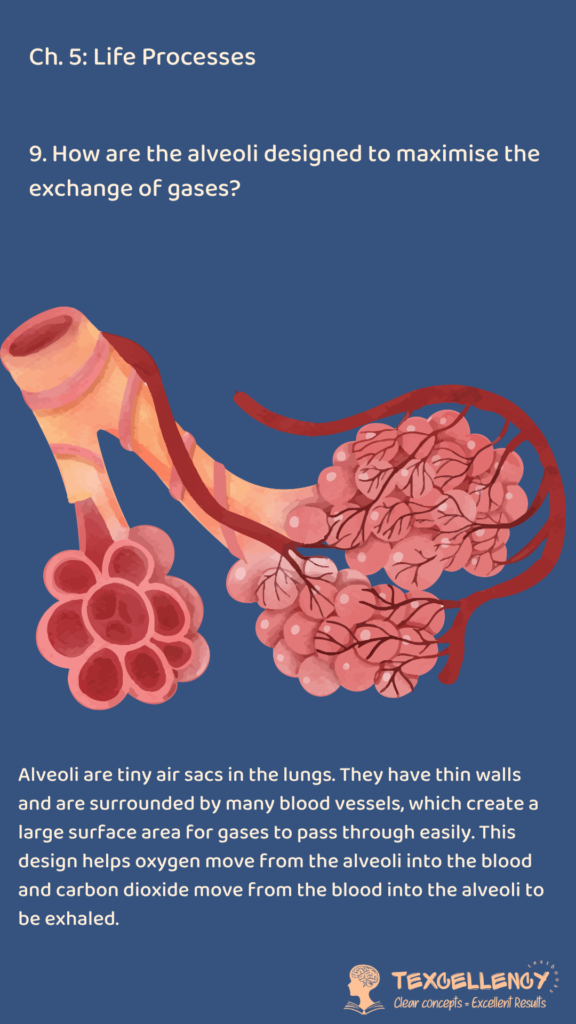
Alveoli maximise gas exchange through five key design features: enormous collective surface area (300-400 million alveoli giving 70-80 m² total), ultra-thin walls (just one cell thick — minimising diffusion distance), dense surrounding capillary network (ensuring constant intimate blood contact), moist inner surface (enabling instant gas dissolution), and constant blood flow (maintaining the concentration gradient that drives diffusion). Together these features make gas exchange extraordinarily fast, efficient, and continuous.
🤔 The Core Design Problem — What Are Alveoli Solving?
Before understanding the design — understand the engineering challenge.
Gas exchange in the lungs happens by diffusion — oxygen moves from the alveolus into the blood because it is at higher concentration in the alveolus than in the arriving deoxygenated blood. CO₂ moves in the opposite direction for the same reason. Simple principle. But here is the challenge:
Diffusion is only fast over very short distances. Across a large surface, or through thick walls, or in a low-concentration environment — diffusion becomes frustratingly slow. Too slow for a body that needs oxygen delivered to 37 trillion cells every second of its life.
So evolution faced this problem: how do you maximise the rate of gas exchange inside the limited space of a human chest?
The answer is the alveolus — one of the most elegant structural solutions in all of biology. Every single design feature of the alveolus exists to solve one or more aspects of this diffusion-speed problem. Let us go through each feature and understand exactly what problem it solves.
🏗️ Design Feature 1 — Enormous Number of Tiny Sacs (Maximum Surface Area)
This is the most important design feature — and the one that most surprises students when they hear the numbers.
Each lung is not one large hollow balloon. Instead — each lung contains approximately 150 to 200 million alveoli — giving both lungs together 300 to 400 million tiny air sacs. Each individual alveolus is only about 0.2 mm in diameter — smaller than a grain of salt.
But here is the mathematical magic of subdivision: individually tiny, collectively enormous. Those 300-400 million alveoli together create a total gas exchange surface area of approximately 70 to 80 square metres — roughly the size of one side of a singles tennis court — packed inside a chest cavity the size of a medium suitcase.
Why does large surface area matter for diffusion? The rate of diffusion is directly proportional to surface area. Double the surface area — double the rate of gas exchange. Having 70-80 m² instead of a single large balloon (which would give only about 0.01 m²) increases the gas exchange rate approximately 7,000 times. Without this subdivision — you would suffocate even while breathing perfectly normally.
🧽 The Kitchen Sponge Analogy — Understanding Surface Area Through Subdivision
Take a solid cube of material the size of your fist. Its outer surface area is perhaps 150 cm². Now imagine that same material formed into a kitchen sponge — riddled with millions of tiny holes and tunnels. The outer dimensions are the same. But the total surface area — the sum of all those tunnel walls — is thousands of times larger.
An alveolus is nature’s sponge. The lungs pack the maximum possible gas-exchange surface into the minimum possible chest volume — exactly like a sponge packs maximum surface area into a small block — by dividing everything into the smallest possible units and packing them together.
This is why someone with emphysema (where alveolar walls break down and multiple alveoli merge into one large sac) becomes progressively breathless — the subdivision is destroyed, surface area collapses, gas exchange plummets — exactly like crushing a sponge into a solid block.
🏗️ Design Feature 2 — Ultra-Thin Walls (Minimum Diffusion Distance)
Each alveolus has walls made of a single layer of flattened cells — called squamous epithelium (also called Type I pneumocytes). One cell. That is it.
The capillary wall surrounding the alveolus is also just one cell thick. And crucially — the alveolar wall and capillary wall are pressed tightly together — fused — with almost no space between them.
This means the total distance a gas molecule must travel from the air inside the alveolus to the haemoglobin inside an RBC in the capillary is less than 0.5 micrometres — 0.0005 mm. Half a thousandth of a millimetre.
Why does thin wall matter for diffusion? The rate of diffusion is inversely proportional to the thickness of the membrane. Thinner membrane = faster diffusion. At 0.5 micrometres — gas molecules cross from air to blood in milliseconds. If the wall were even 1 mm thick — gas exchange would slow to a tiny fraction of what is needed. The alveolar wall is essentially the thinnest biological barrier nature can engineer — a door left as wide open as possible.
🏗️ Design Feature 3 — Dense Capillary Network (Maximum Blood Contact)
Every single alveolus is completely wrapped in a mesh of pulmonary capillaries — so densely packed that the alveolus is essentially immersed in blood, with only the fused alveolar-capillary wall separating air from blood.
These capillaries are so narrow that red blood cells must pass through them single file — one RBC at a time, squeezed against the capillary wall. This forces each RBC into maximum proximity with the alveolar air — every RBC gets full exposure to the oxygen-rich air and has the maximum opportunity to load up with oxygen and offload CO₂.
Why does dense capillary wrapping matter? Without capillaries immediately adjacent to the alveolar wall — oxygen would have to diffuse through multiple layers of tissue before reaching the blood. Every extra micrometre of distance dramatically slows diffusion. By wrapping capillaries directly against the alveolar wall — nature has eliminated all unnecessary distance.
Additionally — the capillary network is so extensive that at any moment, the lungs contain approximately 70 to 100 ml of blood spread across all the capillaries — a thin film of blood in intimate contact with a huge surface area of alveolar air. This maximises the total amount of gas exchange happening simultaneously.
🏗️ Design Feature 4 — Moist Inner Surface (Enabling Gas Dissolution)
The inner lining of every alveolus is coated with a thin film of moisture — a watery liquid layer. Gases cannot diffuse directly through a dry cell membrane — they must first dissolve in liquid before they can cross into or out of the cell.
This moist lining ensures oxygen instantly dissolves as it enters the alveolus — making it immediately available for diffusion across the membrane. Without this moisture — gases would bounce off the dry cell surface rather than diffuse through it.
🔵 Surfactant — the moisture manager: The moist lining also contains a special substance called surfactant (Surface Active Agent) — produced by Type II pneumocytes in the alveolar wall. Surfactant reduces the surface tension of the liquid lining. Without it — the liquid surface tension would cause the tiny alveoli to collapse inward after each exhalation (like a wet plastic bag collapsing when deflated). Surfactant prevents this — keeping alveoli open and ready for the next breath.
This is why premature babies (born before sufficient surfactant is produced — usually before 28 weeks) suffer from Respiratory Distress Syndrome — their alveoli collapse after each breath and must be forced open again — exhausting the baby and causing severe oxygen shortage. Treatment: artificial surfactant is administered immediately after birth.
🏗️ Design Feature 5 — Constant Blood Flow (Maintaining Concentration Gradient)
Diffusion requires a concentration gradient — oxygen must always be at higher concentration in the alveolus than in the arriving blood, and CO₂ must always be at higher concentration in the arriving blood than in the alveolus.
If blood simply sat in the capillaries — it would quickly equilibrate with the alveolar air, the gradient would collapse, and diffusion would stop. Gas exchange would halt.
The constant flow of fresh deoxygenated blood (arriving from the right side of the heart via the pulmonary artery) through the capillaries ensures the gradient is always maintained. Fresh blood — low in oxygen and high in CO₂ — is always arriving. Oxygenated blood — now high in oxygen and low in CO₂ — is always leaving (via the pulmonary vein to the left heart). The gradient never collapses. Gas exchange never stops.
🏙️ The Dhaba Kitchen Analogy — All Five Features Together
Imagine a busy highway dhaba kitchen that must serve thousands of customers per hour.
🟢 Thousands of small cooking stations instead of one giant stove = millions of tiny alveoli instead of one large lung sac → more cooking surface = more food produced simultaneously = more gas exchanged simultaneously.
🟢 Paper-thin tawa walls instead of thick iron pots = one-cell-thick alveolar walls → heat transfers from flame to food almost instantly = gas diffuses from air to blood almost instantly.
🟢 Serving windows at every cooking station = dense capillary network at every alveolus → food reaches customers immediately without travelling far = oxygen reaches blood immediately without diffusing far.
🟢 Wet ingredients pre-soaked and ready = moist alveolar lining → ingredients dissolve and cook instantly = gases dissolve and diffuse instantly.
🟢 Fresh customers always arriving — empty plates always leaving = constant blood flow → the queue of hungry customers (deoxygenated blood) never runs out, gradient is maintained = gas exchange never stops.
Remove any one of these features — and the kitchen (gas exchange) slows dramatically.
📊 Alveolar Design Features — Master Quick Reference Table
| Design Feature | Specific Detail | What Problem It Solves |
|---|---|---|
| Enormous numbers | 300-400 million alveoli | Creates 70-80 m² total surface area |
| Tiny individual size | ~0.2 mm diameter each | Maximum packing density in chest space |
| Ultra-thin walls | One cell thick (squamous epithelium) | Minimises diffusion distance to 0.5 µm |
| Dense capillary network | Capillaries completely wrap each alveolus | Maximum blood-air contact area |
| Single-file RBC flow | RBCs pass one at a time through capillaries | Every RBC gets maximum alveolar exposure |
| Moist inner lining | Thin liquid film on alveolar surface | Enables instant gas dissolution |
| Surfactant | Reduces surface tension of liquid lining | Prevents alveolar collapse after exhalation |
| Constant blood flow | Fresh deoxygenated blood always arriving | Maintains concentration gradient always |
🩺 What Happens When Alveolar Design Fails
🔴 Emphysema — alveolar walls break down (most commonly due to smoking). Multiple small alveoli merge into fewer large sacs. Surface area collapses dramatically — from 70-80 m² to a fraction of that. Gas exchange plummets. Progressive, irreversible breathlessness at rest. No cure — only management. Every cigarette destroys thousands of alveoli permanently.
🔴 Pneumonia — alveoli fill with fluid and pus instead of air. The concentration gradient for gas exchange collapses — there is no fresh air in the alveolus. Gas exchange stops in affected areas. Fever, breathlessness, severe oxygen shortage. Treated with antibiotics (bacterial) or antivirals (viral).
🔴 Pulmonary Oedema — fluid accumulates in alveolar walls (often from heart failure). Increases diffusion distance. Gas exchange slows dramatically. Severe breathlessness. Medical emergency.
🔴 Respiratory Distress Syndrome (premature babies) — surfactant absent → alveoli collapse after each breath → baby exhausted trying to reinflate them → severe oxygen shortage. Treated with artificial surfactant and mechanical ventilation.
🎵 Rhyme to Remember
“Millions of alveoli — small as can be, Pack a tennis court surface — inside you and me! Walls just one cell thin — gases rush right through, Capillaries wrapped tight — always something new, Moist lining dissolves gases — ready to go, Surfactant prevents collapse — with every ebb and flow, Fresh blood always coming — gradient held in place, Five designs together — gas exchange wins the race!”
🔤 Alliterations
“Alveoli are Amazing — millions Assembled to Amplify gas exchange Area” “Thin walls = Tiny distance = Tremendously fast gas Transfer” “Capillaries Closely Cradle each alveolus — Constant Contact with blood” “Surfactant Stops alveoli from Sticking Shut after each breath” “Fresh blood Flow Forever maintains the gradient — gas exchange never Freezes“
🧩 Mnemonic — Remember All Five Design Features
S — T — C — M — F → “Successful Tennis Courts Make Fortunes”
Surface area (enormous — 70-80 m²) • Thin walls (one cell thick) • Capillary network (dense, surrounding) • Moist lining + surfactant • Flow of blood (constant — maintains gradient)
The mnemonic itself echoes the tennis court size comparison — the single most memorable fact about alveoli — so the memory hook reinforces the key number simultaneously.
✅ Exam-Ready Answer (3 marks)
Alveoli are designed to maximise gas exchange in the following ways:
1. Large surface area — The lungs contain 300 to 400 million alveoli, providing a total gas exchange surface area of about 70-80 square metres — allowing enormous amounts of gas to be exchanged simultaneously.
2. Thin walls — The walls of alveoli are just one cell thick (squamous epithelium), minimising the distance gases must diffuse — enabling extremely rapid exchange between air and blood.
3. Rich capillary network — Each alveolus is surrounded by a dense network of blood capillaries. Red blood cells pass through these capillaries in single file, ensuring maximum contact between blood and alveolar air.
4. Moist inner surface — The moist lining of alveoli allows gases to dissolve quickly, facilitating rapid diffusion. Surfactant in this lining prevents alveolar collapse after exhalation.
5. Constant blood supply — Fresh deoxygenated blood continuously arrives at the alveolar capillaries, maintaining the concentration gradient that drives diffusion of O₂ into blood and CO₂ out of blood.
📌 Key Points Checklist
✅ 300-400 million alveoli in both lungs → 70-80 m² total surface area ✅ Individual alveolus ~0.2 mm diameter — tiny but packed in millions ✅ Alveolar walls = one cell thick (squamous epithelium / Type I pneumocytes) ✅ Total diffusion distance (air to haemoglobin) = less than 0.5 micrometres ✅ Dense capillary network completely wraps each alveolus ✅ RBCs pass single file through capillaries — maximum alveolar exposure ✅ Moist inner lining enables gas dissolution before diffusion ✅ Surfactant (from Type II pneumocytes) reduces surface tension — prevents alveolar collapse ✅ Constant blood flow maintains concentration gradient — gas exchange never stops ✅ Emphysema destroys alveolar walls → surface area collapses → permanent breathlessness ✅ Pneumonia fills alveoli with fluid → gradient collapses → gas exchange stops ✅ Premature babies lack surfactant → Respiratory Distress Syndrome
📚 Want ALL of Class 10 Science Explained This Way?
Every chapter. Every concept. Every NCERT question — explained with analogies, rhymes, mnemonics, and real-life examples that make sense and stay in memory long after exam day.
👉 Explore the Full Texcellency Collection 👉 Download Your FREE Book Now