What Would Be the Consequences of a Deficiency of Haemoglobin in Our Bodies? — NCERT Class 10 Science
NCERT Class 10 Science | Chapter Life Processes | Texcellency Book Series
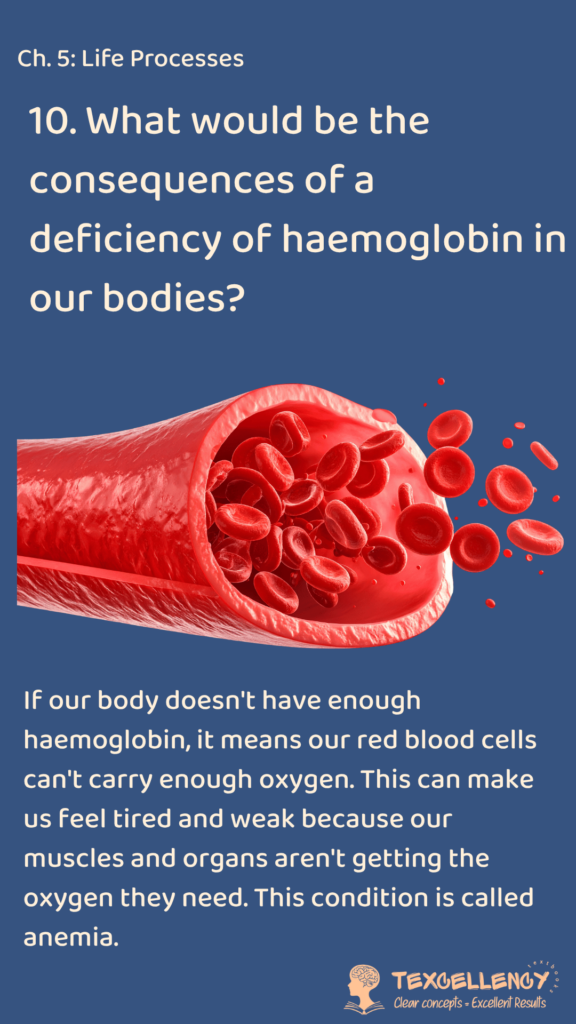
A deficiency of haemoglobin in the body leads to a condition called Anaemia — where the blood cannot carry sufficient oxygen to body cells. The consequences include persistent fatigue and weakness, breathlessness even on mild exertion, pale skin and pale inner eyelids, dizziness and headaches, poor concentration, reduced immunity, and in severe cases — organ damage and heart failure. Since haemoglobin carries oxygen and oxygen powers every single cell — a haemoglobin shortage is effectively an oxygen shortage for the entire body.
🏭 The Big Picture — Why Haemoglobin is So Central to Life
Every cell in your body — from neurons in your brain to muscle fibres in your legs — runs on one fuel: ATP (energy) produced through cellular respiration. And cellular respiration requires one essential ingredient that the cell cannot store for more than a few seconds: oxygen.
Now oxygen reaches your cells only one way — dissolved in blood, carried by haemoglobin inside red blood cells. There is no backup system. There is no alternate oxygen delivery mechanism. Haemoglobin is the body’s only oxygen taxi — and it handles 98.5% of all oxygen transported in the blood.
Reduce the number of taxis — and millions of passengers (cells) are stranded without oxygen. This is anaemia. And its consequences ripple through every organ system in the body simultaneously.
Understanding haemoglobin deficiency is not just exam preparation — approximately 50-60% of Indian women and children are anaemic according to National Health Survey data. This is one of the most common nutritional disorders in India. You almost certainly know someone who has it.
🔬 What Exactly is Haemoglobin — A Quick Recap
Haemoglobin is an iron-containing protein found inside red blood cells (RBCs). Each haemoglobin molecule contains four iron atoms — each capable of binding one oxygen molecule — so each haemoglobin can carry four oxygen molecules simultaneously.
Normal haemoglobin levels: 🔵 Adult men — 13.5 to 17.5 grams per 100 ml of blood 🔵 Adult women — 12 to 15.5 grams per 100 ml of blood 🔵 Children — 11 to 16 grams per 100 ml of blood
When levels fall below the lower limit — anaemia is diagnosed. The lower the haemoglobin — the more severe the anaemia — and the more catastrophic the consequences.
🚌 The Taxi Strike Analogy — Understanding the Consequences of Haemoglobin Deficiency
Imagine Mumbai during a complete taxi and auto strike. The city’s roads are the same. Passengers (oxygen) are available at the airport (lungs) in abundance. Destinations (body cells) are waiting. But there are no taxis (haemoglobin) to do the delivery.
🔴 Some destinations close early — they cannot function without supplies (cells stop producing energy efficiently). 🔴 People at distant destinations suffer first — the farthest cells from the lungs are most oxygen-deprived. 🔴 Critical services struggle — the brain and heart, which need the most oxygen, suffer the most. 🔴 Everyone moves slower — the whole city functions at a fraction of its normal pace. 🔴 If the strike continues long enough — permanent damage begins.
This is exactly what happens in your body when haemoglobin is deficient. Oxygen is available in the lungs — but cannot be delivered efficiently to the cells that need it.
⚠️ The Consequences — Every Major Effect Explained
🔴 Consequence 1 — Persistent Fatigue and Weakness (Most Common Symptom)
Every voluntary movement — walking, climbing stairs, lifting, even sitting upright — requires muscles to contract. Muscle contraction requires ATP. ATP production requires oxygen. Less haemoglobin = less oxygen delivered to muscles = muscles produce less ATP = muscles feel exhausted even without much work.
This is the persistent, bone-deep tiredness of anaemia — not the normal tiredness after exercise, but tiredness that is there when you wake up in the morning, that does not go away with rest, that makes even small tasks feel enormous. An anaemic student struggles to concentrate in class not from laziness — but because their brain cells are running on insufficient oxygen.
🔴 Consequence 2 — Breathlessness on Mild Exertion
When haemoglobin is low — the body detects insufficient oxygen in the blood — and compensates by breathing faster and deeper to push more oxygen through the limited haemoglobin available. This works partially at rest — but the moment any physical effort is made — climbing one flight of stairs, walking fast, carrying a bag — the oxygen demand spikes and the compensation fails. The person becomes breathless at activity levels that would not affect a healthy person at all.
This breathlessness is the body’s emergency alarm — “we are not getting enough oxygen — breathe harder.”
🔴 Consequence 3 — Pale Skin, Pale Gums, and Pale Inner Eyelids
Oxyhaemoglobin (haemoglobin carrying oxygen) is bright red — it is what gives healthy blood and skin a warm, pink undertone. When haemoglobin is deficient — less oxyhaemoglobin circulates — and the skin, gums, inner eyelids (conjunctiva), and nail beds lose their pink colour, becoming pale or even whitish.
Doctors check the inner eyelid (pull down the lower eyelid and look at the red lining) as one of the quickest visible signs of anaemia. In healthy people it is deep pink-red. In anaemic people it is pale pink or white.
🔴 Consequence 4 — Dizziness, Headaches, and Poor Concentration
The brain is the most oxygen-hungry organ in the body — consuming approximately 20% of all oxygen the body uses despite being only 2% of body weight. When haemoglobin is low — the brain is among the first organs to register oxygen shortage — causing:
🔵 Dizziness — particularly when standing up quickly (orthostatic hypotension + reduced oxygen to brain) 🔵 Headaches — blood vessels in the brain dilate trying to deliver more blood (and therefore more oxygen) — causing pressure and pain 🔵 Poor concentration and brain fog — neurons running on reduced oxygen fire less efficiently — thinking slows down, memory suffers, studying becomes difficult 🔵 Fainting — in severe cases, sudden drops in brain oxygen trigger loss of consciousness
🔴 Consequence 5 — Rapid or Irregular Heartbeat (Palpitations)
The heart compensates for low haemoglobin by beating faster — trying to circulate blood more quickly so that whatever haemoglobin exists completes more delivery cycles per minute. More trips per taxi = more passengers delivered despite fewer taxis.
This compensation works in the short term — but at a cost. The heart works significantly harder — leading to palpitations (awareness of rapid or irregular heartbeat), and over time — cardiac hypertrophy (the heart muscle enlarging from overwork) and eventually heart failure in severe, long-term, untreated anaemia.
🔴 Consequence 6 — Reduced Immunity and Slower Healing
The immune system — white blood cells, antibody production, tissue repair — all require energy, and therefore oxygen. Low haemoglobin = low oxygen delivery = reduced immune cell activity = the person falls sick more often, takes longer to recover from infections, and wounds heal more slowly.
This is particularly dangerous in children — frequent infections during the critical developmental years can cause lasting harm to growth and cognitive development.
🔴 Consequence 7 — Impaired Growth and Development in Children
In growing children — cells are dividing rapidly, new tissues are being built, the brain is developing. All of this requires enormous amounts of oxygen. Anaemia in children directly impairs:
🔵 Physical growth — children remain shorter and lighter than their genetic potential 🔵 Brain development — cognitive abilities, learning capacity, memory, and attention are all reduced 🔵 School performance — anaemic children consistently underperform academically — not from lack of ability but from lack of oxygen to the brain
This is the tragic hidden consequence of childhood anaemia — and why the Indian government’s school mid-day meal programme specifically includes iron-rich foods.
🔴 Consequence 8 — Cold Hands and Feet
The body prioritises oxygen delivery to vital organs (brain, heart, lungs) when haemoglobin is low — reducing blood flow to the extremities (hands, feet). Result: persistently cold hands and feet even in warm weather — a classic sign of anaemia.
🏗️ Why Does Haemoglobin Become Deficient — Causes (Important for Full Marks)
Understanding consequences without understanding causes is an incomplete answer. The three main causes:
🔵 Iron deficiency (most common) — haemoglobin requires iron for its structure. Insufficient dietary iron (common in vegetarian diets without adequate green leafy vegetables, in pregnant women, in growing children) = insufficient haemoglobin production. Called Iron Deficiency Anaemia — the most common form worldwide and extremely prevalent in India.
🔵 Vitamin B12 and Folic Acid deficiency — these vitamins are essential for RBC production in bone marrow. Without them — fewer RBCs are produced — and those produced are abnormally large and dysfunctional (Megaloblastic Anaemia).
🔵 Destruction of RBCs — in conditions like Sickle Cell Anaemia (genetic — RBCs are sickle-shaped and fragile, break down rapidly) or Malaria (the malaria parasite specifically destroys RBCs) — RBCs are destroyed faster than they can be replaced — haemoglobin levels crash.
🔵 Blood loss — accidents, surgery, heavy menstrual bleeding, internal bleeding — direct loss of RBCs means direct loss of haemoglobin.
📊 Consequences of Haemoglobin Deficiency — Quick Reference Table
| Body System Affected | Consequence | Why It Happens |
|---|---|---|
| Muscles | Fatigue and weakness | Insufficient O₂ for ATP production |
| Respiratory system | Breathlessness on exertion | Compensatory faster breathing |
| Skin / visible signs | Pallor (pale skin, gums, eyelids) | Less oxyhaemoglobin = less colour |
| Brain | Dizziness, headaches, poor concentration | Brain most sensitive to O₂ shortage |
| Heart | Rapid heartbeat, palpitations | Compensating by circulating blood faster |
| Immune system | Frequent illness, slow healing | Low energy for immune cell function |
| Children — growth | Stunted physical and cognitive growth | O₂ shortage during critical development |
| Extremities | Cold hands and feet | Blood diverted away from extremities |
🎵 Rhyme to Remember
“Haemoglobin carries oxygen — the taxi of the blood, Without enough of it — the body falls with a thud! Tired and weak — no energy to spare, Breathless on the stairs — gasping for air, Pale skin and pale gums — the colour has gone, Dizzy and headachy — all day long, Heart beats faster — trying to cope, Eat your iron and spinach — that is the hope! Anaemia is the name — when haemoglobin is less, Oxygen-starved body — in permanent distress!”
🔤 Alliterations
“Haemoglobin’s job: Hauling oxygen to every Hungry cell in the body” “Anaemia = Always tired, Always pale, Always breathless, Always cold” “Iron Insufficiency = Insufficient haemoglobin = Insufficient oxygen = Impaired function” “Fatigue, Faintness, and Frequent illness — the Famous three F’s of anaemia“
🧩 Mnemonic — Remember All Consequences of Haemoglobin Deficiency
F — B — P — D — H — I — G — C → “Fatigued Bodies Pale, Dizzy, Hearts racing, Immunity Gone, Cold”
Fatigue and weakness • Breathlessness • Pallor (pale skin) • Dizziness and headaches • Heart palpitations • Impaired immunity • Growth impairment in children • Cold hands and feet
Or the simpler two-word memory hook: “OXYGEN SHORTAGE” — every single consequence of haemoglobin deficiency is simply a consequence of oxygen shortage in a different organ or system. Master this one idea and you can generate every consequence yourself.
✅ Exam-Ready Answer (3 marks)
Haemoglobin is the iron-containing protein in red blood cells that carries oxygen from the lungs to all body cells. A deficiency of haemoglobin causes a condition called Anaemia. The consequences are:
1. Reduced oxygen supply to cells — less haemoglobin means less oxygen is transported to body cells, reducing their ability to produce energy (ATP) through cellular respiration.
2. Fatigue and weakness — muscles and organs receive insufficient oxygen, making the person feel persistently tired and weak even without physical exertion.
3. Breathlessness — the body compensates by breathing faster, causing breathlessness especially during mild physical activity.
4. Pale skin and pale mucous membranes — reduced oxyhaemoglobin causes loss of the normal pink colour of skin, gums, and inner eyelids.
5. Dizziness and headaches — the brain, being highly sensitive to oxygen levels, experiences poor function — causing dizziness, headaches, and difficulty concentrating.
6. Rapid heartbeat — the heart beats faster to compensate, which if prolonged can lead to heart problems.
In severe cases, anaemia can cause organ damage and heart failure. It is most commonly caused by iron deficiency, since iron is essential for haemoglobin production.
📌 Key Points Checklist
✅ Haemoglobin deficiency = Anaemia ✅ Normal haemoglobin: men 13.5-17.5 g/100ml • women 12-15.5 g/100ml ✅ Haemoglobin carries 98.5% of all oxygen transported in blood ✅ Consequence 1 = fatigue and weakness — muscles starved of O₂ ✅ Consequence 2 = breathlessness — compensatory faster breathing ✅ Consequence 3 = pallor — pale skin, gums, inner eyelids ✅ Consequence 4 = dizziness, headaches, brain fog — brain most O₂-sensitive organ ✅ Consequence 5 = rapid heartbeat — heart overworks to compensate ✅ Consequence 6 = reduced immunity and slow healing ✅ Consequence 7 = impaired growth and cognitive development in children ✅ Consequence 8 = cold hands and feet — blood diverted to vital organs ✅ Main causes: iron deficiency (most common) • B12/folic acid deficiency • RBC destruction (sickle cell, malaria) • blood loss ✅ 50-60% of Indian women and children are anaemic — most common nutritional disorder in India ✅ All consequences trace back to one root cause: insufficient oxygen delivery to cells
📚 Want ALL of Class 10 Science Explained This Way?
Every chapter. Every concept. Every NCERT question — explained with analogies, rhymes, mnemonics, and real-life examples that make sense and stay in memory long after exam day.
👉 Explore the Full Texcellency Collection 👉 Download Your FREE Book Now
“A good textbook is like a smart GPS — it doesn’t just give you the destination, it tells you every turn along the way, in simple language you actually understand.”