
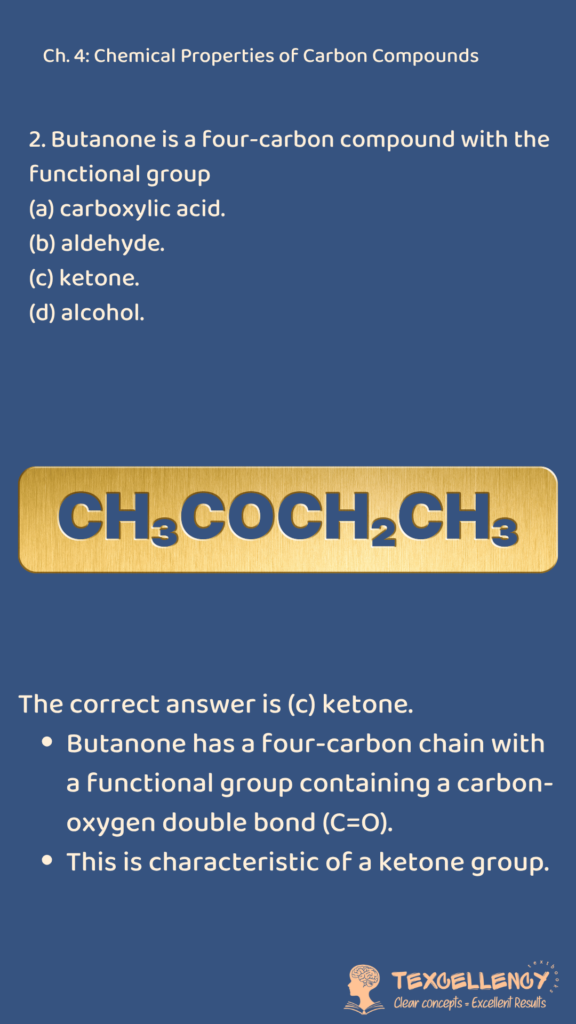
Q. Butanone is a four-carbon compound with the functional group (a) carboxylic acid. (b) aldehyde. (c) ketone. (d) alcohol.
NCERT Class 10 Science | Chapter: Carbon and Its Compounds | Texcellency Book Series
✅ Correct Answer: (c) Ketone
Butanone is a four-carbon compound with the ketone functional group (C=O, carbonyl group, bonded to two carbon atoms on both sides).
🔵 Name decoded: “But” = 4 carbons (from butane) + “an” + “one” = ketone suffix → Butanone = a 4-carbon ketone 🔵 Formula: CH₃–CO–CH₂–CH₃ (also written C₄H₈O) 🔵 Common name: Methyl Ethyl Ketone (MEK) 🔵 The C=O group sits between carbon 2 and the rest of the chain — flanked by carbon atoms on both sides — which is the defining structural feature of a ketone
The name itself tells you the answer. Once you know the IUPAC naming suffixes for each functional group, you can crack any question of this type instantly — no memorisation of individual compounds needed.
🏭 The Name Tag Analogy — IUPAC Names Are Like ID Cards
In the IUPAC naming system, every organic compound carries a name tag that tells you exactly what family it belongs to. The suffix (the ending of the name) is the most important part of that name tag — it is a code that directly tells you the functional group.
Think of it like this: 🔵 A person whose name ends in “–sharma” likely belongs to a specific community 🔵 A compound whose name ends in “–one” belongs to the ketone family 🔵 A compound whose name ends in “–ol” belongs to the alcohol family 🔵 A compound whose name ends in “–al” belongs to the aldehyde family 🔵 A compound whose name ends in “–oic acid” belongs to the carboxylic acid family
The prefix (meth, eth, prop, but, pent…) tells you the carbon count. The suffix tells you the functional group. Put them together and you know exactly what the compound is — its structure, its family, and its chemical behaviour.
Butanone decoded: But (4 carbons) + an + one (ketone) = a 4-carbon ketone. Answer confirmed in the name itself.
🔴 The IUPAC Suffix Master Table — The Key That Unlocks All MCQs
Learning these suffixes lets you identify ANY compound’s functional group from its name alone:
🔵 –ane → Alkane (no functional group, saturated) → example: methane, ethane, propane, butane 🔵 –ene → Alkene (C=C double bond) → example: ethene, propene, butene 🔵 –yne → Alkyne (C≡C triple bond) → example: ethyne, propyne, butyne 🔵 –ol → Alcohol (–OH group) → example: methanol, ethanol, propanol, butanol 🔵 –al → Aldehyde (–CHO group) → example: methanal, ethanal, propanal, butanal 🔵 –one → Ketone (C=O group flanked by two carbons) → example: propanone, butanone, pentanone 🔵 –oic acid → Carboxylic acid (–COOH group) → example: methanoic acid, ethanoic acid, propanoic acid, butanoic acid
The carbon count prefixes: meth = 1C, eth = 2C, prop = 3C, but = 4C, pent = 5C, hex = 6C
So for any “but–” compound: but = 4 carbons. The suffix tells you the rest.
🔶 Why Each Option is Right or Wrong
Option (a) — Carboxylic Acid — ❌ WRONG
🔵 Carboxylic acid functional group = –COOH (carboxyl group — a C=O and an –OH on the SAME carbon) 🔵 IUPAC suffix for carboxylic acid = “–oic acid” 🔵 A 4-carbon carboxylic acid would be named butanoic acid — NOT butanone 🔵 Butanoic acid formula: CH₃–CH₂–CH₂–COOH 🔵 Real-life example: butanoic acid is also called butyric acid — it is responsible for the smell of rancid butter and vomit 🔵 Since the question compound is named “butanone” (ends in “–one”, not “–oic acid”), it cannot be a carboxylic acid ❌
Option (b) — Aldehyde — ❌ WRONG
🔵 Aldehyde functional group = –CHO (carbonyl carbon with at least one hydrogen directly attached, always at the END of the carbon chain) 🔵 IUPAC suffix for aldehyde = “–al” 🔵 A 4-carbon aldehyde would be named butanal — NOT butanone 🔵 Butanal formula: CH₃–CH₂–CH₂–CHO 🔵 Real-life example: ethanal (acetaldehyde, CH₃CHO) is used in manufacturing acetic acid and as a flavouring agent. Methanal (formaldehyde, HCHO) is used as a preservative (formalin). 🔵 Since the question compound is “butanone” (ends in “–one”, not “–al”), it cannot be an aldehyde ❌ 🔵 Critical distinction from ketone: both ketone and aldehyde have a C=O group — the difference is POSITION. Ketone: C=O is BETWEEN two carbons (middle of chain). Aldehyde: C=O has at least one H directly on it (–CHO, end of chain).
Option (c) — Ketone — ✅ CORRECT
🔵 Ketone functional group = C=O (carbonyl group) bonded to TWO carbon atoms on both sides (not hydrogen) 🔵 IUPAC suffix for ketone = “–one” 🔵 Butanone = 4-carbon ketone → the C=O group sits between C2 and C3 in the 4-carbon chain 🔵 Structure: CH₃–CO–CH₂–CH₃ (the bold CO is the ketone functional group) 🔵 Common name: Methyl Ethyl Ketone (MEK) — because it has a methyl group (CH₃–) on one side and an ethyl group (–CH₂–CH₃) on the other side of the C=O 🔵 The name “butanone” directly encodes the answer: but (4C) + one (ketone) = 4-carbon ketone ✅
Option (d) — Alcohol — ❌ WRONG
🔵 Alcohol functional group = –OH (hydroxyl group) 🔵 IUPAC suffix for alcohol = “–ol” 🔵 A 4-carbon alcohol would be named butanol — NOT butanone 🔵 Butanol formula: CH₃–CH₂–CH₂–CH₂–OH (or other isomers) 🔵 Real-life example: butanol is used as an industrial solvent in paints, coatings, and cosmetics 🔵 Since the question compound is “butanone” (ends in “–one”, not “–ol”), it cannot be an alcohol ❌
🔷 Understanding Butanone’s Structure — Step by Step
Step 1 — Identify the carbon count: “But” = 4 carbons. Draw a 4-carbon chain: C–C–C–C
Step 2 — Identify the functional group: “one” suffix = ketone = C=O flanked by carbons on both sides. This C=O must be on carbon 2 (not carbon 1 or 4 — those are the chain ends, and placing C=O at a chain end with a carbon only on one side would make it an aldehyde, not a ketone).
Step 3 — Build the structure: CH₃ – C(=O) – CH₂ – CH₃ Carbon 1 (CH₃) — Carbon 2 (C=O, the ketone group) — Carbon 3 (CH₂) — Carbon 4 (CH₃)
Step 4 — Verify: The C=O is bonded to C1 (as CH₃–) on the left and C3–C4 (as –CH₂–CH₃, the ethyl group) on the right. Both sides are carbon — confirms it is a ketone, not an aldehyde.
Molecular formula verification: C₄H₈O 🔵 4 carbons ✅ (but = 4C) 🔵 8 hydrogens ✅ (follows ketone general formula CₙH₂ₙO) 🔵 1 oxygen ✅ (one C=O group)
🔴 The Ketone vs Aldehyde Confusion — The Most Important Distinction
This is the most commonly confused pair in Class 10 organic chemistry. Both have a C=O (carbonyl) group. The difference is deceptively simple but absolutely crucial:
🔵 Ketone: C=O is sandwiched between two carbon atoms → R–C=O–R’ (both sides of C=O are carbon chains) → The carbonyl carbon has NO hydrogen attached to it directly → Minimum 3 carbons needed (propanone is the smallest ketone: CH₃–CO–CH₃) → Examples: propanone (acetone, 3C), butanone (MEK, 4C), pentanone (5C)
🔵 Aldehyde: C=O has at least one hydrogen directly attached (–CHO) → R–CHO (one side of C=O is a carbon chain, the other side is H) → The carbonyl carbon HAS one hydrogen attached to it directly → The –CHO group is always at the END of the carbon chain → Can have just 1 carbon: methanal (HCHO) — the simplest aldehyde → Examples: methanal (formaldehyde, 1C), ethanal (acetaldehyde, 2C), propanal (3C), butanal (4C)
The test question to ask yourself: Does the C=O carbon have a hydrogen directly attached to it? 🔵 YES → Aldehyde (–CHO, at chain end) 🔵 NO → Ketone (C=O between two carbons, in chain middle)
🔶 Real-Life Examples of All Four Functional Groups in the Options
Ketone — Butanone (MEK) and Propanone (Acetone): 🔵 Propanone (acetone, CH₃COCH₃) — the liquid in nail polish remover. The distinctive sharp smell when you open a nail polish remover bottle is acetone (propanone). Also used to clean paint brushes and as a lab solvent. 🔵 Butanone (MEK, CH₃COCH₂CH₃) — used in manufacturing of paints, varnishes, adhesives, and as a solvent in the plastics industry. You have likely smelled it near paint shops. 🔵 Your body makes ketones too — during fasting or a low-carbohydrate diet, your liver produces ketone bodies (acetoacetate, beta-hydroxybutyrate) as an energy source when glucose is unavailable. The “keto diet” is named after this process.
Aldehyde — Methanal (Formaldehyde) and Ethanal (Acetaldehyde): 🔵 Methanal (formaldehyde, HCHO) — used as a preservative for biological specimens in labs (formalin = 37–40% formaldehyde in water). The liquid that preserved specimens in your biology lab contains methanal. 🔵 Ethanal (acetaldehyde, CH₃CHO) — produced in the body when alcohol (ethanol) is metabolised. The headache and nausea of a hangover are partly caused by ethanal buildup in the blood. 🔵 Vanillin — the flavour compound in vanilla — is an aldehyde (4-hydroxy-3-methoxybenzaldehyde). The smell of vanilla is the smell of an aldehyde.
Alcohol — Ethanol and Methanol: 🔵 Ethanol (C₂H₅OH) — wine, beer, sanitisers, biofuel. The alcohol in beverages. Used throughout this chapter. 🔵 Methanol (CH₃OH) — toxic, used as industrial solvent. Fatal if consumed. See the safety warning in our Homologous Series post.
Carboxylic Acid — Ethanoic Acid and Methanoic Acid: 🔵 Ethanoic acid (CH₃COOH) — vinegar. The most important carboxylic acid in Class 10. 🔵 Methanoic acid (HCOOH) — ant sting acid. The burning pain when an ant bites you is methanoic acid injection. 🔵 Butanoic acid (CH₃CH₂CH₂COOH) — the smell of rancid butter and vomit. Unpleasant but memorable.
📊 All Four Options — Complete Functional Group Summary
Carboxylic Acid: Functional group = –COOH | IUPAC suffix = –oic acid | 4-carbon example = butanoic acid (CH₃CH₂CH₂COOH) | Real life = vinegar (ethanoic acid), ant sting (methanoic acid)
Aldehyde: Functional group = –CHO | IUPAC suffix = –al | 4-carbon example = butanal (CH₃CH₂CH₂CHO) | Real life = formalin/preservative (methanal), vanilla flavour (vanillin)
Ketone: Functional group = C=O between two C | IUPAC suffix = –one | 4-carbon example = butanone (CH₃COCH₂CH₃) ✅ | Real life = nail polish remover (propanone/acetone), paint solvent (butanone/MEK)
Alcohol: Functional group = –OH | IUPAC suffix = –ol | 4-carbon example = butanol (CH₃CH₂CH₂CH₂OH) | Real life = wine/sanitiser (ethanol)
🎵 Rhyme to Remember
“–ol is alcohol with OH in hand, –al is aldehyde — CHO at the end!* –one is the ketone with C=O inside,* Flanked by two carbons — in the middle it hides!* –oic acid is the carboxylic one, with COOH,* Now read the name BUTANONE — what does it say?* But = four carbons, ONE = ketone today!* Ketone is the answer — (c) wins the day!”*
🧩 Mnemonics
🔵 “OLD CAR” — the four functional group suffixes in one phrase: –OL (alcohol), –AL (aldehyde), –C=O middle (ketone/–ONE), –OIC ACID (carboxylic acid) → OLD CAR 🔵 “KETONE = C=O KEpt in the middlE, flanked by carbONEs on both sides” — the C=O is kept in the middle — never at the end. 🔵 “ALDEHYDE ends in –CHO = Chain Has an O at the End” — the –CHO group is always at the chain end. 🔵 “BUT + ONE = BUTANONE = 4-carbon ketone — decode the name, get the answer” — IUPAC names are self-decoding. 🔵 “Acetone (nail polish remover) = propanone = 3-carbon ketone. MEK (paint solvent) = butanone = 4-carbon ketone.” — real-life anchors for ketone examples. 🔵 “Minimum carbon count: Alcohol = 1C (methanol). Aldehyde = 1C (methanal). Carboxylic acid = 1C (methanoic). Ketone = 3C (propanone) — needs a carbon on EACH side of C=O.”
✅ Exam-Ready Answer (Write This in Board Exam)
Butanone is a four-carbon compound with the functional group:
Answer: (c) Ketone
Explanation:
The name “butanone” is decoded as: “but” = 4 carbons (from butane) + “one” = ketone (the IUPAC suffix for ketones).
The ketone functional group is C=O (carbonyl group) bonded to two carbon atoms on both sides — it sits between two carbon chains, not at the end.
Structure of butanone: CH₃–CO–CH₂–CH₃ (molecular formula C₄H₈O)
The C=O group is on carbon 2, flanked by a methyl group (CH₃–) on one side and an ethyl group (–CH₂–CH₃) on the other — confirming the ketone structure.
Why other options are wrong: 🔵 (a) Carboxylic acid has –COOH group, IUPAC suffix “–oic acid” — a 4-carbon carboxylic acid is butanoic acid, not butanone 🔵 (b) Aldehyde has –CHO group at chain end, IUPAC suffix “–al” — a 4-carbon aldehyde is butanal, not butanone 🔵 (d) Alcohol has –OH group, IUPAC suffix “–ol” — a 4-carbon alcohol is butanol, not butanone
The IUPAC suffix “–one” always and exclusively indicates a ketone functional group.
📌 Key Points Checklist
✅ Correct answer = (c) Ketone ✅ Butanone = 4-carbon ketone = CH₃–CO–CH₂–CH₃ = C₄H₈O ✅ Ketone functional group = C=O bonded to two carbon atoms on BOTH sides (middle of chain) ✅ IUPAC suffixes: –ol = alcohol | –al = aldehyde | –one = ketone | –oic acid = carboxylic acid ✅ Carbon prefixes: meth=1 | eth=2 | prop=3 | but=4 | pent=5 | hex=6 ✅ Ketone vs aldehyde: BOTH have C=O — but ketone = C=O between two C atoms | aldehyde = C=O with H directly attached (–CHO, at chain end) ✅ Minimum carbon for ketone = 3 (propanone, CH₃COCH₃) — needs carbon on both sides of C=O ✅ Butanone common name = Methyl Ethyl Ketone (MEK) — used in paints, varnishes, adhesives ✅ Propanone (acetone, 3C) = nail polish remover — most familiar ketone in daily life ✅ 4-carbon examples of all groups: butanone (ketone) | butanal (aldehyde) | butanol (alcohol) | butanoic acid (carboxylic acid)
📚 Want ALL of Class 10 Science Explained This Way? Every chapter. Every concept. Every NCERT question — with analogies, rhymes, mnemonics, and real-life examples.