
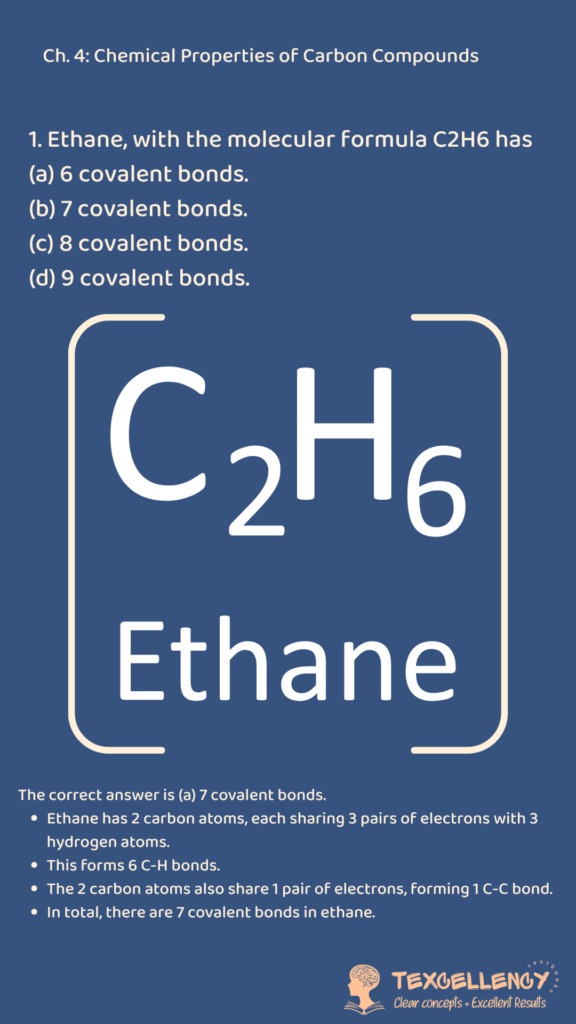
Ethane, with the molecular formula C2H6 has (a) 6 covalent bonds (b) 7 covalent bonds (c) 8 covalent bonds (d) 9 covalent bonds
NCERT Class 10 Science | Chapter: Carbon and Its Compounds | Texcellency Book Series
✅ Correct Answer: (b) 7 Covalent Bonds
Ethane (C₂H₆) has 7 covalent bonds in total: 🔵 6 C–H bonds (each carbon is bonded to 3 hydrogen atoms — 2 carbons × 3 hydrogens = 6 C–H bonds) 🔵 1 C–C bond (the two carbon atoms are bonded to each other by one covalent bond) 🔵 Total: 6 + 1 = 7 covalent bonds ✅
This is a counting question — but the way to get it right every single time is to understand the method, not just memorise the number for ethane. Let us build that understanding completely.
🏭 The Handshake Analogy — What a Covalent Bond Really Is
A covalent bond is formed when two atoms SHARE a pair of electrons — one electron from each atom — to complete their outer shells.
Think of it as a handshake. Two people (two atoms) each extend one hand (one electron). Their hands meet and clasp (the shared pair). That clasped handshake = ONE covalent bond. It belongs to both people simultaneously — neither one owns it alone.
🔵 In ethane: every C–H bond is a handshake between one carbon arm and one hydrogen arm 🔵 The C–C bond is a handshake between the two carbon atoms themselves 🔵 Count the total number of handshakes in the molecule = count the total covalent bonds
The question “how many covalent bonds?” simply asks: how many handshakes are happening simultaneously inside this molecule?
🔴 Understanding Carbon and Hydrogen — Valency First
Before counting bonds, you must know the valency of each atom involved:
Carbon (C): 🔵 Atomic number = 6 🔵 Electronic configuration = 2, 4 🔵 Valence electrons = 4 (in the outermost shell) 🔵 Electrons needed to complete octet = 4 more 🔵 Therefore carbon forms 4 covalent bonds — always, in every organic compound 🔵 Carbon’s tetravalency (4 bonds) is the foundation of all organic chemistry
Hydrogen (H): 🔵 Atomic number = 1 🔵 Electronic configuration = 1 🔵 Valence electrons = 1 🔵 Electrons needed to complete duplet (2 electrons in first shell) = 1 more 🔵 Therefore hydrogen forms 1 covalent bond — always, in every compound
The rule to remember: Every C in any organic molecule must have exactly 4 bonds coming out of it (no more, no less — unless it is an ion, which we do not deal with in Class 10). Every H has exactly 1 bond.
🔶 Counting Bonds in Ethane — The Step-by-Step Method
Step 1 — Draw the structure of ethane:
Ethane formula = C₂H₆ = 2 carbons, 6 hydrogens
Structure: H₃C–CH₃
Written in full electron dot / bond-line notation:
H   H
|   |
H–C–C–H
|   |
H   H
Step 2 — Count bonds on Carbon 1 (left carbon): 🔵 C1–H bond 1 (top hydrogen) 🔵 C1–H bond 2 (left hydrogen) 🔵 C1–H bond 3 (bottom hydrogen) 🔵 C1–C2 bond (to the other carbon) 🔵 Total bonds on C1 = 4 ✅ (carbon valency satisfied)
Step 3 — Count bonds on Carbon 2 (right carbon): 🔵 C2–H bond 4 (top hydrogen) 🔵 C2–H bond 5 (right hydrogen) 🔵 C2–H bond 6 (bottom hydrogen) 🔵 C2–C1 bond (same bond as C1–C2 above — counted ONCE, shared between both carbons) 🔵 Total bonds on C2 = 4 ✅ (carbon valency satisfied)
Step 4 — Total unique bonds in the molecule: 🔵 C–H bonds: 6 (three from C1 + three from C2) 🔵 C–C bonds: 1 (the single bond between C1 and C2 — counted ONCE, not twice) 🔵 TOTAL = 6 + 1 = 7 covalent bonds ✅
The critical rule: The C–C bond is SHARED between both carbons — it is ONE bond, not two. This is where most students who answer (c) 8 go wrong — they count it twice. Count it once.
🔷 Why Each Option is Wrong — The Analysis
Option (a) — 6 covalent bonds — ❌ WRONG
The student who answers 6 has counted only the C–H bonds and forgotten the C–C bond entirely. 🔵 6 C–H bonds are present — correct 🔵 But the C–C bond (the backbone bond connecting the two carbons) was not counted 🔵 6 + 1 = 7, not 6 🔵 Mistake: Forgot to count the C–C bond 🔵 Tempting because there are exactly 6 hydrogen atoms in C₂H₆ — the number of H atoms matches option (a) — a classic trap ❌
Option (b) — 7 covalent bonds — ✅ CORRECT
🔵 6 C–H bonds + 1 C–C bond = 7 ✅ 🔵 Every carbon has exactly 4 bonds (C valency = 4) ✅ 🔵 Every hydrogen has exactly 1 bond (H valency = 1) ✅ 🔵 The molecule is fully and correctly accounted for ✅
Option (c) — 8 covalent bonds — ❌ WRONG
The student who answers 8 has counted the C–C bond twice — once for each carbon involved. 🔵 C1 has 4 bonds — counting: 3 C–H + 1 C–C = 4 🔵 C2 has 4 bonds — counting: 3 C–H + 1 C–C = 4 🔵 If you add: 4 + 4 = 8 — this counts the C–C bond TWICE 🔵 But the C–C bond is ONE shared bond between two carbons — it must be counted ONCE only 🔵 Correct count = (4 + 4) – 1 (subtract once for the double-counted C–C) = 7, not 8 🔵 Mistake: Double-counted the C–C bond ❌
Option (d) — 9 covalent bonds — ❌ WRONG
🔵 9 has no valid basis in the structure of ethane 🔵 Even if you added all bonds on both carbons (4 + 4 = 8) AND the C–C bond yet again = 9 — this would mean triple-counting the C–C bond — which is clearly wrong 🔵 Mistake: Multiple counting errors, no valid structural justification ❌
🔴 The Shortcut Formula — Count Bonds in ANY Alkane Instantly
This is the exam-winning shortcut that applies to all straight-chain alkanes:
For any alkane CₙH₂ₙ₊₂: 🔵 Number of C–C bonds = n – 1 (one less than the number of carbons — each new carbon adds one C–C bond) 🔵 Number of C–H bonds = 2n + 2 (equals the number of H atoms) 🔵 Total covalent bonds = (n–1) + (2n+2) = 3n + 1
Verify for ethane (n = 2): 3(2) + 1 = 7 ✅
Apply to other alkanes: 🔵 Methane CH₄ (n=1): 3(1)+1 = 4 bonds → 0 C–C + 4 C–H = 4 ✅ 🔵 Ethane C₂H₆ (n=2): 3(2)+1 = 7 bonds → 1 C–C + 6 C–H = 7 ✅ 🔵 Propane C₃H₈ (n=3): 3(3)+1 = 10 bonds → 2 C–C + 8 C–H = 10 ✅ 🔵 Butane C₄H₁₀ (n=4): 3(4)+1 = 13 bonds → 3 C–C + 10 C–H = 13 ✅ 🔵 Pentane C₅H₁₂ (n=5): 3(5)+1 = 16 bonds → 4 C–C + 12 C–H = 16 ✅
The formula 3n+1 works instantly — no need to draw the full structure, no risk of miscounting. Just identify n and calculate.
🔶 The Electron Dot Structure of Ethane — For Complete Understanding
An electron dot structure (Lewis structure) shows every electron in the molecule as a dot. Shared pairs = covalent bonds.
In ethane (C₂H₆): 🔵 Each C contributes 4 valence electrons 🔵 Each H contributes 1 valence electron 🔵 Total valence electrons = 2(4) + 6(1) = 8 + 6 = 14 valence electrons 🔵 All 14 electrons are arranged as 7 shared pairs (7 bonding pairs, 0 lone pairs) 🔵 7 shared pairs = 7 covalent bonds — confirmed again
This is another way to verify the answer: total valence electrons ÷ 2 (since each bond uses 2 electrons, one from each atom) = number of bonds. For ethane: 14 ÷ 2 = 7. ✅
🔷 Extending the Method — Bond Count in Ethene and Ethyne
While this question is about ethane, students often get follow-up questions about ethene (C₂H₄) and ethyne (C₂H₂). Let us count their bonds too using the same method — and understand why they differ:
Ethene C₂H₄ (alkene — one C=C double bond): 🔵 Structure: H₂C=CH₂ 🔵 C–H bonds = 4 (two per carbon × 2 carbons) 🔵 C=C bonds = 1 double bond — but a double bond = 2 covalent bonds (2 shared pairs) 🔵 Total = 4 (C–H) + 2 (C=C double bond) = 6 covalent bonds 🔵 Verify with valence electrons: 2(4) + 4(1) = 12 electrons → 12 ÷ 2 = 6 bonds ✅
Ethyne C₂H₂ (alkyne — one C≡C triple bond): 🔵 Structure: HC≡CH 🔵 C–H bonds = 2 (one per carbon × 2 carbons) 🔵 C≡C bonds = 1 triple bond — but a triple bond = 3 covalent bonds (3 shared pairs) 🔵 Total = 2 (C–H) + 3 (C≡C triple bond) = 5 covalent bonds 🔵 Verify with valence electrons: 2(4) + 2(1) = 10 electrons → 10 ÷ 2 = 5 bonds ✅
The pattern across the C₂ family: 🔵 Ethane C₂H₆ (single C–C): 7 bonds 🔵 Ethene C₂H₄ (double C=C): 6 bonds 🔵 Ethyne C₂H₂ (triple C≡C): 5 bonds
Notice: as the C–C bond order increases (single → double → triple), the number of H atoms decreases and the total bond count DECREASES. This is because the C–C multiple bonds “use up” carbon’s valency, leaving fewer bonds available for hydrogen.
📊 Bond Count Summary — Key Hydrocarbons for Class 10
Methane CH₄: 4 C–H bonds + 0 C–C bonds = 4 bonds total Ethane C₂H₆: 6 C–H bonds + 1 C–C bonds = 7 bonds total ← this question Propane C₃H₈: 8 C–H bonds + 2 C–C bonds = 10 bonds total Ethene C₂H₄: 4 C–H bonds + 1 C=C (=2 bonds) = 6 bonds total Ethyne C₂H₂: 2 C–H bonds + 1 C≡C (=3 bonds) = 5 bonds total
🎵 Rhyme to Remember
“Ethane has two carbons — C₂H₆ is its name, Six C–H bonds and one C–C — seven’s the game!* Carbon makes four bonds — tetravalency is key,* Hydrogen makes just one — simple as can be!* Six hydrogens, six C–H bonds — that’s clear,* One C–C backbone bond — add it, make it seven here!* Three n plus one — the formula so bright,* For any alkane’s bonds — it always gets it right!”*
🧩 Mnemonics
🔵 “7 = 6 + 1: Six C–H, One C–C — Ethane’s bond count done!” — the simplest possible way to remember. 🔵 “3n+1 = alkane bond formula — n=2 for ethane → 3(2)+1 = 7” — one formula, works for all alkanes. 🔵 “C–C bond = ONE bond between TWO carbons — never count it twice” — the anti-mistake rule for option (c). 🔵 “Count valence electrons ÷ 2 = number of bonds: ethane has 14 valence electrons → 14÷2 = 7 bonds” — second method to verify. 🔵 “C has 4 hands. H has 1 hand. Every hand must shake another hand. Count the handshakes = count the bonds.”
✅ Exam-Ready Answer (Write This in Board Exam)
Ethane, with the molecular formula C₂H₆, has:
Answer: (b) 7 covalent bonds
Explanation:
Ethane has the structure H₃C–CH₃. To count its covalent bonds:
C–H bonds: Each carbon atom is bonded to 3 hydrogen atoms. 2 carbons × 3 H each = 6 C–H bonds
C–C bonds: The two carbon atoms are bonded to each other by one single covalent bond = 1 C–C bond
Total covalent bonds = 6 + 1 = 7
Verification using valency: 🔵 Carbon valency = 4. Each C in ethane forms 4 bonds (3 C–H + 1 C–C) ✅ 🔵 Hydrogen valency = 1. Each H in ethane forms 1 bond (1 C–H) ✅ 🔵 All valencies are satisfied — structure is complete and correct.
Why other options are wrong: 🔵 (a) 6 — counts only C–H bonds, forgets the C–C bond 🔵 (c) 8 — counts the C–C bond twice (once for each carbon), but it is ONE shared bond, counted once only 🔵 (d) 9 — no valid structural basis
Shortcut formula for any straight-chain alkane CₙH₂ₙ₊₂: Total bonds = 3n + 1 For ethane: n = 2 → 3(2) + 1 = 7 ✅
📌 Key Points Checklist
✅ Correct answer = (b) 7 covalent bonds ✅ Ethane C₂H₆ = 6 C–H bonds + 1 C–C bond = 7 total ✅ Carbon valency = 4 (tetravalent) — forms exactly 4 bonds in every organic compound ✅ Hydrogen valency = 1 — forms exactly 1 bond always ✅ C–C bond is ONE bond shared between two carbons — count it ONCE only (not twice) ✅ Common mistake (a) 6 = forgot the C–C bond | Common mistake (c) 8 = counted C–C bond twice ✅ Shortcut formula for straight-chain alkane CₙH₂ₙ₊₂: Total bonds = 3n + 1 ✅ Methane n=1: 4 bonds | Ethane n=2: 7 bonds | Propane n=3: 10 bonds | Butane n=4: 13 bonds ✅ Ethene C₂H₄: 6 bonds (4 C–H + 1 double C=C = 4+2) | Ethyne C₂H₂: 5 bonds (2 C–H + 1 triple C≡C = 2+3) ✅ Verification method: total valence electrons ÷ 2 = bond count (ethane: 14÷2 = 7)
📚 Want ALL of Class 10 Science Explained This Way? Every chapter. Every concept. Every NCERT question — with analogies, rhymes, mnemonics, and real-life examples.