
Q. You must have seen tarnished copper vessels being cleaned with lemon or tamarind juice. Explain why these sour substances are effective in cleaning the vessels.
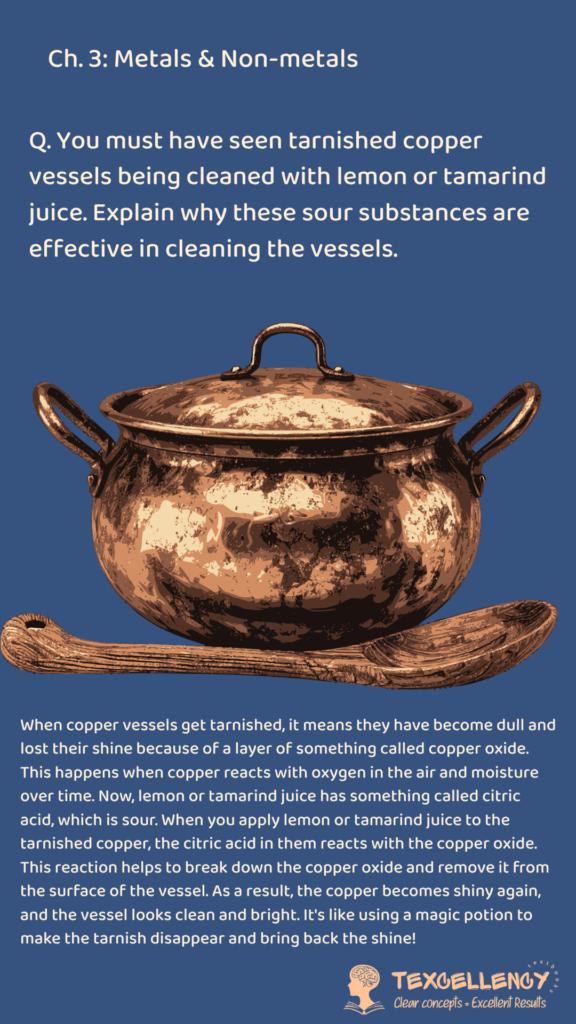
NCERT Class 10 Science | Chapter: Acids, Bases and Salts / Carbon and Its Compounds | Texcellency Book Series
✅ Answer in Brief (For Quick Revision)
Lemon juice contains citric acid and tamarind juice contains tartaric acid — both are weak organic acids. The tarnish on copper vessels is primarily copper oxide (CuO) — a basic oxide — along with basic copper carbonate (verdigris, the green layer). When the acidic lemon or tamarind juice is applied to the tarnished vessel, the acid reacts with the basic copper oxide and copper carbonate layers in an acid-base neutralisation reaction, dissolving them and forming soluble copper salts that can be washed away. The clean, shiny copper metal surface underneath is then exposed — making the vessel look bright again.
🏭 The Rust Remover Analogy — Acid as a Chemical Eraser
Imagine a beautiful painting (the shiny copper vessel) that has been covered with a layer of grey paint by mistake (the tarnish — copper oxide). You need a chemical eraser that can dissolve only the grey paint without touching the original painting underneath.
Lemon and tamarind juice ARE that chemical eraser. They contain acids that react with and dissolve the tarnish (CuO — basic oxide) — but they are too mild to attack the copper metal underneath (copper is low on the reactivity series and does not react with weak organic acids). The grey paint dissolves and washes away. The original brilliant painting — the shiny copper — is revealed.
This is precisely why grandmothers in Indian households have been cleaning copper and brass vessels with lemon, tamarind, and raw mango (amchur) for thousands of years — they were doing chemistry, even without knowing it by that name.
🔴 Step 1 — What is the Tarnish on Copper Vessels?
Before understanding the cleaning, you must understand what you are cleaning.
Freshly polished copper is a beautiful shiny reddish-brown metal. But over time, when exposed to the environment, copper reacts with oxygen, moisture, and carbon dioxide in the air and forms a dull coating — this is called tarnish.
Type 1 — Copper Oxide (CuO) — The Black/Dark Layer: 🔵 Reaction: 2Cu + O₂ → 2CuO 🔵 Copper reacts with oxygen in air → forms black copper(II) oxide 🔵 This is the dark, dull coating seen on copper vessels after use — makes them look dirty and old 🔵 CuO is a basic oxide (all metal oxides are basic in nature)
Type 2 — Basic Copper Carbonate / Verdigris — The Green Layer: 🔵 Reaction: 2Cu + O₂ + CO₂ + H₂O → Cu₂(OH)₂CO₃ (basic copper carbonate) 🔵 Copper reacts with oxygen + carbon dioxide + moisture over longer periods 🔵 Forms a distinctive green/bluish-green coating called verdigris 🔵 This is the green colour you see on old copper statues, domes, and rooftops (the Statue of Liberty’s green colour is verdigris on copper!) 🔵 Also basic in nature — reacts with acids
Both types of tarnish are basic — and this is the key. Acids react with bases. So any acid can dissolve this tarnish. The question is which acids are safe to use on kitchen vessels — and lemon/tamarind provide the answer.
🔶 Step 2 — What Acids Are in Lemon and Tamarind?
Lemon Juice — Citric Acid: 🔵 Acid present: Citric acid (C₆H₈O₇) — a tricarboxylic acid (has three –COOH groups) 🔵 Concentration: about 5–8% citric acid by weight in lemon juice 🔵 pH: approximately 2–3 — acidic enough to dissolve copper oxide effectively 🔵 Nature: weak organic acid — safe for food contact, safe for use on kitchen vessels 🔵 Why it tastes sour: the H⁺ ions released by citric acid stimulate the sour taste receptors on your tongue — all acids taste sour for this reason 🔵 Also present: small amounts of ascorbic acid (Vitamin C, C₆H₈O₆) — another weak acid that also helps in cleaning
Tamarind — Tartaric Acid: 🔵 Acid present: Tartaric acid (C₄H₆O₆) — a dicarboxylic acid (has two –COOH groups) — present at 8–23% in tamarind pulp 🔵 Also contains: citric acid and malic acid in smaller amounts 🔵 pH: approximately 2–3 in tamarind solution — similarly acidic to lemon 🔵 Nature: weak organic acid — safe for food and kitchen use 🔵 Why tamarind is used in cooking: its tartaric acid provides the characteristic sour taste in sambar, rasam, puliyodarai, and chutneys
Other kitchen acids that work the same way: 🔵 Vinegar (ethanoic acid / acetic acid — CH₃COOH) — also cleans copper effectively 🔵 Curd / yogurt (lactic acid — C₃H₆O₃) — used in traditional vessel cleaning in some regions 🔵 Amchur / raw mango powder (citric acid + malic acid) — another traditional cleaning agent 🔵 All of these work by the same principle: organic acid + basic copper oxide → copper salt + water
🔷 Step 3 — The Chemical Reaction — What Happens When Acid Meets Tarnish
Reaction 1 — Citric Acid (from lemon) + Copper Oxide:
The general reaction pattern: Acid + Metal Oxide (basic oxide) → Metal Salt + Water
3CuO + 2C₆H₈O₇ → Cu₃(C₆H₅O₇)₂ + 3H₂O (Copper oxide + Citric acid → Copper citrate + Water)
🔵 CuO (the basic black tarnish layer) is dissolved by the citric acid 🔵 Copper citrate formed is soluble — it dissolves in the juice/water and is washed away with rubbing 🔵 Water is released as the second product 🔵 The copper metal surface underneath — unaffected by the weak acid — is exposed and shines
Reaction 2 — Tartaric Acid (from tamarind) + Copper Oxide:
CuO + C₄H₆O₆ → CuC₄H₄O₆ + H₂O (Copper oxide + Tartaric acid → Copper tartrate + Water)
🔵 Same pattern — acid dissolves the basic copper oxide layer 🔵 Copper tartrate (the salt formed) is soluble and washes away 🔵 Shiny copper surface revealed
Reaction 3 — With Basic Copper Carbonate (Verdigris):
When acid meets the green verdigris layer (basic copper carbonate): Cu₂(OH)₂CO₃ + 2H⁺ (from acid) → 2Cu²⁺ + 2H₂O + CO₂↑ (Basic copper carbonate + acid → copper ions in solution + water + carbon dioxide gas)
🔵 This reaction produces CO₂ gas — you might notice slight fizzing when you rub lemon on a heavily tarnished copper or brass vessel 🔵 The copper ions go into solution as copper salts — washed away 🔵 Clean copper surface exposed
The unifying principle across all three reactions: 🔵 Tarnish layers = BASIC (CuO is a basic oxide, copper carbonate is basic) 🔵 Lemon/tamarind = ACIDIC 🔵 Acid + Base → Salt + Water = acid-base neutralisation 🔵 The salt formed is soluble → washes away with water 🔵 Clean copper underneath is left exposed and shining
🔴 Why Copper Itself is NOT Dissolved — The Crucial Point
Students sometimes worry: “If acid dissolves the tarnish, will it also eat into the copper vessel itself?”
The answer is NO — for a beautiful chemical reason:
🔵 Copper is LOW on the reactivity series — below hydrogen. This means copper does NOT react with dilute acids (HCl, H₂SO₄, citric acid, tartaric acid) under normal conditions. 🔵 Only oxidising acids like concentrated H₂SO₄ or concentrated HNO₃ can dissolve copper metal — and these are never present in lemon or tamarind juice. 🔵 The citric and tartaric acids in lemon and tamarind juice are weak organic acids — they are strong enough to dissolve the basic CuO tarnish layer but too weak to attack the copper metal beneath. 🔵 Result: the cleaning is self-limiting — once the tarnish layer is gone, the acid has nothing more to react with and the copper metal is safe.
This is precisely why lemon and tamarind are ideal for cleaning copper — not so strong that they damage the vessel, but perfectly strong enough to dissolve the tarnish. Nature has provided the perfect chemical cleaning agent.
🔶 The Real-Life Connection — Chemistry in Every Indian Kitchen
This question is one of the most beautiful in Class 10 Science — because it connects classroom chemistry directly to a practice every Indian child has seen at home.
🔵 Your दादी / नानी cleaning the पूजा की थाली with नींबू — acid-base neutralisation 🔵 The इमली used to clean पीतल के बर्तन — tartaric acid dissolving basic copper/zinc oxide tarnish 🔵 The green colour on old temple copper domes (verdigris) — basic copper carbonate, same chemistry 🔵 The Statue of Liberty’s green colour — pure verdigris on copper — same chemical compound as the tarnish on your kitchen vessel, just on a much grander scale 🔵 Why new copper vessels are shiny but old ones are dull — oxidation forms CuO and verdigris over time
Every time you see someone rub a lemon on a copper vessel and watch it turn shiny — you are watching an acid-base neutralisation reaction happening before your eyes. The same reaction you studied in Chapter 2 (Acids, Bases and Salts) is happening in your kitchen every day.
🔷 This Question Connects Two NCERT Chapters
This is worth highlighting for students preparing for board exams:
🔵 Chapter 2 — Acids, Bases and Salts: The principle here is acid + basic oxide → salt + water (acid-base reaction). Citric acid and tartaric acid are acids. CuO is a basic oxide. Salt (copper citrate/tartrate) + water are products. This is a textbook acid-base neutralisation.
🔵 Chapter 4 — Carbon and Its Compounds: Citric acid and tartaric acid are ORGANIC compounds — they are carbon compounds with –COOH (carboxyl) functional groups. Citric acid has three –COOH groups. Tartaric acid has two –COOH groups. The fact that they are carboxylic acids is why they are acidic and why they react with the basic copper oxide tarnish.
Understanding this cross-chapter connection shows examiners that you grasp chemistry at a deeper level than just memorising isolated facts.
📊 Summary — Why Lemon and Tamarind Clean Copper
The tarnish: CuO (black, basic oxide) + Cu₂(OH)₂CO₃ (green, basic carbonate) — both basic in nature — form on copper surface due to reaction with O₂, CO₂, moisture in air
The cleaners: Lemon juice (citric acid, pH 2–3) + Tamarind juice (tartaric acid, pH 2–3) — both acidic weak organic acids — safe for food and kitchen use
The reaction: Acid (citric/tartaric) + Basic tarnish (CuO/copper carbonate) → Soluble copper salt + Water (+ CO₂ if carbonate is involved)
The result: Soluble salt washes away with water + rubbing → Shiny copper metal surface exposed → Vessel looks clean and bright again
Why copper metal is safe: Copper is low on reactivity series — weak organic acids dissolve CuO tarnish but cannot attack copper metal — cleaning is self-limiting and safe
🎵 Rhyme to Remember
“Copper vessels dull and dark — CuO is the blame, A basic oxide sits on top — tarnish is its name!* Lemon brings its citric acid — tamarind brings tartaric too,* Both are sour, both are acidic — both know what to do!* Acid meets the basic tarnish — neutralisation begins,* Copper salt dissolves in water — shiny copper wins!* Wash it off and rub it clean — the vessel glows again,* Chemistry in your kitchen — see it, know it, explain!”*
🧩 Mnemonics
🔵 “TARNISH = Basic. LEMON/TAMARIND = Acidic. ACID + BASE = SALT + WATER = CLEAN VESSEL.” — the entire explanation in one equation. 🔵 “Lemon = Citric acid (3 COOH groups). Tamarind = Tartaric acid (2 COOH groups).” — count the carboxyl groups: lemon has more (3), tamarind has fewer (2). 🔵 “CuO = Copper’s Old coat — remove it with acid.” — CuO is the “old coat” of oxidised copper — acid strips it off. 🔵 “Sour = Acidic = H⁺ ions = reacts with basic tarnish = cleans copper.” — the chain from taste to chemistry to cleaning. 🔵 “Copper is BELOW hydrogen in reactivity series = weak acids cannot dissolve copper METAL — only the basic tarnish LAYER.” — why the vessel is safe from acid attack. 🔵 “Green statue = Verdigris = Basic copper carbonate = same chemistry as your kitchen vessel tarnish.” — Statue of Liberty as a memory hook.
✅ Exam-Ready Answer (Write This in Board Exam)
You must have seen tarnished copper vessels being cleaned with lemon or tamarind juice. Explain why these sour substances are effective in cleaning the vessels.
Copper vessels become tarnished over time due to the formation of a dull layer of copper oxide (CuO) on the surface, caused by the reaction of copper with oxygen in the air. Copper may also develop a green coating of basic copper carbonate (verdigris) when exposed to oxygen, carbon dioxide, and moisture over longer periods.
Both copper oxide and basic copper carbonate are basic in nature.
Lemon juice contains citric acid and tamarind juice contains tartaric acid — both are weak organic acids. When applied to the tarnished vessel, these acids react with the basic copper oxide and basic copper carbonate in an acid-base neutralisation reaction:
CuO + Acid (citric/tartaric) → Copper salt (soluble) + Water
The copper salt formed is soluble and is washed away along with water when the vessel is rinsed and rubbed. This removes the tarnish layer completely, exposing the clean, shiny copper metal surface underneath.
The copper metal itself is not dissolved because copper is low in the reactivity series and does not react with weak organic acids — only the basic tarnish layer is removed.
This is why lemon and tamarind — both sour (acidic) substances — are effective in cleaning tarnished copper vessels.
📌 Key Points Checklist
✅ Tarnish on copper = primarily CuO (copper oxide, black, basic) + Cu₂(OH)₂CO₃ (verdigris, green, basic) ✅ Tarnish forms because: Cu + O₂ → CuO (oxidation in air) ✅ Lemon contains citric acid (C₆H₈O₇, 3 COOH groups, pH 2–3) ✅ Tamarind contains tartaric acid (C₄H₆O₆, 2 COOH groups, pH 2–3) ✅ Both are weak organic acids — safe for kitchen use ✅ Reaction: Acid + CuO (basic oxide) → Copper salt (soluble) + Water = acid-base neutralisation ✅ Soluble copper salt washes away → clean shiny copper metal surface exposed ✅ Copper metal NOT dissolved — copper is low in reactivity series — safe from weak organic acids ✅ Sour taste = acidic nature = H⁺ ions = ability to neutralise basic tarnish ✅ Same principle: vinegar (ethanoic acid), curd (lactic acid), amchur (citric+malic acid) — all clean copper for the same reason ✅ Cross-chapter connection: Chapter 2 (acid-base neutralisation) + Chapter 4 (organic carboxylic acids) ✅ Real-world scale: Statue of Liberty’s green colour = verdigris = same compound as kitchen copper tarnish
📚 Want ALL of Class 10 Science Explained This Way? Every chapter. Every concept. Every NCERT question — with analogies, rhymes, mnemonics, and real-life examples.