
Q. While cooking, if the bottom of the vessel is getting blackened on the outside, it means that (a) the food is not cooked completely. (b) the fuel is not burning completely. (c) the fuel is wet. (d) the fuel is burning completely.
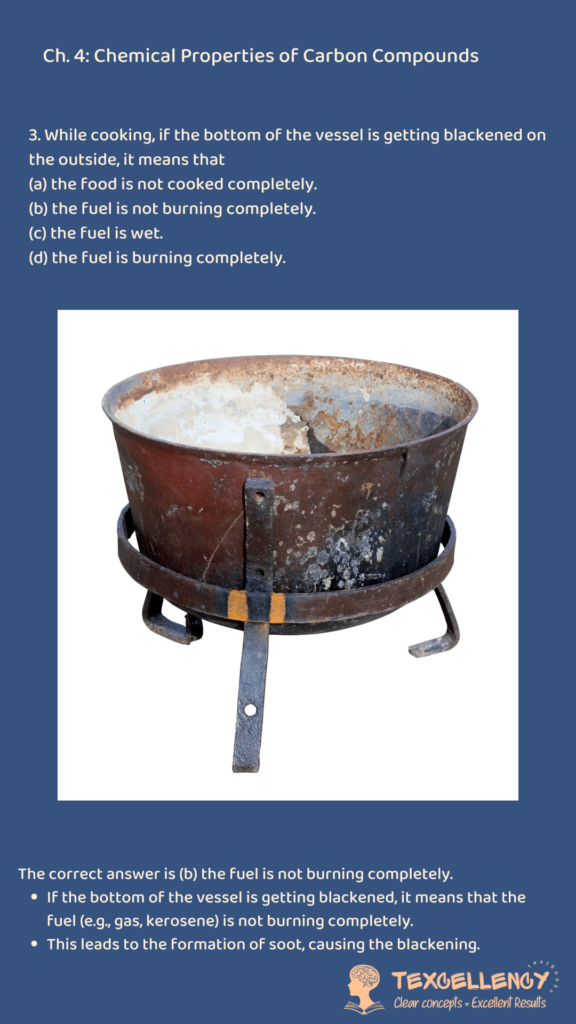
NCERT Class 10 Science | Chapter: Carbon and Its Compounds | Texcellency Book Series
✅ Correct Answer: (b) The fuel is not burning completely
The blackening on the outside bottom of a cooking vessel is caused by soot — tiny particles of unburnt carbon — which are produced when the fuel burns incompletely due to an insufficient supply of oxygen. This is a direct, visible sign of incomplete combustion.
Let us now understand exactly why this is happening in your kitchen — because this question is not just about ticking the right option in an exam. It is about understanding something that happens in millions of Indian kitchens every day, and that has real health and safety consequences.
🏭 The Candle Analogy — See Incomplete Combustion Right Now
You can demonstrate this immediately at home. Light a candle (a carbon compound — long-chain hydrocarbon) and hold a clean steel plate just above the flame for a few seconds.
🔵 If you hold it in the yellow/orange tip of the candle flame → the plate turns BLACK → this is soot (unburnt carbon) from incomplete combustion 🔵 If you hold it in the blue inner base of the candle flame → the plate stays relatively clean → this is the zone of more complete combustion
The black deposit you just made is the same thing that blackens the bottom of your cooking vessel. Same chemistry. Same cause. Incomplete combustion. Not enough oxygen reaching all the fuel molecules. Unburnt carbon particles escape and deposit on whatever surface they touch.
🔴 Why Each Option is Right or Wrong — The Complete Analysis
This is the most important section for MCQ preparation. Examiners sometimes rephrase options — you must understand WHY each option is correct or wrong, not just memorise the answer.
Option (a) — The food is not cooked completely — ❌ WRONG
The question says the bottom of the vessel is getting blackened on the OUTSIDE. The blackening is on the exterior — the side facing the flame — not the interior where the food is. This blackening is a property of the combustion happening below the vessel, not a property of the food inside. Food not cooking completely would be a consequence of the vessel not getting hot enough — it does not cause external blackening. This option confuses the symptom (blackening) with an unrelated outcome (food not cooking). ❌
Option (b) — The fuel is not burning completely — ✅ CORRECT
When fuel burns incompletely (insufficient oxygen supply), it produces carbon soot particles alongside CO and water vapour. These soot particles are extremely fine, hot, and sticky — they rise with the flame and deposit on the cool surface of the vessel bottom, turning it black. This is the direct, scientifically correct cause of vessel blackening. ✅
Option (c) — The fuel is wet — ❌ WRONG
Moisture (water) in a fuel would make it difficult to ignite and might produce steam, sputtering, and an unstable flame — but it does not specifically produce the black carbon soot that causes vessel blackening. Carbon soot comes from incomplete combustion of the carbon in the fuel — not from water in the fuel. Additionally, cooking fuels like LPG are gases that cannot be “wet” in the conventional sense. This option is a distractor. ❌
Option (d) — The fuel is burning completely — ❌ WRONG
This is the exact opposite of the correct answer. When fuel burns completely, it produces only CO₂ (a colourless gas) and H₂O (water vapour) — both of which are invisible and leave no deposits. The vessel bottom stays perfectly clean when combustion is complete. A clean, un-blackened vessel = sign of complete combustion. A blackened vessel = sign of incomplete combustion. Option (d) gets it backwards. ❌
🔶 The Chemistry of Incomplete vs Complete Combustion — Deep Explanation
Complete Combustion — What SHOULD happen:
When sufficient oxygen is available, every carbon atom in the fuel reacts with two oxygen atoms to form CO₂, and every hydrogen atom reacts with oxygen to form H₂O:
CH₄ + 2O₂ → CO₂ + H₂O + maximum heat (methane, complete)
2C₄H₁₀ + 13O₂ → 8CO₂ + 10H₂O + maximum heat (butane/LPG, complete)
🔵 Products: CO₂ (colourless gas) + H₂O (colourless vapour) 🔵 No solid particles, no soot, no blackening 🔵 Flame colour: BLUE — clean, hot, efficient 🔵 Maximum heat released — efficient cooking 🔵 Vessel bottom: stays CLEAN
Incomplete Combustion — What ACTUALLY happens when air supply is poor:
When oxygen is insufficient, not all carbon atoms can find enough oxygen to form CO₂. Some carbon atoms only partially oxidise to CO (carbon monoxide), and some escape as free carbon soot particles:
CH₄ + O₂ (insufficient) → CO + C + H₂O + less heat (incomplete, with soot)
2C₄H₁₀ + 9O₂ → 8CO + 10H₂O (butane with limited O₂ — CO formed, incomplete)
🔵 Products: CO (toxic gas) + C (soot — black solid particles) + H₂O 🔵 Soot particles rise with the hot gases and stick to the vessel bottom → BLACKENING 🔵 Flame colour: YELLOW or ORANGE — sooty, cooler, inefficient 🔵 Less heat released — inefficient cooking (same fuel, less useful energy) 🔵 Vessel bottom: turns BLACK
The critical equation to remember:
Complete combustion: Fuel + Sufficient O₂ → CO₂ + H₂O + MAXIMUM heat + BLUE flame + CLEAN vessel
Incomplete combustion: Fuel + Insufficient O₂ → CO + C(soot) + H₂O + LESS heat + YELLOW flame + BLACK vessel
🔷 The Flame Colour Diagnostic — Read Your Stove Like a Pro
Your gas stove’s flame colour tells you everything about whether combustion is complete or incomplete:
🔵 Blue flame throughout = complete combustion = sufficient oxygen = maximum heat = no soot = ✅ perfect 🔵 Yellow/orange flame = incomplete combustion = insufficient oxygen = soot forming = vessel blackening = less efficient = ❌ needs fixing 🔵 Blue flame at base, yellow at tip = partially incomplete — the outer yellow tip is where oxygen is limited — mild soot formation
This is why gas stove manufacturers design burners with holes specifically to allow the right air-to-fuel ratio. When those holes get clogged with food spills and grease, the air supply reduces → combustion becomes incomplete → flame turns yellow → vessel bottom blackens.
🔴 The Hidden Danger — Carbon Monoxide (CO) Poisoning
This is a critically important real-life consequence that goes beyond the exam question.
Incomplete combustion does not just produce soot. It also produces carbon monoxide (CO) — a colourless, odourless, tasteless, extremely toxic gas.
🔵 CO binds to haemoglobin in the blood approximately 200 times more strongly than oxygen does 🔵 Once CO occupies a haemoglobin molecule, oxygen cannot bind to it → the blood cannot carry oxygen to the body’s cells → cells begin to die 🔵 Even small amounts of CO in an enclosed space (like a closed kitchen) can cause: headache, dizziness, nausea (early symptoms) → unconsciousness → death (at high concentrations) 🔵 CO is called the “silent killer” precisely because it has no smell, no colour, no taste — you cannot detect it without an instrument
Real-life situations where incomplete combustion and CO are dangerous: 🔵 Running a generator indoors or in a garage — produces CO in enclosed space → CO poisoning 🔵 Poorly ventilated kitchen with blocked burner holes — gradual CO buildup 🔵 Using a charcoal grill or kerosene stove indoors without ventilation 🔵 Car engine running in a closed garage
The fix: Always ensure good ventilation when burning any fuel. Open windows in the kitchen. Get your burner holes cleaned regularly.
🔶 Practical Solutions — How to Prevent Vessel Blackening
The blackening tells you something is wrong. Here is how to fix it:
🔵 Clean the burner holes regularly — use a pin or needle to clear blocked air holes in the gas burner. Blocked holes reduce air supply → incomplete combustion → yellow flame → blackening. 🔵 Check the air regulator — many gas stoves have a sliding air regulator on the burner that adjusts the air-to-gas ratio. Open it more if the flame is yellow. 🔵 Ensure kitchen ventilation — good airflow brings fresh oxygen to the flame and removes exhaust gases. 🔵 Use the right burner for the vessel size — using a large flame under a small vessel wastes fuel and can cause uneven combustion at the vessel edges. 🔵 Check for gas leaks — excessive gas supply relative to available air also causes incomplete combustion.
📊 Complete Combustion vs Incomplete Combustion — Summary
Complete combustion: sufficient O₂ + fuel → CO₂ + H₂O + maximum heat + blue flame + clean vessel + no CO + no soot ✅
Incomplete combustion: insufficient O₂ + fuel → CO + C(soot) + H₂O + less heat + yellow/orange flame + blackened vessel + toxic CO ❌
🎵 Rhyme to Remember
“Blue flame means complete — clean and bright, CO₂ and water — the products right!* Yellow flame means trouble — soot and CO too,* The vessel turns black — that’s the incomplete clue!* Air holes blocked? — the oxygen runs low,* Carbon escapes as soot — blackening the stove!* Clean those burner holes — let the air flow free,* Blue flame and clean vessel — that’s how it should be!”*
🧩 Mnemonics
🔵 “BLACK = Burning Lacks Adequate Carbon-burning oxygen Knowledge” — vessel turns black when combustion lacks adequate oxygen. 🔵 “BLUE = Best, Lots of oxygen Used Efficiently” — blue flame = complete combustion = maximum efficiency. 🔵 “YELLOW = Your fuel is Emitting Low-oxygen Low-efficiency Output Wastefully” — yellow flame = problem signal. 🔵 “Complete combustion = CO₂ + H₂O (both invisible) = CLEAN. Incomplete = CO + C soot (soot visible) = DIRTY.” 🔵 “CO = Carbon monoxide = Colourless + Odourless = SILENT KILLER — always ventilate when burning fuel.”
✅ Exam-Ready Answer (Write This in Board Exam)
While cooking, if the bottom of the vessel is getting blackened on the outside, it means that:
Answer: (b) The fuel is not burning completely.
Explanation: When a fuel does not get sufficient oxygen (air supply), it undergoes incomplete combustion instead of complete combustion. During incomplete combustion, not all carbon atoms in the fuel are fully oxidised to CO₂. Some carbon atoms are only partially oxidised to CO (carbon monoxide), and some escape as free carbon particles called soot.
These soot particles rise with the hot gases from the flame and deposit on the outer bottom surface of the cooking vessel, turning it black.
Complete combustion (sufficient oxygen): Fuel + O₂ → CO₂ + H₂O + maximum heat — blue flame — no soot — vessel stays clean.
Incomplete combustion (insufficient oxygen): Fuel + O₂ (limited) → CO + C (soot) + H₂O + less heat — yellow/sooty flame — soot deposits — vessel bottom turns black.
Why other options are wrong: 🔵 (a) Food not cooked completely — blackening is on the OUTSIDE of vessel, caused by the flame — not related to food inside. 🔵 (c) Fuel is wet — moisture does not produce carbon soot that causes blackening. 🔵 (d) Fuel is burning completely — complete combustion produces only CO₂ + H₂O (invisible gases) — no soot — no blackening. This is the opposite of correct.
📌 Key Points Checklist
✅ Correct answer = (b) fuel is not burning completely ✅ Blackening = soot = unburnt carbon particles from incomplete combustion ✅ Incomplete combustion = insufficient oxygen → CO + C(soot) + H₂O + less heat ✅ Complete combustion = sufficient oxygen → CO₂ + H₂O + maximum heat + no soot ✅ Blue flame = complete combustion ✅ | Yellow/orange flame = incomplete combustion ❌ ✅ Complete combustion equation (butane): 2C₄H₁₀ + 13O₂ → 8CO₂ + 10H₂O ✅ Incomplete combustion also produces CO (carbon monoxide) — colourless, odourless, toxic ✅ CO binds haemoglobin 200× more strongly than O₂ → blocks oxygen transport → CO poisoning ✅ Cause of incomplete combustion in stoves: blocked burner air holes, poor ventilation ✅ Fix: clean burner holes regularly, ensure kitchen ventilation, check air regulator
📚 Want ALL of Class 10 Science Explained This Way? Every chapter. Every concept. Every NCERT question — with analogies, rhymes, mnemonics, and real-life examples.