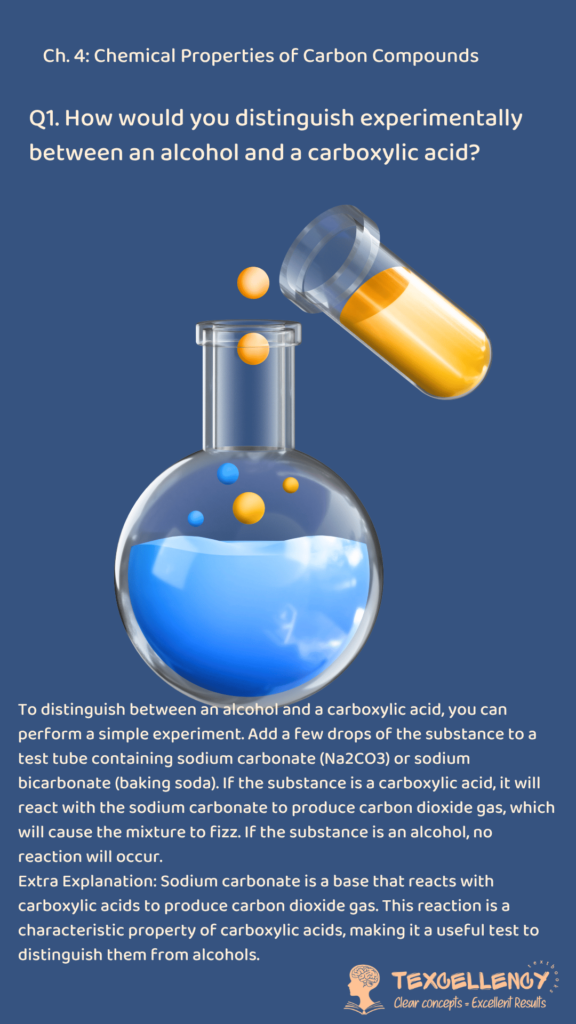
How would you distinguish experimentally between an alcohol and a carboxylic acid?
NCERT Class 10 Science | Chapter: Carbon and Its Compounds | Texcellency Book Series
✅ Answer: Three Simple Experiments Can Tell Them Apart
You can distinguish between an alcohol and a carboxylic acid using any one (or all three) of these experiments:
🔵 Test 1 — Litmus Paper Test: Carboxylic acid turns blue litmus red. Alcohol does not change litmus colour at all. 🔵 Test 2 — Sodium Carbonate / Sodium Bicarbonate Test (Na₂CO₃ / NaHCO₃): Carboxylic acid reacts and produces brisk fizzing (CO₂ gas). Alcohol shows no reaction, no fizzing. 🔵 Test 3 — Esterification Test: Carboxylic acid + alcohol + concentrated H₂SO₄ (on heating) produces a sweet fruity smell (an ester). Alcohol alone with H₂SO₄ produces no sweet smell.
All three are valid exam answers. Test 2 (the fizzing / Na₂CO₃ test) is the most commonly expected one in NCERT Class 10. Let us understand every single test deeply — because the examiner can ask this in five different ways and you need to be ready for all of them.
🏭 The Security Guard Analogy — Why They Behave Differently
Imagine two visitors arriving at the gate of an acid-sensitive laboratory.
Visitor 1 — Carboxylic Acid: carries an acidic ID card. The moment it meets the security system (a base like Na₂CO₃ or litmus), it triggers an alarm — the litmus turns red, the sodium carbonate fizzes. It cannot hide its acidic identity.
Visitor 2 — Alcohol: carries a neutral ID card. It walks past the security system quietly. Litmus does not react. Na₂CO₃ does not react. No alarm, no fizzing. It is chemically neutral — it has no acidic proton to give away.
This is the fundamental chemical difference: carboxylic acids are acidic (they have a -COOH group that releases H⁺ ions). Alcohols are neutral (they have a -OH group but it does NOT release H⁺ ions under normal conditions).
🔴 Test 1 — Litmus Paper Test (The Quickest Test)
What to do:
🔵 Take two strips of blue litmus paper. 🔵 Place a drop of the first substance (alcohol) on one strip. 🔵 Place a drop of the second substance (carboxylic acid) on the other strip. 🔵 Observe colour change.
What happens:
🔵 Alcohol + Blue Litmus → No colour change. Blue remains blue. Alcohol is neutral — it does not release H⁺ ions. 🔵 Carboxylic Acid + Blue Litmus → Turns RED. This is because carboxylic acid releases H⁺ ions in solution (it is a weak acid), and H⁺ ions turn blue litmus red.
The chemical reason:
Carboxylic acids contain the -COOH functional group. In water: RCOOH ⇌ RCOO⁻ + H⁺
That H⁺ is what turns the litmus red. Ethanoic acid (vinegar) — the most common carboxylic acid in Class 10 — does exactly this.
Alcohols contain the -OH functional group. But this -OH does NOT release H⁺ in water. Ethanol (the most common alcohol in Class 10) is completely neutral.
Memory hook: “Acid turns litmus RED — Alcohol leaves it DEAD (unchanged)”
🔴 Test 2 — Sodium Carbonate / Sodium Bicarbonate Test (The Fizzing Test — Most Important for Exam)
What to do:
🔵 Take two test tubes. 🔵 Add a small amount of Na₂CO₃ (sodium carbonate) or NaHCO₃ (sodium bicarbonate / baking soda) to each. 🔵 Add a few drops of alcohol to Test Tube 1. 🔵 Add a few drops of carboxylic acid to Test Tube 2. 🔵 Observe.
What happens:
🔵 Alcohol + Na₂CO₃ → No reaction. No fizzing. No gas produced. 🔵 Carboxylic Acid + Na₂CO₃ → Brisk fizzing. CO₂ gas is released. A sodium salt is also formed.
The chemical equation:
2CH₃COOH + Na₂CO₃ → 2CH₃COONa + H₂O + CO₂↑
(Ethanoic acid + Sodium carbonate → Sodium ethanoate + Water + Carbon dioxide gas)
The CO₂ gas is what causes the brisk fizzing / bubbling you see in the test tube. This fizzing is the visible proof that a carboxylic acid is present.
How to confirm it is CO₂:
Pass the gas through lime water (Ca(OH)₂ solution). If lime water turns milky → confirmed CO₂ → confirmed carboxylic acid.
CO₂ + Ca(OH)₂ → CaCO₃↓ + H₂O (milky white precipitate of calcium carbonate forms)
Why does alcohol NOT react?
Sodium carbonate is a base. It reacts with acids to produce CO₂. Alcohol is not an acid — it does not donate H⁺ to Na₂CO₃ — so no salt, no water, no CO₂, no fizzing.
Memory hook: “Carboxylic acid + Na₂CO₃ = FIZZ. Alcohol + Na₂CO₃ = NOTHING.”
🔴 Test 3 — Esterification Test (The Sweet Smell Test)
What to do:
🔵 Take a test tube with a small amount of alcohol (e.g., ethanol). 🔵 Add a carboxylic acid (e.g., ethanoic acid) and a few drops of concentrated H₂SO₄ (as catalyst). 🔵 Warm the mixture gently. 🔵 Pour the product into water. 🔵 Smell carefully.
What happens:
🔵 A sweet, fruity smell is produced — this is the ester formed by the reaction. 🔵 If the unknown substance is a carboxylic acid: when mixed with a known alcohol + H₂SO₄ and heated, it will produce a sweet-smelling ester. 🔵 If the unknown substance is an alcohol: when mixed with a known carboxylic acid + H₂SO₄ and heated, it will also produce the ester.
The reaction (esterification):
CH₃COOH + C₂H₅OH ⇌ CH₃COOC₂H₅ + H₂O (Ethanoic acid + Ethanol → Ethyl ethanoate + Water)
Ethyl ethanoate smells like nail polish remover / pears / fruit candy.
Key point for the exam:
This test works best to confirm a carboxylic acid — because the carboxylic acid is the one contributing the -COOH group that forms the ester. If you add a known alcohol to the unknown liquid with H₂SO₄ and heat — and you get a sweet smell — the unknown was a carboxylic acid.
Memory hook: “Carboxylic acid makes SWEET smells with alcohol. Alcohol alone makes nothing sweet.”
📊 Complete Comparison Table — Alcohol vs Carboxylic Acid
| Property | Alcohol | Carboxylic Acid |
|---|---|---|
| Functional Group | -OH (hydroxyl) | -COOH (carboxyl) |
| Nature | Neutral | Acidic (weak acid) |
| Example | Ethanol (C₂H₅OH) | Ethanoic acid (CH₃COOH) |
| Litmus Test | No change in blue litmus | Turns blue litmus RED |
| Na₂CO₃ Test | No reaction, no fizzing | Brisk fizzing, CO₂ released |
| NaHCO₃ Test | No reaction | Fizzing, CO₂ released |
| Esterification | Forms ester WITH carboxylic acid | Forms ester WITH alcohol |
| Smell | Characteristic smell (not sweet) | Sour smell (like vinegar) |
| pH | ~7 (neutral) | Less than 7 (acidic) |
🔶 Why This Question Is Important — What the Examiner Actually Wants
This question appears in NCERT Class 10 Science, Chapter 4: Carbon and Its Compounds. It tests whether you understand:
🔵 The chemical properties of alcohols and carboxylic acids — not just their definitions 🔵 Whether you can design an experiment — observation + inference format 🔵 The acidic nature of carboxylic acids and neutral nature of alcohols
The perfect exam answer has THREE parts:
- Name the test / reagent used
- State the observation for each substance
- Give the inference (what the observation tells you)
✅ Exam-Ready Answer (Write This in Your Board Exam)
How would you distinguish experimentally between an alcohol and a carboxylic acid?
We can use the Sodium Carbonate (Na₂CO₃) Test:
Procedure: Add a few drops of each substance separately to test tubes containing sodium carbonate solution.
Observation: 🔵 Alcohol + Na₂CO₃ → No reaction. No gas evolved. No fizzing. 🔵 Carboxylic Acid + Na₂CO₃ → Brisk effervescence. Colourless CO₂ gas is evolved, which turns lime water milky.
Chemical Equation: 2CH₃COOH + Na₂CO₃ → 2CH₃COONa + H₂O + CO₂↑
Inference: The substance that produces CO₂ gas (brisk fizzing) with Na₂CO₃ is the carboxylic acid. The substance that shows no reaction is the alcohol.
Reason: Carboxylic acids are acidic — they react with bases like Na₂CO₃ to produce CO₂. Alcohols are neutral — they do not react with Na₂CO₃.
(Alternatively, a litmus test can also be used: carboxylic acid turns blue litmus red; alcohol does not change the colour of litmus.)
🎵 Rhyme to Remember
“Carboxylic acid has COOH to give, It donates H⁺ — that is how it lives, Meets Na₂CO₃ — and fizzes with glee, CO₂ bubbles for the whole class to see! But alcohol is neutral, quiet and tame, Meets Na₂CO₃ — and nothing became, No fizz, no gas, no litmus turned red, Alcohol stays neutral — enough said!”
🧩 Mnemonics
🔵 “ACID FIZZES, ALCOHOL MISSES” — carboxylic acid fizzes with Na₂CO₃; alcohol misses the reaction entirely. 🔵 “COOH = Commits to H⁺, gives it away” — the carboxyl group is acidic because it releases H⁺. 🔵 “-OH in alcohol = Only Hangs on, never lets go” — the -OH in alcohol does NOT release H⁺. 🔵 “Red litmus = acid detected. Blue unchanged = alcohol suspected.”
📌 Key Points Checklist
✅ Best test = Na₂CO₃ test: carboxylic acid fizzes (CO₂ evolved), alcohol does not react ✅ Litmus test also works: carboxylic acid turns blue litmus red, alcohol does not ✅ Esterification test: carboxylic acid + alcohol + conc. H₂SO₄ + heat = sweet-smelling ester ✅ Carboxylic acid functional group = -COOH (releases H⁺, acidic) ✅ Alcohol functional group = -OH (does NOT release H⁺, neutral) ✅ Equation: 2CH₃COOH + Na₂CO₃ → 2CH₃COONa + H₂O + CO₂↑ ✅ CO₂ confirmed by: lime water turns milky ✅ Ethanoic acid = most common carboxylic acid in Class 10 (vinegar) ✅ Ethanol = most common alcohol in Class 10 ✅ Perfect exam answer = Procedure + Observation + Chemical Equation + Inference
📚 Want ALL of Class 10 Science Explained This Way? Every chapter. Every concept. Every NCERT question — with analogies, rhymes, mnemonics, and real-life examples.
👉 Explore the Full Texcellency Collection 👉 Download Your FREE Book Now