
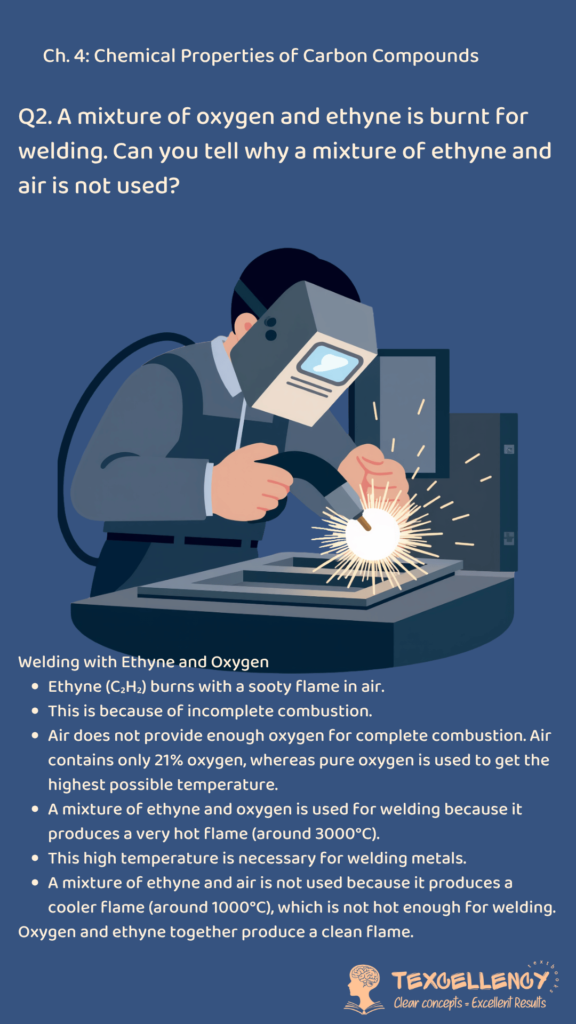
A mixture of oxygen and ethyne is burnt for welding. Can you tell why a mixture of ethyne and air is not used?
NCERT Class 10 Science | Chapter: Carbon and Its Compounds | Texcellency Book Series
✅ Answer: Air Contains Only 21% Oxygen — Not Enough for the Extreme Heat Welding Demands
When ethyne burns with pure oxygen, it produces a flame of approximately 3000°C — hot enough to melt and fuse metals together. This is the oxy-acetylene (oxyethyne) flame used in welding.
When ethyne burns with air, it produces a much cooler flame of only about 1000°C — and also produces a sooty, smoky, yellow flame due to incomplete combustion.
Two reasons air fails for welding: 🔵 Reason 1 — Temperature too low: Air is only 21% oxygen. The remaining 79% is mostly nitrogen — which does not support combustion and actually absorbs heat from the flame, making it cooler. Pure oxygen gives 100% oxygen — so the flame is far hotter. 🔵 Reason 2 — Incomplete combustion + sooty flame: With limited oxygen from air, ethyne undergoes incomplete combustion — producing carbon soot, carbon monoxide, and a smoky yellow flame. This sooty flame deposits carbon on the metal surface, making a clean, strong weld impossible.
🏭 The Cooking Stove Analogy — Understanding Complete vs Incomplete Combustion
You have seen a gas stove at home. When the air holes on the burner are open and working properly, the flame is blue — hot, clean, complete combustion. When those air holes are blocked (reduced oxygen supply), the flame turns yellow and sooty — incomplete combustion.
The same principle applies here:
🔵 Ethyne + Pure Oxygen = Blue, roaring, ultra-hot flame (3000°C) = Complete combustion — all the carbon in ethyne burns completely to CO₂. No soot. Clean flame. Perfect for welding.
🔵 Ethyne + Air = Yellow, sooty, cooler flame (~1000°C) = Incomplete combustion — not enough oxygen to burn all the carbon. Unburnt carbon particles escape as black soot. Not suitable for welding.
A welder cannot afford a sooty, 1000°C flame. They need a clean, 3000°C flame that will actually melt steel. Only pure oxygen delivers that.
🔴 What Exactly is Ethyne (Acetylene)?
Before going deeper, let us make sure we know the star of this question.
🔵 Chemical name: Ethyne | Common name: Acetylene | Formula: C₂H₂ 🔵 Structure: HC≡CH — two carbon atoms connected by a triple bond, with one hydrogen on each carbon 🔵 Belongs to: the alkyne family (unsaturated hydrocarbons with triple bonds) 🔵 Property relevant here: Because of its triple bond and high carbon content (2 carbons, only 2 hydrogens), ethyne has a very high energy content per molecule — which is why it produces such an intense flame when burned with sufficient oxygen. 🔵 Stored in: compressed gas cylinders (dissolved in acetone for safety)
🔶 The Complete Combustion Reaction — What Happens with Pure Oxygen
When ethyne burns completely with pure oxygen:
2C₂H₂ + 5O₂ → 4CO₂ + 2H₂O + Heat (≈3000°C)
What this means step by step: 🔵 Every carbon atom in ethyne finds enough oxygen → burns completely to CO₂ 🔵 Every hydrogen atom finds enough oxygen → burns completely to H₂O 🔵 No carbon is left over → no soot → clean blue flame 🔵 The enormous energy released in this complete combustion = 3000°C flame temperature
At 3000°C, most metals (steel melts at ~1370°C, iron at ~1538°C) will melt and fuse — which is exactly what welding requires.
🔶 The Incomplete Combustion — What Happens with Air
When ethyne burns with air (only 21% O₂, rest N₂):
C₂H₂ + O₂ (insufficient) → CO + C (soot) + H₂O + less heat
What this means step by step: 🔵 Not enough oxygen → carbon atoms cannot all find an O₂ partner → some carbon escapes as black soot particles 🔵 Some carbon partly oxidises to CO (carbon monoxide — toxic gas) instead of CO₂ 🔵 Nitrogen in air absorbs heat without contributing to combustion → flame temperature drops 🔵 Result: sooty yellow-orange flame at roughly 1000°C — not nearly hot enough to melt steel 🔵 The soot deposits on the metal surface → even if the temperature were sufficient, soot contamination would make a weak, impure weld
🔷 The Nitrogen Problem — Why Air’s 79% Nitrogen Kills the Flame
This is the part most students miss — and what separates a good answer from an excellent one.
Air is not just “diluted oxygen.” It is a mixture: 21% O₂ + 78% N₂ + 1% other gases.
Nitrogen (N₂) is an extremely stable, inert molecule under normal combustion conditions. When you burn ethyne in air: 🔵 The nitrogen does NOT burn — it simply gets heated by the flame 🔵 Heating this massive amount of nitrogen absorbs a huge amount of the flame’s energy 🔵 This energy is “wasted” on heating N₂ instead of doing useful work (melting metal) 🔵 Result: flame temperature drops dramatically
With pure oxygen, there is zero nitrogen. Every bit of energy from combustion goes into the flame itself — no energy wasted. This is why the temperature nearly triples (1000°C → 3000°C) when you switch from air to pure oxygen.
🔴 Why Soot is a Disaster for Welding
A good weld requires: 🔵 Metal surfaces to melt cleanly and fuse together 🔵 No foreign contamination at the join point 🔵 A strong, uniform metallic bond at the joint
Soot (unburnt carbon particles) deposits on the metal surface during heating. This carbon layer: 🔵 Prevents clean metal-to-metal contact 🔵 Creates a weak, brittle joint 🔵 Contaminates the weld zone 🔵 Can cause cracks in the weld under stress
This is why even if the air-ethyne flame were somehow hot enough, the soot problem alone would disqualify it for precision welding.
📊 Complete Comparison Table — Ethyne + Pure O₂ vs Ethyne + Air
| Feature | Ethyne + Pure Oxygen | Ethyne + Air |
|---|---|---|
| Oxygen supply | 100% pure O₂ | Only 21% O₂ |
| Type of combustion | Complete combustion | Incomplete combustion |
| Flame temperature | ~3000°C | ~1000°C |
| Flame colour | Blue (clean) | Yellow / orange (sooty) |
| Products | CO₂ + H₂O only | CO₂ + CO + soot + H₂O |
| Soot produced | None | Yes — black carbon soot |
| Suitable for welding? | ✅ YES | ❌ NO |
| Reason | Hot enough + clean flame | Too cool + sooty flame |
🔶 Real-World Application — The Oxyacetylene Torch
The equipment used in welding with ethyne + oxygen is called an oxyacetylene torch (or oxy-acetylene welding torch). It is one of the oldest and most widely used welding technologies in the world.
🔵 Temperature achieved: up to 3500°C at the inner cone of the flame 🔵 Used for: cutting thick steel plates, welding iron and steel structures, brazing, soldering 🔵 How it works: two separate cylinders — one of compressed ethyne (acetylene), one of pure compressed oxygen — are connected through hoses to the torch. The flow rates are adjusted to get the perfect mixture for the required temperature. 🔵 The inner blue cone of the oxyacetylene flame is the hottest zone — welders point this at the metal joint. 🔵 Industries using it: shipbuilding, construction, automobile manufacturing, metal sculpture
🎵 Rhyme to Remember
“Ethyne needs oxygen — pure and complete, To burn at 3000 degrees of heat, With air it burns sooty, yellow and slow, Only a thousand degrees — that’s too low! Nitrogen in air just soaks up the flame, Incomplete combustion is the name of the game, So for welding metals — remember this well, Pure oxygen + ethyne = the flame that excels!”
🧩 Mnemonics
🔵 “AIR = Absorbs, Incomplete, Reduces temperature” — air absorbs heat through nitrogen, causes incomplete combustion, reduces flame temperature. All three reasons in one word. 🔵 “PURE O₂ = Perfect, Unstoppable, Roaring Energy” — pure oxygen gives a perfect, unstoppable, roaring 3000°C flame. 🔵 “Sooty = Shoddy weld” — a sooty flame from air = a shoddy, weak, contaminated weld. 🔵 “3000 for welding, 1000 for nothing” — ethyne + O₂ = 3000°C (useful), ethyne + air = 1000°C (useless for welding).
✅ Exam-Ready Answer (Write This in Board Exam)
A mixture of oxygen and ethyne is burnt for welding. Can you tell why a mixture of ethyne and air is not used?
A mixture of ethyne and air is NOT used for welding because of two reasons:
Reason 1 — Insufficient Temperature: Air contains only about 21% oxygen — the remaining 79% is mostly nitrogen, which does not support combustion and absorbs heat from the flame, significantly lowering the flame temperature. Ethyne burnt with air produces a flame of only about 1000°C — which is not hot enough to melt and weld metals.
In contrast, ethyne burnt with pure oxygen produces a flame of approximately 3000°C — hot enough to melt steel and fuse metal joints.
Reason 2 — Incomplete Combustion and Sooty Flame: With insufficient oxygen from air, ethyne undergoes incomplete combustion, producing carbon soot, carbon monoxide, and a yellow smoky flame. The soot deposits on the metal surface, contaminating the weld joint and making a clean, strong weld impossible.
Complete combustion equation (with pure O₂): 2C₂H₂ + 5O₂ → 4CO₂ + 2H₂O + Heat (~3000°C)
With pure oxygen, combustion is complete — no soot, no CO, only CO₂ and H₂O — producing a clean blue flame at 3000°C, ideal for welding.
📌 Key Points Checklist
✅ Ethyne + pure O₂ = complete combustion = 3000°C = clean blue flame = perfect for welding ✅ Ethyne + air = incomplete combustion = ~1000°C = sooty yellow flame = useless for welding ✅ Air is only 21% O₂ — nitrogen in air absorbs heat and lowers flame temperature ✅ Incomplete combustion products = CO (carbon monoxide) + C (soot) + H₂O ✅ Complete combustion equation: 2C₂H₂ + 5O₂ → 4CO₂ + 2H₂O ✅ Soot deposits contaminate the weld joint — weakens the weld ✅ Ethyne formula = C₂H₂ (alkyne, triple bond HC≡CH) ✅ Oxyacetylene torch = industrial name for the ethyne + O₂ welding equipment ✅ Metals like steel melt at ~1370°C — only the 3000°C oxyethyne flame can weld them ✅ Two reasons for exam: (1) temperature too low with air (2) incomplete combustion + soot with air
📚 Want ALL of Class 10 Science Explained This Way? Every chapter. Every concept. Every NCERT question — with analogies, rhymes, mnemonics, and real-life examples.