Which Signals Will Get Disrupted in Case of a Spinal Cord Injury? — NCERT Class 10 Science
NCERT Class 10 Science | Chapter 6 — Control and Coordination | Texcellency Book Series
🎯 The One-Line Answer Google Loves
A spinal cord injury disrupts three types of signals — sensory signals travelling upward from body to brain, motor signals travelling downward from brain to muscles, and reflex signals processed within the spinal cord itself. The extent of disruption depends on where on the spinal cord the injury occurs and how severe it is.
🏗️ First — Understand What the Spinal Cord Actually Does
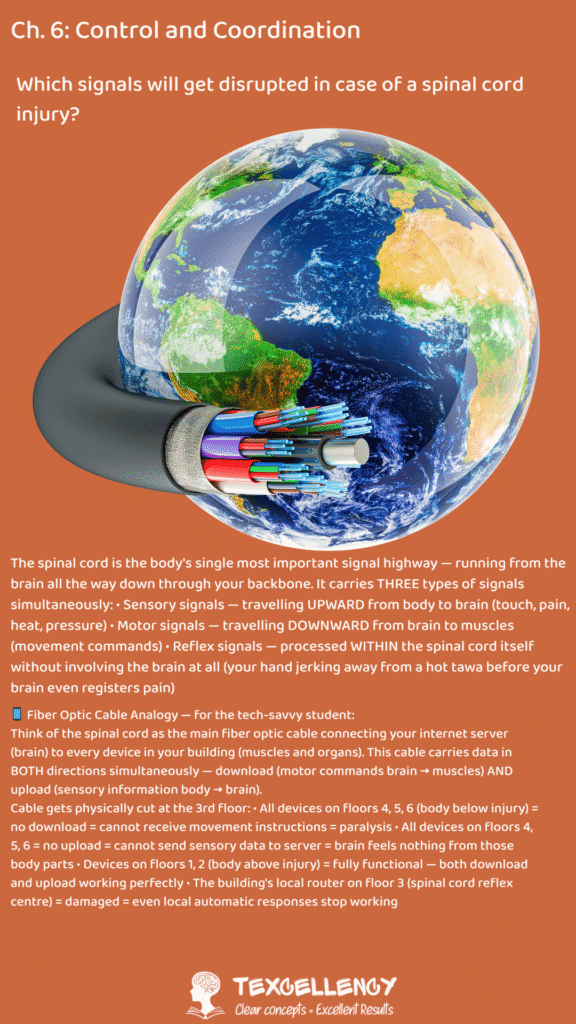
The spinal cord is the body’s single most important signal highway — a long, cylindrical bundle of nerve fibres running from the base of the brain all the way down through your backbone (vertebral column).
It is NOT just a passive wire. It is an active processing centre that simultaneously manages three completely different types of signals:
🔵 Sensory signals — travelling UPWARD from body to brain. Every time you feel touch, pain, heat, cold, pressure — that information is picked up by sensory receptors in your skin and organs, converted into electrical signals, and carried UPWARD through the spinal cord to the brain for processing. This is how your brain knows you are sitting on a chair right now.
🔵 Motor signals — travelling DOWNWARD from brain to muscles. Every time your brain decides to move — walk, pick up a pen, turn your head — it sends electrical commands DOWNWARD through the spinal cord to the specific muscles that need to contract. This is voluntary movement.
🔵 Reflex signals — processed WITHIN the spinal cord itself, without involving the brain at all. When your hand touches a hot tawa — the pain signal reaches the spinal cord — and the spinal cord IMMEDIATELY sends a motor signal back to your hand muscles saying “PULL BACK!” — all before the signal even reaches the brain. Your brain registers the pain a fraction of a second LATER. The spinal cord took the executive decision independently. This life-saving shortcut is called a reflex arc.
🌐 The Fiber Optic Cable Analogy — The Clearest Way to Understand This
Think of the spinal cord as the main fiber optic cable connecting your internet server (brain) to every device in a tall building (muscles and organs all over your body). This cable carries data in BOTH directions simultaneously — download (motor commands: brain → muscles) AND upload (sensory information: body → brain). The cable also has local routers at each floor that handle emergency responses automatically without contacting the main server.
Now imagine the cable gets physically cut at the 5th floor:
🔴 All devices on floors 6, 7, 8, 9, 10 (body parts BELOW the injury) = no download = cannot receive movement instructions from the brain = paralysis — they cannot move voluntarily.
🔴 All devices on floors 6, 7, 8, 9, 10 = no upload = cannot send sensory data upward to the brain = loss of sensation — the person feels absolutely nothing from those body parts. No pain, no touch, no temperature.
🟢 All devices on floors 1, 2, 3, 4 (body parts ABOVE the injury) = fully functional — both upload and download working perfectly. Brain communicates with them normally.
🔴 The local router at floor 5 (spinal cord reflex centre at injury level) = damaged = even the automatic local emergency responses — the reflex arcs — stop working at and below that level.
The higher up the spinal cord the injury occurs — the more of the body loses both sensation and movement. A neck-level injury can paralyse the entire body below the neck including the arms. A lower-back injury may only affect the legs.
🚂 The Railway Track Analogy — for students who love trains
Think of the spinal cord as a double-track railway line between Mumbai (brain) and Chennai (body extremities).
One track carries trains from Mumbai to Chennai (motor signals — brain to muscles — movement commands). The other track carries trains from Chennai to Mumbai (sensory signals — body to brain — sensations and information). There are also local stations along the way with their own small loops — the reflex arcs — that handle local emergencies without waiting for Mumbai’s instructions.
A landslide blocks the track at Pune: Both Mumbai-to-Chennai trains AND Chennai-to-Mumbai trains stop completely at Pune. Everything south of Pune is cut off — no movement commands can reach there, no sensory information can come back from there. The local Pune station’s emergency loop (reflex arc at injury level) is also buried under the landslide. Everything above Pune — Mumbai and stations north — continues to function perfectly.
📊 Signals Disrupted — Quick Reference Table
| Signal Type | Direction | Function | Disrupted? |
|---|---|---|---|
| Sensory (Afferent) | Body → Brain (Upward) | Carries touch, pain, heat, pressure to brain | ✅ Yes — below injury level |
| Motor (Efferent) | Brain → Body (Downward) | Carries movement commands to muscles | ✅ Yes — below injury level |
| Reflex | Within spinal cord | Automatic protective responses | ✅ Yes — at and below injury level |
| Signals above injury | Both directions | All normal communication above injury site | ❌ Not disrupted |
🏥 Real-Life Connection — Why This Matters
This is not just theory. In real spinal cord injuries — such as those caused by road accidents, sports injuries, or falls — doctors immediately check:
🔵 Can the patient feel a pinprick below the injury level? — This tests if sensory signals are intact.
🔵 Can the patient move their toes or fingers below the injury level? — This tests if motor signals are intact.
🔵 Are reflexes present below the injury level? — This tests if reflex arcs are intact.
The answers tell doctors exactly how severe the injury is and what level of the spinal cord is affected. A person with complete loss of both sensation AND movement below the waist is said to have paraplegia. Complete loss below the neck — affecting both arms and legs — is called tetraplegia (or quadriplegia).
🔁 What About Reflex Arcs — Why Are They Separately Mentioned?
Most students forget to include reflex disruption in their answer — and lose marks. Here is why reflex arcs deserve special mention:
Reflex arcs are entirely within the spinal cord. The brain is NOT involved. So even if the brain is completely healthy and trying to send signals — a damaged spinal cord means the reflex arc at that level is also broken. The person loses both voluntary control (motor + sensory) AND automatic protective responses (reflexes) below the injury level.
Three signals disrupted. Not two. Always mention all three in your exam answer.
🎵 Rhyme to Remember
“Spinal cord is the highway wide, Sensory signals go upside, Motor signals travel down, Reflex arcs protect the town — Injure the cord — the highway breaks, All three signals — the injury takes!”
🔤 Alliterations
“Sensory Signals Shoot upward, Swiftly” “Motor Messages March downward, Majestically” “Reflexes Respond Rapidly, Right inside the cord” “Spinal cord injury Silences all three Simultaneously“
🧩 Mnemonic — Remember the 3 Disrupted Signals
S — M — R → “Students Must Remember” Sensory signals (upward) • Motor signals (downward) • Reflex signals (within cord)
Or picture it as a 3-lane highway — all three lanes are blocked when the highway is damaged. Lane 1 = Sensory (going up). Lane 2 = Motor (going down). Lane 3 = Reflex (local loop).
✅ Exam-Ready Answer (3 marks)
In case of a spinal cord injury, the following signals get disrupted:
1. Sensory signals — These travel upward from the body to the brain, carrying information about touch, pain, heat, and pressure. A spinal cord injury blocks these signals — the brain receives no sensory information from body parts below the injury level. The person loses sensation.
2. Motor signals — These travel downward from the brain to the muscles, carrying movement commands. A spinal cord injury blocks these signals — the muscles below the injury level receive no commands from the brain. The person loses voluntary movement (paralysis).
3. Reflex signals — These are processed within the spinal cord itself, without involving the brain (reflex arcs). A spinal cord injury at that level disrupts these local automatic responses as well — the person loses protective reflexes below the injury level.
The higher the injury on the spinal cord, the more of the body is affected.
📌 Key Points Checklist
✅ Spinal cord = signal highway between brain and body ✅ Three signals travel through spinal cord: sensory (up), motor (down), reflex (local) ✅ Sensory disrupted → loss of sensation below injury level ✅ Motor disrupted → loss of voluntary movement (paralysis) below injury level ✅ Reflex disrupted → loss of automatic protective responses at and below injury level ✅ Body parts ABOVE injury level — unaffected, function normally ✅ Higher the injury → more of the body affected ✅ Paraplegia = legs affected • Tetraplegia = all four limbs affected ✅ Always mention ALL THREE signals in exam — most students mention only two
📚 Want ALL of Class 10 Science Explained This Way?
Every chapter. Every concept. Every NCERT question — explained with analogies, rhymes, mnemonics, and real-life connections that make sense and stay in memory long after the exam.
👉 Explore the Full Texcellency Collection 👉 Download Your FREE Book Now
“A good textbook is like a smart GPS — it doesn’t just give you the destination, it tells you every turn along the way, in simple language you actually understand.”