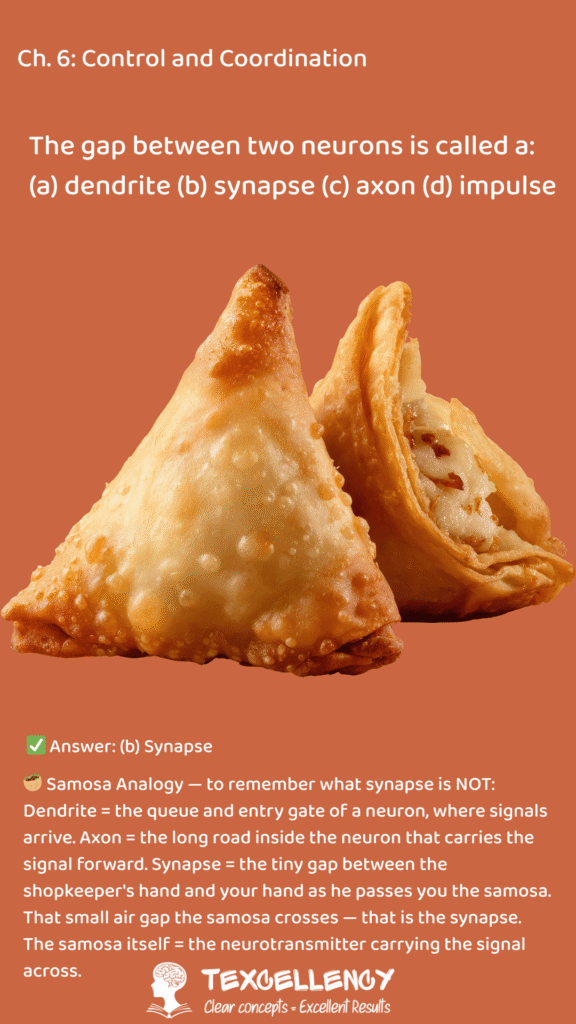
The Gap Between Two Neurons is Called a: (a) Dendrite (b) Synapse (c) Axon (d) Impulse — NCERT Class 10 Science
NCERT Class 10 Science | Chapter 7 — Control and Coordination | Texcellency Book Series
✅ Answer: (b) Synapse
The gap between two neurons is called a Synapse — more specifically, the gap itself is called the synaptic cleft, and the entire junction including the cleft and the surrounding structures is called the synapse. But in NCERT Class 10 context, synapse refers to the gap between two neurons.
Before we go deeper into why Synapse is correct — let us understand all four options properly. Because this question is really testing whether you know the difference between four crucial neuron-related terms. A student who understands all four will never get confused in any neuron question — MCQ or long answer.
🔌 The Four Options — Each One Decoded
🔵 Option (a) — Dendrite: NOT the gap
A dendrite is not a gap — it is a part of the neuron itself. Dendrites are the short, branched, tree-like extensions that grow out of the cell body of a neuron. Their job is to receive incoming nerve signals from other neurons and carry those signals toward the cell body. The word dendrite comes from the Greek word for tree — and they do look like bare tree branches spreading out in all directions.
Think of dendrites as the open hands of a cricketer in the outfield — spread wide, ready to receive whatever comes toward them. They are the receiving end of the neuron — the input side.
A dendrite is INSIDE the neuron. It is NOT the gap between neurons. So (a) is wrong.
✅ Option (b) — Synapse: THE CORRECT ANSWER
A synapse is the junction — including the gap — between the axon terminal of one neuron and the dendrite of the next neuron. It is one of the most fascinating structures in the entire body.
Here is the remarkable fact that surprises most students: neurons do NOT physically touch each other. There is always a tiny gap between them — called the synaptic cleft — typically about 20 nanometres wide. That is 20 millionths of a millimetre. Invisible even under most microscopes. And yet — this tiny gap is where one of the most critical events in your nervous system happens every single moment.
How does the electrical signal cross this gap?
🔷 Step 1 — The nerve impulse (electrical signal) travels along the axon of Neuron 1 and reaches the axon terminals at the end.
🔷 Step 2 — The arriving electrical signal triggers small packages called vesicles inside the axon terminal to release neurotransmitters — chemical messengers — into the synaptic cleft.
🔷 Step 3 — These neurotransmitters float across the synaptic cleft and bind to receptor proteins on the dendrite of Neuron 2.
🔷 Step 4 — This binding converts the chemical signal back into an electrical impulse in Neuron 2 — and the signal continues its journey.
Electrical → Chemical → Electrical. The signal changes form to cross the gap and then changes back. Like switching from road transport to ferry to cross a river — and back to road on the other side.
📱 The Bluetooth Analogy — The Clearest Way to Understand Synapse
Synapse is like the gap between two smartphones sharing a file over Bluetooth.
Your phone has the message (nerve impulse). The second phone needs it. But they are not physically connected by any wire — the signal jumps across the gap wirelessly as a radio wave. In exactly the same way, neurotransmitters are the “Bluetooth signal” that carry the nerve impulse chemically across the synaptic cleft from one neuron to the next neuron’s dendrites.
Phone 1 sends → Signal crosses gap wirelessly → Phone 2 receives → Phone 2 now has the message and acts on it.
Neuron 1 fires → Neurotransmitters cross synaptic cleft → Neuron 2’s dendrites receive → Neuron 2 fires onward.
Same logic. Different scale.
🚉 The Railway Station Platform Gap Analogy — for the concept of crossing without touching
You are on a Mumbai local train. You want to get to the platform. There is a small gap between the train door and the platform edge. You cannot stay in the train — you must cross that gap to reach the platform and continue your journey. You step across. Gap crossed. Journey continues.
The nerve impulse is the passenger. The axon terminal is the train. The synaptic cleft is the platform gap. The neurotransmitters are the step the passenger takes to cross. The dendrite of Neuron 2 is the platform — where the journey continues.
The gap looks small and insignificant — but without crossing it successfully, the entire signal journey stops dead. The synapse is the most critical handover point in the entire nervous system.
🔵 Option (c) — Axon: NOT the gap
An axon is not a gap — it is another part of the neuron itself. The axon is the single, long fibre that extends from the cell body and carries the electrical nerve impulse away from the cell body toward the axon terminals. It is the neuron’s transmission wire — sometimes stretching over a metre in length.
The axon is covered by the myelin sheath — a fatty white insulating layer that speeds up signal transmission dramatically by making the impulse jump from one gap in the myelin (Node of Ranvier) to the next, rather than travelling the entire length continuously.
The axon is INSIDE the neuron. It carries the signal WITHIN the neuron. It is NOT the gap between neurons. So (c) is wrong.
🔵 Option (d) — Impulse: NOT the gap
An impulse (nerve impulse) is not a gap — it is the signal itself — the electrical message that travels along the neuron. It is an electrochemical wave — a brief reversal of the electrical charge across the neuron membrane — that sweeps from the dendrites through the cell body down the axon to the axon terminals.
Think of the impulse as the WhatsApp message itself — not the phone, not the cable, not the gap between devices — but the actual content being transmitted. The synapse is the gap the message must cross. The impulse is what crosses it.
An impulse travels WITHIN the neuron. It is the signal, not the structure. It is NOT the gap between neurons. So (d) is wrong.
📊 All Four Options — Side by Side Clarity Table
| Term | What it IS | Location | Role in Signal Transmission |
|---|---|---|---|
| Synapse ✅ | The gap/junction between two neurons | Between neurons | Where signal transfers from one neuron to next via neurotransmitters |
| Dendrite ❌ | Short branched extension of cell body | Part of neuron (input end) | Receives incoming signals |
| Axon ❌ | Long single fibre from cell body | Part of neuron (output end) | Carries signal away from cell body |
| Impulse ❌ | The electrical signal itself | Travels along neuron | The message being carried — not a structure |
⚡ Why is the Synapse So Important — Beyond Just the Answer
The synapse is not just a gap — it is the control valve of the entire nervous system. Here is why:
🔵 One-way signal flow — neurotransmitters are released ONLY from axon terminals — NEVER from dendrites. This means signals can only cross the synapse in one direction — from axon terminal of Neuron 1 to dendrite of Neuron 2. NEVER backward. The synapse is what makes the entire nervous system directional and orderly.
🔵 Signal amplification or inhibition — some neurotransmitters are excitatory (they make the next neuron MORE likely to fire — like pressing the accelerator). Others are inhibitory (they make the next neuron LESS likely to fire — like pressing the brake). The synapse is where the nervous system fine-tunes and controls signal strength.
🔵 Many drugs and medicines work at synapses — caffeine, antidepressants, anaesthetics, painkillers — most of them work by either mimicking neurotransmitters, blocking receptor sites, or preventing neurotransmitter breakdown at synapses. Understanding the synapse is the foundation of pharmacology.
🔵 Learning and memory are formed at synapses — when the same neural pathway is used repeatedly, the synapses along that pathway become more efficient — releasing more neurotransmitter, responding faster. This is how skills are learned, memories are formed, and habits are built. Every time you practise something — you are physically strengthening synapses.
🎵 Rhyme to Remember
“Dendrite receives — it is inside, Axon transmits — it is the ride, Impulse is the message rushing through, But Synapse is the GAP — that much is true! Neurotransmitters swim across the space, Carrying the signal from place to place — Two neurons never touch — and yet they speak, Through the synapse — the connection they seek!”
🔤 Alliterations
“Synapse = the Space between two neurons where Signals are Sent chemically” “Dendrites Detect and Deliver signals toward the cell body” “Axons Always carry signals Away from the cell body” “Impulses are the electrical Instructions rushing Inside the neuron“
🧩 Mnemonic — Never Confuse These Four Terms Again
D — A — S — I → “Delivery Always Starts Inside”
Dendrites receive → Axon transmits → Synapse is the gap between → Impulse is the signal crossing all of these
Or remember by location: Dendrite = INPUT end of neuron (inside neuron) Axon = OUTPUT end of neuron (inside neuron) Synapse = BETWEEN neurons (outside both neurons — the gap) Impulse = the SIGNAL itself (not a structure at all)
Quick trick: “Which is the gap?” → Only Synapse is BETWEEN neurons. All others are INSIDE or ARE the signal.
✅ Exam-Ready Answer
Answer: (b) Synapse
The gap between two neurons is called a synapse (specifically the gap is called the synaptic cleft). Neurons do not physically touch each other — there is always a tiny gap between the axon terminal of one neuron and the dendrite of the next.
When a nerve impulse reaches the axon terminal, it triggers the release of chemical messengers called neurotransmitters into this gap. These neurotransmitters diffuse across the synaptic cleft and bind to receptor proteins on the dendrite of the next neuron, generating a new electrical impulse in that neuron. This is how the signal is transmitted from one neuron to the next.
The synapse ensures one-way signal transmission since neurotransmitters are only released from axon terminals and received by dendrites — never the reverse.
📌 Key Points Checklist
✅ Gap between two neurons = Synapse (synaptic cleft = the gap itself) ✅ Neurons NEVER physically touch each other ✅ Signal crosses synapse chemically via neurotransmitters ✅ Signal transfer at synapse: Electrical → Chemical → Electrical ✅ Neurotransmitters released from axon terminal only → one-way flow guaranteed ✅ Dendrite = part of neuron = receives incoming signals = INPUT end ✅ Axon = part of neuron = carries signal away from cell body = OUTPUT end ✅ Impulse = the electrical signal itself — not a structure ✅ Synapse controls signal direction, strength, and is where memory and learning are formed ✅ Most drugs affecting the nervous system work by interfering with synaptic transmission
📚 Want ALL of Class 10 Science Explained This Way?
Every chapter. Every concept. Every NCERT question — explained with analogies, rhymes, mnemonics, and real-life examples that make sense and stay in memory long after exam day.
👉 Explore the Full Texcellency Collection 👉 Download Your FREE Book Now
“A good textbook is like a smart GPS — it doesn’t just give you the destination, it tells you every turn along the way, in simple language you actually understand.”