
What are the differences between the transport of materials in xylem and phloem?
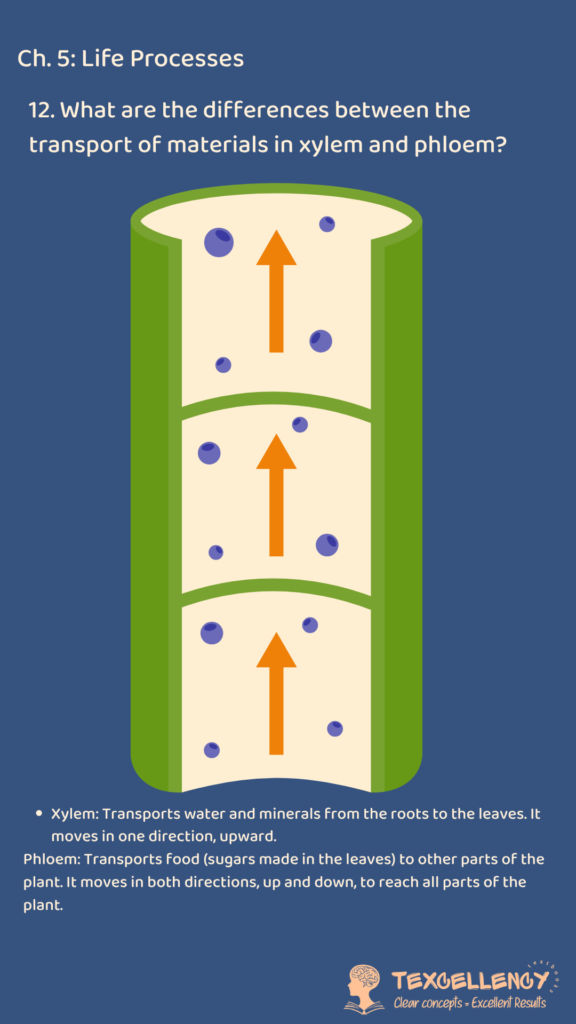
What Are the Differences Between the Transport of Materials in Xylem and Phloem? — NCERT Class 10 Science
NCERT Class 10 Science | Chapter 6 — Life Processes | Texcellency Book Series
Xylem transports water and dissolved minerals from roots upward to leaves and other parts — movement is always unidirectional (upward only) — driven by transpiration pull and root pressure — and requires no energy (passive). Phloem transports prepared food (sucrose/sugars) from leaves to all parts of the plant — movement is bidirectional (up and down) — driven by osmotic pressure — and requires energy (active).
🌳 The Big Picture — Why Plants Need Two Separate Transport Systems
Think about what a plant needs to survive. On one hand it needs a constant supply of raw materials — water and minerals — absorbed from the soil by roots and needed at the leaves for photosynthesis. On the other hand, after the leaves make food (glucose/sucrose) through photosynthesis, that food must be distributed to every cell in the plant — roots, stem, developing fruits, seeds — everywhere.
These are two completely different transport jobs:
🔵 Job 1 — Move water and minerals from soil (roots) upward to leaves. One source (roots). One destination (leaves and other aerial parts). Always upward. No energy needed if the right forces are harnessed.
🔵 Job 2 — Move food from leaves (where it is made) to everywhere else in the plant. One main source (leaves). Many destinations (roots, stems, fruits, seeds, growing tips). Must go both up and down. Needs energy because food must be actively loaded into the transport system.
One transport system cannot efficiently do both jobs. So plants evolved two separate, parallel conducting tubes — xylem for water and minerals, phloem for food — running side by side through the entire plant like a dual-pipeline system.
🚰 The Water Pipeline + Food Delivery Van Analogy — The Clearest Picture
Xylem = The municipal water supply pipeline. Underground pipes (roots) collect water from the source (soil), push it upward through building pipes (stem), and deliver it to every tap and outlet (leaves, flowers, fruits). Flow is always in one direction — upward from source to consumer. No pump motor needed — the pressure system (transpiration pull + root pressure) moves water naturally, like how water pressure drives taps.
Phloem = The food delivery van network. The kitchen (leaves) prepares food (glucose/sucrose). Delivery vans (phloem sieve tubes) pick up the food and drive it to every address in the building — upstairs (developing buds, flowers) AND downstairs (roots, storage organs). Two-way traffic. Needs a driver (energy) to load and unload at each stop.
Same plant. Two parallel pipelines. Completely different contents. Completely different direction rules. Completely different energy requirements.
🔬 Part 1 — Xylem: The Water and Mineral Highway
🏗️ Structure of Xylem
Xylem is made of dead cells — hollow, thick-walled, lignified tubes that form continuous pipelines from root to leaf tip. The main conducting elements are tracheids and vessel elements — both dead at maturity, with no cell contents — essentially hollow tubes perfectly designed for water flow with minimum resistance.
Being dead is actually an advantage here — dead cells have no cell contents blocking water flow. The hollow tubes allow water to move freely with maximum efficiency, like empty pipes.
⚙️ How Does Water Move Through Xylem — The Three Forces
🔷 Force 1 — Transpiration Pull (the main force): Leaves constantly lose water vapour through stomata — a process called transpiration. As water evaporates from leaf cells, it creates a tension — a pulling force — that literally sucks water upward through the xylem from the roots. This is called the transpiration pull or cohesion-tension theory. Water molecules cling to each other (cohesion) and to xylem walls (adhesion), forming an unbroken column that is pulled upward from top. Like drinking through a straw — suction at the top pulls liquid up from the bottom.
🔷 Force 2 — Root Pressure: Root cells actively absorb mineral ions from soil — creating a higher solute concentration inside roots than outside. This draws water into roots by osmosis — creating a pressure that pushes water upward into the xylem. This root pressure is the lower push — while transpiration pull is the upper pull. Both work together.
🔷 Force 3 — Capillary Action: Water naturally rises in very narrow tubes due to cohesion and adhesion forces. Xylem vessels are narrow — so capillary action contributes to moving water upward, especially in shorter plants.
Combined result: Water moves continuously upward from roots → stem → leaves without the plant spending any energy. Completely passive. Solar-powered through the evaporation at leaves driving transpiration pull.
📦 What Does Xylem Transport?
🔵 Water — the most important raw material for photosynthesis and for maintaining cell turgor 🔵 Dissolved mineral salts absorbed from soil — nitrogen, phosphorus, potassium, calcium, magnesium — essential for protein synthesis, chlorophyll formation, enzyme function
🔬 Part 2 — Phloem: The Food Distribution Network
🏗️ Structure of Phloem
Unlike xylem, phloem is made of living cells — because the active loading and unloading of food requires living cellular machinery. The main conducting elements are sieve tube elements — long, cylindrical cells with perforated end walls called sieve plates that allow food to flow between cells. Each sieve tube element is accompanied by a companion cell — a fully active cell that provides energy and metabolic support to the sieve tube (which has reduced its own cellular machinery to maximise flow space).
⚙️ How Does Food Move Through Phloem — The Pressure Flow Hypothesis
🔷 Step 1 — Loading at the Source (leaves): Photosynthesis produces glucose in leaf cells. This glucose is converted to sucrose (more stable for transport) and actively loaded into the sieve tubes at the leaves using energy (ATP). This increases the solute concentration inside the sieve tube at the leaf end — drawing water in by osmosis — creating HIGH pressure at the leaf (source) end.
🔷 Step 2 — Unloading at the Sink (roots, fruits, seeds): At the destination — roots, growing fruits, storage organs — sucrose is actively unloaded from the sieve tubes into surrounding cells (where it is used or stored). This decreases solute concentration in the sieve tube at the sink end — water leaves by osmosis — creating LOW pressure at the sink end.
🔷 Step 3 — Flow from High to Low Pressure: The pressure difference between source (high) and sink (low) drives food through the phloem from source to sink — just like air moves from high pressure to low pressure. This is the pressure flow hypothesis (also called mass flow hypothesis).
Why bidirectional? Because leaves are the source — but sinks exist both above the leaves (developing buds, flowers, young fruits) AND below the leaves (roots, storage organs). Food must flow both upward and downward simultaneously — which xylem with its unidirectional pull cannot do. Phloem handles this beautifully with its pressure-flow system.
📦 What Does Phloem Transport?
🔵 Sucrose — the main form in which photosynthetically produced food is transported 🔵 Amino acids — in smaller quantities 🔵 Some hormones and signalling molecules 🔵 Water (accompanies the dissolved substances)
🚂 The Train System Analogy — for the direction difference
Xylem = A one-way express train from Mumbai to Delhi. Only goes northward (upward). Cannot reverse. Carries one cargo (water + minerals). Very fast. No stops at intermediate stations for loading/unloading. Passive — no engine needed, wind and gravity do the work.
Phloem = A two-way local train running between all stations. Goes both up and down depending on where the cargo is needed. Carries prepared food. Stops at every station (every cell that needs food). Active — needs an engine (energy/ATP) to load and unload cargo at each stop. Bidirectional because different destinations are in different directions from the kitchen (leaves).
📊 Xylem vs Phloem — The Master Comparison Table
| Feature | Xylem | Phloem |
|---|---|---|
| Material transported | Water and dissolved mineral salts | Prepared food (sucrose, amino acids) |
| Direction of transport | Unidirectional — upward only | Bidirectional — up and down |
| Cells involved | Dead cells (tracheids, vessels) | Living cells (sieve tubes, companion cells) |
| Energy requirement | Passive — no energy needed | Active — requires energy (ATP) |
| Driving force | Transpiration pull + root pressure | Osmotic pressure (pressure flow) |
| Process name | Ascent of sap | Translocation |
| Source → Destination | Roots → Leaves and aerial parts | Leaves → All parts (roots, fruits, seeds, buds) |
| Cell wall | Thick, lignified | Thin, cellulosic |
| Direction of evolution | More ancient | More recently evolved |
🌿 Key Terms Every Student Must Know
🔵 Transpiration — loss of water vapour from leaves through stomata. Creates the pull that drives xylem transport. The “exhaust” of the water transport engine.
🔵 Transpiration Pull — the suction force created by transpiration that pulls the entire water column upward through xylem.
🔵 Translocation — the technical term for movement of food through phloem. Often asked: “What is the process by which phloem transports food?” — Answer: Translocation.
🔵 Ascent of Sap — the technical term for upward movement of water and minerals through xylem.
🔵 Source — the part of the plant that produces or releases food into phloem (mainly leaves during photosynthesis, or storage organs during germination).
🔵 Sink — the part of the plant that receives food from phloem (roots, growing fruits, seeds, meristematic tissues).
🎵 Rhyme to Remember
“Xylem carries water — always going up, Dead hollow tubes — filling every cup, Transpiration pulls it — roots push it too, Minerals dissolved — riding through and through! Phloem carries food — the sucrose so sweet, Living sieve tubes — making transport complete, Up to the buds — down to the roots below, Two directions — energy makes it flow! X for eXit (upward) — P for Please (both ways), Two systems together — keep the plant alive always!”
🔤 Alliterations
“Xylem = Water eXpress — going up eXclusively, eXpending no energy” “Phloem = Food Flowing both Forward and Far — upward and downward” “Transpiration Tugs the water column Toward the Top” “Translocation Transfers food to every Tissue that needs it“
🧩 Mnemonic — Never Confuse Xylem and Phloem Again
X = eXit water upward → Xylem carries water and minerals → always upward → no energy
Ph = PHood (Food with a Ph!) → Phloem carries food → both directions → needs energy
Or the classic student trick: “X for eXtra thirsty roots sending water UP” “Ph for PHotosynthesis food going EVERYWHERE”
Remember direction with: “Xylem = One way street. Phloem = Two way road.”
✅ Exam-Ready Answer (3–4 marks)
Differences between transport in Xylem and Phloem:
Xylem: 1. Transports water and dissolved mineral salts from roots to leaves and other aerial parts. 2. Movement is unidirectional — always upward. 3. Made of dead cells (tracheids and vessel elements) with thick lignified walls. 4. Transport is passive — requires no energy. Driven by transpiration pull and root pressure. 5. The process is called the ascent of sap.
Phloem: 1. Transports prepared food (mainly sucrose) from leaves to all parts of the plant — roots, fruits, seeds, growing tips. 2. Movement is bidirectional — both upward and downward, depending on where the food is needed. 3. Made of living cells (sieve tube elements and companion cells). 4. Transport is active — requires energy (ATP) for loading and unloading food at source and sink. 5. The process is called translocation.
📌 Key Points Checklist
✅ Xylem = water + minerals = upward only = passive = dead cells = transpiration pull ✅ Phloem = food (sucrose) = bidirectional = active (needs energy) = living cells = pressure flow ✅ Xylem cells are dead at maturity — hollow tubes for maximum water flow efficiency ✅ Phloem cells are living — need cellular machinery for active loading/unloading ✅ Transpiration pull = main force driving xylem transport = created by water evaporation from leaves ✅ Root pressure = secondary force pushing water into xylem from below ✅ Translocation = movement of food through phloem ✅ Ascent of sap = movement of water through xylem ✅ Source = leaves (food made here) → Sink = roots, fruits, seeds (food used/stored here) ✅ Phloem bidirectional because sinks exist both above AND below the leaves
📚 Want ALL of Class 10 Science Explained This Way?
Every chapter. Every concept. Every NCERT question — explained with analogies, rhymes, mnemonics, and real-life examples that make sense and stay in memory long after exam day.
👉 Explore the Full Texcellency Collection 👉 Download Your FREE Book Now
“A good textbook is like a smart GPS — it doesn’t just give you the destination, it tells you every turn along the way, in simple language you actually understand.”