
Q. Which of the following hydrocarbons undergo addition reactions: C2H6, C3H8, C3H6, C2H2 and CH4.
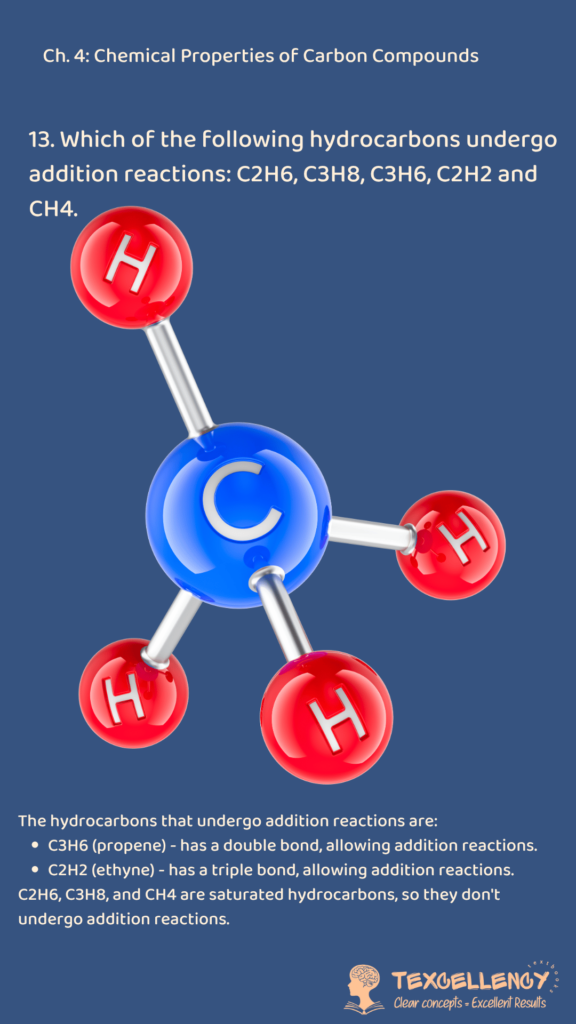
NCERT Class 10 Science | Chapter: Carbon and Its Compounds | Texcellency Book Series
✅ Answer: C₃H₆ (Propene) and C₂H₂ (Ethyne) Undergo Addition Reactions
🔵 C₃H₆ (Propene) — ✅ YES — it is an alkene (contains one C=C double bond) → undergoes addition reactions 🔵 C₂H₂ (Ethyne / Acetylene) — ✅ YES — it is an alkyne (contains one C≡C triple bond) → undergoes addition reactions 🔵 C₂H₆ (Ethane) — ❌ NO — it is an alkane (only C–C single bonds) → does NOT undergo addition reactions 🔵 C₃H₈ (Propane) — ❌ NO — it is an alkane (only C–C single bonds) → does NOT undergo addition reactions 🔵 CH₄ (Methane) — ❌ NO — it is an alkane (only C–C single bonds) → does NOT undergo addition reactions
The golden rule: Only unsaturated hydrocarbons (alkenes and alkynes — those with C=C or C≡C bonds) undergo addition reactions. Saturated hydrocarbons (alkanes — those with only C–C single bonds) do NOT undergo addition reactions. Instead, alkanes undergo substitution reactions.
🏭 The Seat Analogy — Understanding Saturated vs Unsaturated
Imagine a train compartment. Every seat represents a bond a carbon atom can form.
🔵 Saturated hydrocarbon (alkane): Every single seat in the compartment is occupied — by hydrogen atoms. There is no empty seat for a new passenger (new atom) to sit. The train is FULL. Nothing can be added. This is methane (CH₄), ethane (C₂H₆), propane (C₃H₈) — all seats taken by H atoms.
🔵 Unsaturated hydrocarbon (alkene/alkyne): Some seats are “double-booked” — two passengers sharing one seat awkwardly (the double bond). These double-booked passengers can be separated — one moves to a newly added seat — making room for a new passenger to board. This is the addition reaction. The C=C double bond is like that awkwardly shared seat — available to be broken open and used.
🔴 Step 1 — Identify Each Hydrocarbon by Name and Type
Before answering the question, you must know what each formula represents. This is where marks are won.
CH₄ — Methane — Alkane
🔵 Name: Methane 🔵 Family: Alkane (saturated hydrocarbon) 🔵 Structure: 1 carbon, 4 hydrogens — H–C–H with 4 single bonds | All bonds are C–H single bonds 🔵 Degree of unsaturation: ZERO — no double bonds, no triple bonds 🔵 Real-life: The main component of LPG (cooking gas), natural gas, biogas. The gas that burns with a blue flame in your kitchen stove. 🔵 Addition reaction? ❌ NO — fully saturated, no double/triple bond to add across 🔵 Typical reaction: Substitution reaction (e.g., with Cl₂ in sunlight: CH₄ + Cl₂ → CH₃Cl + HCl)
C₂H₆ — Ethane — Alkane
🔵 Name: Ethane 🔵 Family: Alkane (saturated hydrocarbon) 🔵 Structure: 2 carbons connected by a single bond, each carbon has 3 hydrogen atoms | H₃C–CH₃ 🔵 Degree of unsaturation: ZERO 🔵 General formula check: Alkanes follow CₙH₂ₙ₊₂ → for n=2: C₂H₆ ✓ (2×2+2 = 6) 🔵 Addition reaction? ❌ NO — saturated, no reactive multiple bond 🔵 Typical reaction: Substitution
C₃H₈ — Propane — Alkane
🔵 Name: Propane 🔵 Family: Alkane (saturated hydrocarbon) 🔵 Structure: 3 carbons in a chain, all single bonds | H₃C–CH₂–CH₃ 🔵 Degree of unsaturation: ZERO 🔵 General formula check: CₙH₂ₙ₊₂ → for n=3: C₃H₈ ✓ (2×3+2 = 8) 🔵 Real-life: Propane is used in camping gas cylinders and is a component of LPG 🔵 Addition reaction? ❌ NO — saturated 🔵 Typical reaction: Substitution
C₃H₆ — Propene — Alkene ✅
🔵 Name: Propene (also called Propylene) 🔵 Family: Alkene (unsaturated hydrocarbon — one C=C double bond) 🔵 Structure: 3 carbons, one double bond between carbon 1 and carbon 2 | H₂C=CH–CH₃ 🔵 Degree of unsaturation: ONE (one C=C double bond) 🔵 General formula check: Alkenes follow CₙH₂ₙ → for n=3: C₃H₆ ✓ (2×3 = 6) 🔵 Real-life: Propene is an important industrial chemical — used to make polypropylene plastic (the plastic used in chairs, containers, ropes, packaging) 🔵 Addition reaction? ✅ YES — the C=C double bond can undergo addition with H₂, Br₂, HCl, H₂O etc.
C₂H₂ — Ethyne — Alkyne ✅
🔵 Name: Ethyne (also called Acetylene) 🔵 Family: Alkyne (unsaturated hydrocarbon — one C≡C triple bond) 🔵 Structure: 2 carbons connected by a triple bond, one hydrogen on each carbon | H–C≡C–H 🔵 Degree of unsaturation: TWO (a triple bond = two degrees of unsaturation, can undergo addition twice) 🔵 General formula check: Alkynes follow CₙH₂ₙ₋₂ → for n=2: C₂H₂ ✓ (2×2-2 = 2) 🔵 Real-life: Ethyne is the gas used in oxyacetylene welding torches (burns at 3000°C with pure oxygen). Also used industrially to make plastics and synthetic rubber. 🔵 Addition reaction? ✅ YES — the C≡C triple bond can undergo addition (even twice — once across each of the two extra bonds in the triple bond)
🔶 Step 2 — What IS an Addition Reaction?
An addition reaction is a reaction in which two molecules combine to form a single product — by breaking a multiple bond (C=C or C≡C) and adding atoms across it.
The key requirement: The molecule MUST have a C=C double bond OR a C≡C triple bond. The multiple bond “opens up” and the incoming atoms (H₂, Br₂, HCl, H₂O etc.) attach to the carbons on either side.
General form: A=B + X–Y → A(X)–B(Y)
The double bond becomes a single bond. The two atoms of X–Y attach to the two carbons that previously shared the double bond.
🔴 Step 3 — Addition Reactions of C₃H₆ (Propene) with Examples
1. Hydrogenation of Propene (Addition of H₂)
CH₂=CH–CH₃ + H₂ →(Ni catalyst, heat)→ CH₃–CH₂–CH₃ (Propene + Hydrogen → Propane)
🔵 The double bond breaks open — one H attaches to each carbon 🔵 Product: Propane (a saturated alkane — the double bond is gone) 🔵 Catalyst needed: Nickel (Ni) or Platinum (Pt) 🔵 This is the same chemistry as hydrogenation of cooking oil → Dalda/Vanaspati
2. Halogenation of Propene (Addition of Br₂)
CH₂=CH–CH₃ + Br₂ → CH₂Br–CHBr–CH₃ (Propene + Bromine → 1,2-dibromopropane)
🔵 Orange bromine water turns COLOURLESS — this is the bromine water test for unsaturation 🔵 One Br attaches to each of the two carbons that had the double bond 🔵 This is exactly the same chemistry that distinguishes cooking oil from butter (see our Butter vs Cooking Oil post)
3. Addition of HCl to Propene
CH₂=CH–CH₃ + HCl → CH₃–CHCl–CH₃ (Propene + Hydrogen chloride → 2-chloropropane)
🔵 H adds to one carbon, Cl adds to the other carbon of the double bond 🔵 Product is a halogenated alkane
🔴 Step 4 — Addition Reactions of C₂H₂ (Ethyne) with Examples
Ethyne is special — it has a TRIPLE bond, which means it can undergo addition reactions TWICE (once for each extra bond beyond the single bond).
1. Hydrogenation of Ethyne — First Addition
HC≡CH + H₂ →(Ni catalyst)→ H₂C=CH₂ (Ethyne + Hydrogen → Ethene)
🔵 First H₂ adds across one of the two extra bonds — triple bond becomes double bond 🔵 Product: Ethene (still unsaturated — still has a double bond — can react again)
2. Hydrogenation of Ethyne — Second Addition
H₂C=CH₂ + H₂ →(Ni catalyst)→ H₃C–CH₃ (Ethene + Hydrogen → Ethane)
🔵 Second H₂ adds across the remaining double bond — double bond becomes single bond 🔵 Final product: Ethane (now fully saturated — no more addition possible) 🔵 Net reaction: HC≡CH + 2H₂ → CH₃–CH₃ (ethyne → ethane in two steps)
3. Halogenation of Ethyne (Addition of Br₂)
HC≡CH + Br₂ → CHBr=CHBr (first addition) CHBr=CHBr + Br₂ → CHBr₂–CHBr₂ (second addition)
🔵 Again, ethyne can react with TWO molecules of Br₂ (one for each extra bond)
4. Addition of HCl to Ethyne (Industrial Importance)
HC≡CH + HCl → CH₂=CHCl (Ethyne + HCl → Vinyl chloride / Chloroethene)
🔵 Vinyl chloride is the monomer used to make PVC (polyvinyl chloride) plastic — one of the most widely used plastics in the world (pipes, cables, flooring, credit cards, synthetic leather) 🔵 This is a brilliant real-world application of an addition reaction on ethyne
🔷 Step 5 — Why Do Alkanes NOT Undergo Addition Reactions?
This is the conceptual core — and the part that most students skip.
Reason 1 — No Multiple Bond to Add Across
CH₄, C₂H₆, C₃H₈ have ONLY single bonds (C–C and C–H). An addition reaction requires a multiple bond to open up. No multiple bond = no addition reaction. Simple.
Reason 2 — They Are “Satisfied” / “Saturated”
Each carbon in an alkane is bonded to the maximum number of atoms it can bond to (4 bonds, all used up). There is no “room” to add anything. The molecule is chemically content — it does not need to react by addition.
What DO Alkanes React By?
Alkanes undergo substitution reactions — where one atom (usually H) is REPLACED by another atom (usually a halogen like Cl), rather than adding a new atom.
CH₄ + Cl₂ →(sunlight)→ CH₃Cl + HCl (Methane + Chlorine → Chloromethane + Hydrogen chloride)
🔵 One H is substituted (replaced) by one Cl 🔵 No double bond needed — it is a free radical substitution 🔵 This is why alkanes are also called paraffins — from Latin “parum affinis” meaning “little affinity” — they are relatively unreactive under normal conditions
📊 Complete Analysis Table — All 5 Hydrocarbons
| Hydrocarbon | Name | Family | Bond Type | Addition Reaction? | Typical Reaction |
|---|---|---|---|---|---|
| CH₄ | Methane | Alkane | C–C, C–H (single only) | ❌ NO | Substitution |
| C₂H₆ | Ethane | Alkane | C–C, C–H (single only) | ❌ NO | Substitution |
| C₃H₈ | Propane | Alkane | C–C, C–H (single only) | ❌ NO | Substitution |
| C₃H₆ | Propene | Alkene | C=C (one double bond) | ✅ YES | Addition |
| C₂H₂ | Ethyne | Alkyne | C≡C (one triple bond) | ✅ YES (twice) | Addition |
🔶 The General Formula Shortcut — Identify the Family Instantly
If you know the general formula, you can identify the family and immediately know whether addition reactions are possible:
🔵 CₙH₂ₙ₊₂ → Alkane → Saturated → NO addition reaction → CH₄ (n=1): 2(1)+2=4 ✓ | C₂H₆ (n=2): 2(2)+2=6 ✓ | C₃H₈ (n=3): 2(3)+2=8 ✓
🔵 CₙH₂ₙ → Alkene → One C=C double bond → YES addition reaction → C₃H₆ (n=3): 2(3)=6 ✓ — propene confirmed as alkene
🔵 CₙH₂ₙ₋₂ → Alkyne → One C≡C triple bond → YES addition reaction (twice) → C₂H₂ (n=2): 2(2)-2=2 ✓ — ethyne confirmed as alkyne
This shortcut is exam gold. Apply the formula, identify the family, decide instantly.
🎵 Rhyme to Remember
“Alkane, alkene, alkyne — three families in a line, Alkane has singles — it won’t add, it’s fine,* Alkene has a double — addition is its game,* Alkyne has a triple — it plays the same!* CH₄, C₂H₆, C₃H₈ — all alkanes, all say NO,* C₃H₆ and C₂H₂ — they’re the ones that go!* Double bond or triple bond — that’s the only key,* No multiple bond, no addition — that’s chemistry!”*
🧩 Mnemonics
🔵 “ANES DON’T ADD, ENES AND YNES DO” — alkANES don’t undergo addition; alkENES and alkYNES do. The suffix tells you everything. 🔵 “CₙH₂ₙ₊₂ = FULL (no room to add) | CₙH₂ₙ = ONE DOOR OPEN | CₙH₂ₙ₋₂ = TWO DOORS OPEN” — the general formula tells you how many addition reactions are possible. 🔵 “DOUBLE or TRIPLE = Addition possible. SINGLE only = Substitution only.” 🔵 “Ethyne adds TWICE — it has a triple, react it nice — first to ethene, then to ethane.” 🔵 “Vinyl chloride from ethyne + HCl = the birth of PVC plastic” — real-world hook for ethyne’s addition reaction.
✅ Exam-Ready Answer (Write This in Board Exam)
Which of the following hydrocarbons undergo addition reactions: C₂H₆, C₃H₈, C₃H₆, C₂H₂ and CH₄?
Answer: C₃H₆ (Propene) and C₂H₂ (Ethyne)
Addition reactions are undergone only by unsaturated hydrocarbons — those containing C=C double bonds (alkenes) or C≡C triple bonds (alkynes). These multiple bonds open up and allow new atoms to add across them.
C₃H₆ (Propene) — Alkene — ✅ Undergoes addition reaction: Propene contains one C=C double bond. Example: CH₂=CH–CH₃ + H₂ →(Ni)→ CH₃–CH₂–CH₃ (propene → propane) CH₂=CH–CH₃ + Br₂ → CH₂Br–CHBr–CH₃ (bromine water decolourised)
C₂H₂ (Ethyne) — Alkyne — ✅ Undergoes addition reaction (can react twice): Ethyne contains one C≡C triple bond. Example: HC≡CH + H₂ →(Ni)→ H₂C=CH₂ (first addition — ethene formed) H₂C=CH₂ + H₂ →(Ni)→ H₃C–CH₃ (second addition — ethane formed)
C₂H₆ (Ethane), C₃H₈ (Propane), CH₄ (Methane) — Alkanes — ❌ Do NOT undergo addition reactions: These are saturated hydrocarbons — they contain only C–C and C–H single bonds. No multiple bond is present for addition to occur. They undergo substitution reactions instead.
📌 Key Points Checklist
✅ Answer: C₃H₆ (propene) and C₂H₂ (ethyne) undergo addition reactions ✅ Addition reactions require C=C (double bond) OR C≡C (triple bond) — multiple bonds only ✅ Alkanes (CH₄, C₂H₆, C₃H₈) = saturated = only single bonds = NO addition = substitution instead ✅ Alkenes (C₃H₆ = propene) = one C=C double bond = one addition reaction possible ✅ Alkynes (C₂H₂ = ethyne) = one C≡C triple bond = TWO addition reactions possible ✅ General formula: alkane CₙH₂ₙ₊₂ | alkene CₙH₂ₙ | alkyne CₙH₂ₙ₋₂ ✅ Addition of H₂ = hydrogenation (needs Ni catalyst + heat) — same as cooking oil → Dalda ✅ Addition of Br₂ = halogenation — bromine water turns colourless (test for unsaturation) ✅ Ethyne + HCl → vinyl chloride → polymerises to PVC plastic (industrial application) ✅ Alkanes undergo substitution (not addition): CH₄ + Cl₂ → CH₃Cl + HCl (in sunlight)
📚 Want ALL of Class 10 Science Explained This Way? Every chapter. Every concept. Every NCERT question — with analogies, rhymes, mnemonics, and real-life examples.