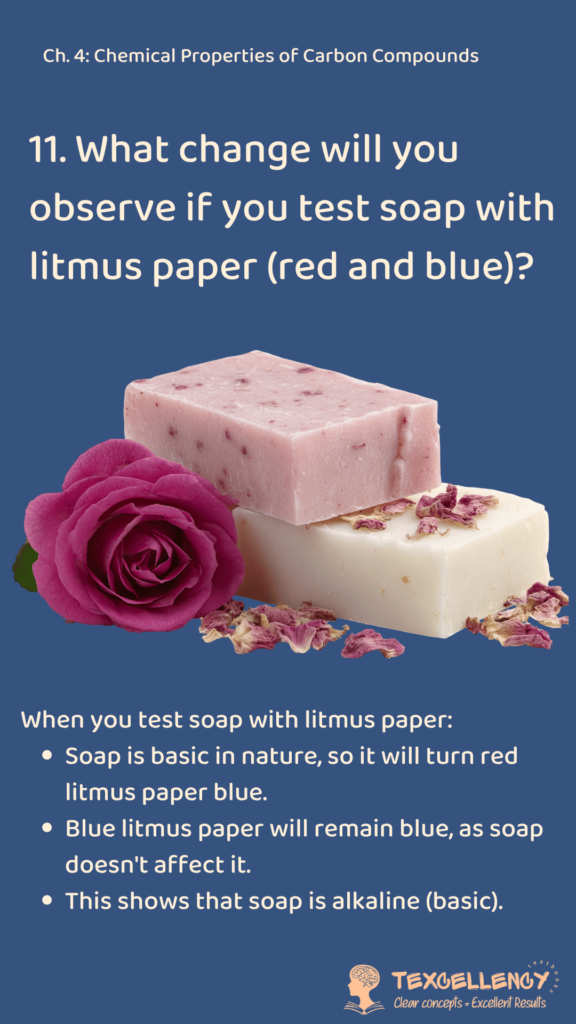
What change will you observe if you test soap with litmus paper (red and blue)?
NCERT Class 10 Science | Chapter: Carbon and Its Compounds | Texcellency Book Series
✅ Answer: Red Litmus Turns Blue. Blue Litmus Stays Blue.
🔵 Red litmus paper + soap solution → Turns BLUE — because soap is basic (alkaline), and bases turn red litmus blue. 🔵 Blue litmus paper + soap solution → Stays BLUE — because soap is basic. Blue litmus already indicates a basic substance — it does not change colour further. It will not turn red (that only happens with acids).
Conclusion from the test: Soap is basic (alkaline) in nature — pH greater than 7 (typically around pH 9–10).
This is the complete answer. Now let us understand WHY soap is basic — because the examiner often follows this question with “explain why.”
🏭 The Colour Signal Analogy — Litmus as a Traffic Light
Think of litmus paper as a chemical traffic light with only two colours:
🔵 RED signal = acidic environment (pH below 7) — acids turn blue litmus RED 🔵 BLUE signal = basic/alkaline environment (pH above 7) — bases turn red litmus BLUE
When soap arrives at the litmus paper traffic light: 🔵 Red litmus sees soap → soap is basic → the signal upgrades from RED to BLUE ✅ 🔵 Blue litmus sees soap → soap is basic → the signal is already BLUE → no change needed ✅
Soap will NEVER turn blue litmus red — that would require an acid. Soap is the opposite of acidic — it is alkaline.
🔴 The Litmus Test — Step by Step Procedure
What You Need:
🔵 A bar of soap (or a soap solution made by dissolving soap in water) 🔵 One strip of red litmus paper 🔵 One strip of blue litmus paper 🔵 A clean glass rod or dropper
Procedure:
🔵 Dissolve a small piece of soap in distilled water to make soap solution 🔵 Dip the glass rod into the soap solution and touch it to the red litmus strip 🔵 Dip the glass rod again and touch it to the blue litmus strip 🔵 Observe both strips immediately
Observations:
🔵 Red litmus strip → Turns BLUE — colour change observed ✅ 🔵 Blue litmus strip → Remains BLUE — no colour change ✅
Inference:
🔵 The substance that turns red litmus blue and does not change blue litmus = basic (alkaline) 🔵 Therefore, soap solution is basic in nature
🔶 Why Is Soap Basic? — The Chemistry Behind It
This is the deeper explanation — worth understanding thoroughly.
What Is Soap Made Of?
Soap is made by a process called saponification — the reaction of a fat or oil (like vegetable oil or animal fat) with a strong base (sodium hydroxide — NaOH, or potassium hydroxide — KOH) under heating.
Saponification reaction:
Fat/Oil + NaOH (strong base) → Soap (sodium salt of fatty acid) + Glycerol
For example: CH₃(CH₂)₁₆COOH + NaOH → CH₃(CH₂)₁₆COONa + H₂O (Stearic acid + Sodium hydroxide → Sodium stearate (soap) + Water)
🔵 Sodium stearate (CH₃(CH₂)₁₆COONa) is a typical soap molecule 🔵 It is the sodium salt of stearic acid — a fatty acid (weak acid) 🔵 This salt is formed by the reaction of a strong base (NaOH) with a weak acid (stearic acid)
The Rule That Explains Everything:
Salt of strong base + weak acid → alkaline (basic) solution when dissolved in water
This is the hydrolysis rule: 🔵 When sodium stearate (soap) dissolves in water, it partially hydrolyses 🔵 The stearate ion (CH₃(CH₂)₁₆COO⁻) reacts with water: RCOO⁻ + H₂O ⇌ RCOOH + OH⁻ 🔵 This reaction produces OH⁻ ions (hydroxide ions) in solution 🔵 OH⁻ ions make the solution basic / alkaline 🔵 These OH⁻ ions are what turn the red litmus BLUE
The pH of Soap:
🔵 Typical soap solution has pH 9 to 10 — mildly to moderately alkaline 🔵 This is NOT as strongly alkaline as NaOH (pH 13–14) — soap is gentle enough for skin 🔵 For comparison: pure water = pH 7, vinegar (ethanoic acid) = pH ~3, bleach = pH ~12, soap = pH 9–10 🔵 Baby soaps are formulated to pH ~7 (near neutral) to be extra gentle on infant skin
🔷 The Complete Litmus Rules — For Quick Revision
Students often confuse which litmus turns which colour. Here is the definitive table:
| Substance | Nature | Red Litmus | Blue Litmus |
|---|---|---|---|
| Acids (HCl, H₂SO₄, vinegar) | Acidic (pH < 7) | Stays RED ❌ | Turns RED ✅ |
| Bases/Alkalis (NaOH, soap, baking soda) | Basic (pH > 7) | Turns BLUE ✅ | Stays BLUE ❌ |
| Neutral substances (pure water) | Neutral (pH = 7) | Stays RED ❌ | Stays BLUE ❌ |
🔵 The only colour change with bases: Red → Blue 🔵 The only colour change with acids: Blue → Red 🔵 Neutral substances change neither
🔴 Common Student Mistakes — And the Correct Answer
❌ Mistake 1: “Blue litmus turns red with soap”
Correct: Blue litmus does NOT turn red with soap. Red is the colour for ACIDS. Soap is a BASE. Blue litmus stays blue.
❌ Mistake 2: “Both litmus papers change colour”
Correct: Only RED litmus changes (to blue). Blue litmus already shows blue — it has nothing to change to.
❌ Mistake 3: “Soap is neutral — neither litmus changes”
Correct: Soap is basic (alkaline) — NOT neutral. It does turn red litmus blue. The confusion arises because soap is mild — but mild does not mean neutral.
❌ Mistake 4: “Soap turns litmus paper green”
Correct: Litmus paper only shows red or blue — there is no green option. Green is a colour shown by universal indicator or pH paper — not by litmus specifically.
🔶 Soap vs Detergent — Same Litmus Result, Different Chemistry
A common exam extension question:
🔵 Soap (sodium/potassium salt of fatty acid) — basic, pH ~9–10 → turns red litmus blue ✅ 🔵 Detergent (sodium salt of sulphonic acid) — also mildly basic/near neutral, pH ~7–9 → typically also turns red litmus blue (mildly) ✅ 🔵 Key difference: Soap reacts with hard water (forms scum), detergent does not — but for the litmus test, both show basic nature
🔷 Real-Life Connections — Where You Experience Soap’s Alkalinity
🔵 Soap stings your eyes — because it is alkaline (pH 9–10), and your tear fluid is slightly acidic/neutral (pH ~7.4). The alkaline soap irritates the mucous membranes. This is why “no-tears” baby shampoos are pH-balanced to ~7. 🔵 Soap removes grease — partly because its alkaline nature helps saponify (break down) surface fats and oils. 🔵 Soap feels slippery — the alkaline OH⁻ ions partially saponify the surface layer of skin oils, creating a soapy slippery feel. This is the same sensation as touching NaOH solution (but much milder). 🔵 Old-fashioned lye soap — made with excess NaOH, this was strongly alkaline (pH 11–12) and would irritate skin. Modern soaps are carefully pH-balanced.
🎵 Rhyme to Remember
“Soap is basic — remember this well, Red litmus meets soap — it turns blue, you can tell!* Blue litmus meets soap — it stays blue, no change,* Alkaline soap — pH nine is its range!* Acids turn blue litmus red — that’s the other side,* But soap is no acid — it’s basic with pride!”*
🧩 Mnemonics
🔵 “BASES TURN RED TO BLUE — ACIDS TURN BLUE TO RED” — the two rules of litmus in one line. Soap is a base → red turns blue. 🔵 “Soap = Basic = Blue winner” — soap wins the blue colour every time — red litmus turns blue, blue litmus stays blue. Blue always wins with soap. 🔵 “Strong base + Weak acid salt = Basic solution” — NaOH (strong) + fatty acid (weak) → soap → basic. This is WHY soap is alkaline. 🔵 “OH⁻ from soap = blue from litmus” — the hydroxide ions released by soap hydrolysis are what turn red litmus blue. 🔵 “pH 9–10 = Soap zone” — mild, safe alkalinity. Not as harsh as NaOH (pH 13), not neutral (pH 7).
✅ Exam-Ready Answer (Write This in Board Exam)
What change will you observe if you test soap with litmus paper (red and blue)?
Observation: 🔵 Red litmus paper — turns BLUE when tested with soap solution 🔵 Blue litmus paper — remains BLUE (no change) when tested with soap solution
Inference: Soap solution is basic (alkaline) in nature (pH approximately 9–10).
Reason: Soap is the sodium (or potassium) salt of a long-chain fatty acid, made by the saponification of fats/oils with NaOH or KOH. It is a salt of a strong base (NaOH) and a weak acid (fatty acid). When dissolved in water, it partially hydrolyses to produce OH⁻ (hydroxide) ions, making the solution alkaline. This alkaline nature causes red litmus to turn blue, while blue litmus (already in its basic colour form) shows no change.
📌 Key Points Checklist
✅ Red litmus + soap → turns BLUE (colour change observed) ✅ Blue litmus + soap → stays BLUE (no colour change) ✅ Soap is BASIC / ALKALINE — pH approximately 9–10 ✅ Soap is NOT acidic — it will NEVER turn blue litmus red ✅ Soap is NOT neutral — it is mildly alkaline, not pH 7 ✅ Why soap is basic: salt of strong base (NaOH) + weak acid (fatty acid) → alkaline hydrolysis → OH⁻ ions released ✅ Saponification: fat/oil + NaOH → soap (sodium salt of fatty acid) + glycerol ✅ Only red litmus changes colour with soap — blue litmus stays unchanged ✅ Litmus rule: bases turn red → blue | acids turn blue → red | neutral = no change ✅ Soap stings eyes because it is alkaline (pH 9–10) while eye fluid is near-neutral (pH ~7.4)
📚 Want ALL of Class 10 Science Explained This Way? Every chapter. Every concept. Every NCERT question — with analogies, rhymes, mnemonics, and real-life examples.