
What is an homologous series? Explain with an example.
NCERT Class 10 Science | Chapter: Carbon and Its Compounds | Texcellency Book Series
✅ Answer in Brief (For Quick Revision)
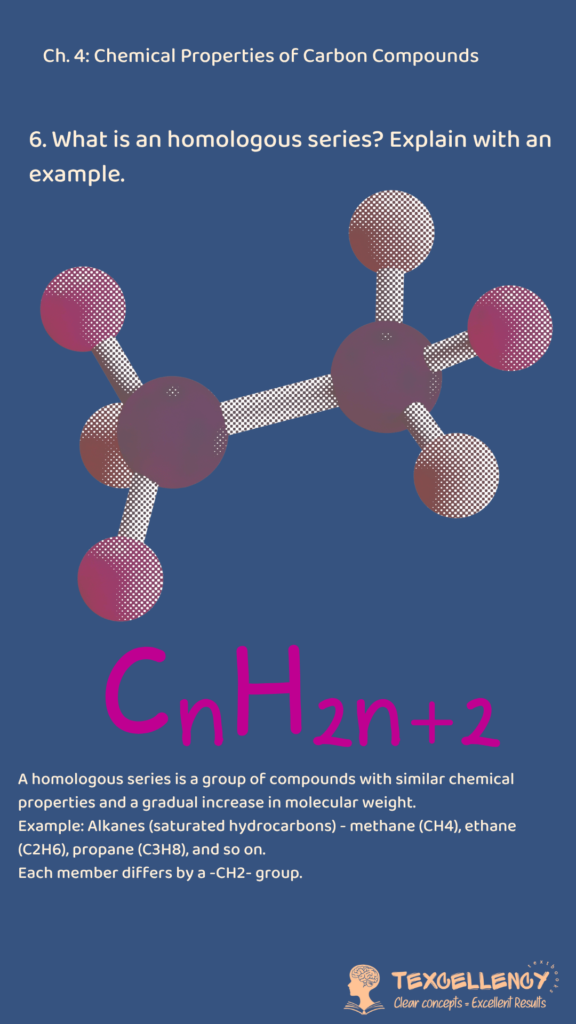
A homologous series is a series of organic compounds that have the same functional group, the same general formula, and similar chemical properties — where each consecutive member differs from the next by one –CH₂– unit (a difference of 14 in molecular mass). The members of a homologous series show a gradual, predictable change in physical properties (like boiling point and physical state) as the carbon chain length increases — but their chemical properties remain essentially the same because the functional group is unchanged.
🏭 The Apartment Building Analogy
Imagine a tall apartment building. Every floor is identical in design and layout — same number of rooms, same electrical connections, same plumbing (same functional group, same chemical properties). But each floor adds one more room (one more –CH₂– unit) compared to the floor below. As you go higher: 🔵 The floor number increases (carbon number increases) 🔵 The total size of the apartment increases (molecular mass increases by 14 u each floor) 🔵 The apartment gets progressively heavier to heat and cool (boiling point increases gradually) 🔵 But the fundamental design — the electrical system, the plumbing, the way the apartment works — is identical on every floor (same chemical properties)
This building IS a homologous series. Each floor is one homologue. The entire building is the series.
🔴 The Five Characteristics of a Homologous Series
These five characteristics define what a homologous series is. Knowing all five earns full marks.
Characteristic 1 — Same General Formula: All members of a homologous series can be represented by a single general formula. This formula changes only in the value of n (the number of carbon atoms). For example, all alkanes follow CₙH₂ₙ₊₂. Plug in n=1 → CH₄. Plug in n=2 → C₂H₆. Plug in n=3 → C₃H₈. The formula is the same — only n changes.
Characteristic 2 — Consecutive Members Differ by –CH₂– (14 u): Each member of the series differs from the one before it and the one after it by exactly one –CH₂– group — one carbon atom and two hydrogen atoms. The molecular mass difference between any two consecutive members is always 14 u (12 for C + 2×1 for H). This regular, step-by-step increase is the defining structural signature of a homologous series.
Characteristic 3 — Same Functional Group: Every member of a homologous series contains the same functional group. The functional group is what gives the series its chemical identity. All alcohols have –OH. All carboxylic acids have –COOH. All alkenes have C=C. The functional group does not change as you move up the series — only the length of the carbon chain changes.
Characteristic 4 — Similar Chemical Properties: Because every member has the same functional group, every member undergoes essentially the same types of chemical reactions. All alkanes undergo substitution and combustion. All alkenes undergo addition reactions. All alcohols undergo esterification and oxidation. All carboxylic acids turn litmus red and fizz with Na₂CO₃. The chemical behaviour is a family trait — every member shares it.
Characteristic 5 — Gradual Change in Physical Properties: While chemical properties stay the same, physical properties change gradually and predictably as you move up the series. Boiling point, melting point, and density all increase with increasing carbon chain length and molecular mass. This is because larger molecules have stronger van der Waals forces between them — needing more energy (higher temperature) to separate. The physical state also changes — short chain members are gases, medium chain members are liquids, long chain members are solids.
🔶 Example 1 — The Alkane Homologous Series (Saturated Hydrocarbons)
The alkane series is the most important and most commonly used example in Class 10.
General formula: CₙH₂ₙ₊₂
🔵 n=1: Methane (CH₄) — molecular mass 16 u — gas at room temperature — main component of natural gas and CNG — used as cooking fuel 🔵 n=2: Ethane (C₂H₆) — molecular mass 30 u — gas — component of LPG 🔵 n=3: Propane (C₃H₈) — molecular mass 44 u — gas — major component of LPG (cooking gas cylinders) 🔵 n=4: Butane (C₄H₁₀) — molecular mass 58 u — gas (just above room temperature) — the other major LPG component — used in lighters 🔵 n=5: Pentane (C₅H₁₂) — molecular mass 72 u — liquid at room temperature — component of petrol
Difference between consecutive members: always 14 u (–CH₂–): CH₄ (16) → C₂H₆ (30): difference = 14 ✅ C₂H₆ (30) → C₃H₈ (44): difference = 14 ✅ C₃H₈ (44) → C₄H₁₀ (58): difference = 14 ✅ C₄H₁₀ (58) → C₅H₁₂ (72): difference = 14 ✅
Boiling point trend — gradual increase: 🔵 CH₄: –161°C | C₂H₆: –89°C | C₃H₈: –42°C | C₄H₁₀: –1°C | C₅H₁₂: +36°C 🔵 Notice: each boiling point is significantly higher than the one before — but the jump is gradual and predictable 🔵 Physical state changes from gas (C₁–C₄) to liquid (C₅–C₁₇) to solid wax (C₁₈+) — all in the same alkane series
Same chemical properties — all alkanes: 🔵 All undergo combustion: CₙH₂ₙ₊₂ + O₂ → CO₂ + H₂O + Heat 🔵 All undergo substitution with halogens in sunlight: CₙH₂ₙ₊₂ + Cl₂ →(sunlight)→ CₙH₂ₙ₊₁Cl + HCl 🔵 None undergo addition reactions (no C=C double bond)
🔷 Example 2 — The Alkene Homologous Series (with C=C double bond)
General formula: CₙH₂ₙ (series starts at n=2 — no stable single-carbon alkene exists)
🔵 n=2: Ethene (C₂H₄) — molecular mass 28 u — gas — used to ripen fruits industrially — monomer for polyethene (polythene) plastic 🔵 n=3: Propene (C₃H₆) — molecular mass 42 u — gas — monomer for polypropylene plastic (chairs, ropes, containers) 🔵 n=4: Butene (C₄H₈) — molecular mass 56 u — gas 🔵 n=5: Pentene (C₅H₁₀) — molecular mass 70 u — liquid
Same chemical properties — all alkenes: 🔵 All undergo addition reactions (with H₂, Br₂, HCl) — because all have C=C double bond 🔵 All decolourise bromine water (test for unsaturation) 🔵 All undergo polymerisation (form addition polymers)
🔴 Example 3 — The Alcohol Homologous Series (with –OH group)
General formula: CₙH₂ₙ₊₁OH
🔵 n=1: Methanol (CH₃OH) — molecular mass 32 u — extremely toxic — used as industrial solvent, fuel additive — do NOT confuse with ethanol — drinking methanol causes blindness and death 🔵 n=2: Ethanol (C₂H₅OH) — molecular mass 46 u — the alcohol in beverages, sanitisers, biofuel — the one you have been studying throughout this chapter 🔵 n=3: Propanol (C₃H₇OH) — molecular mass 60 u — used as solvent in cosmetics and pharmaceuticals 🔵 n=4: Butanol (C₄H₉OH) — molecular mass 74 u — industrial solvent
Same chemical properties — all alcohols: 🔵 All are neutral (–OH does not release H⁺) 🔵 All undergo oxidation to give carboxylic acids or aldehydes 🔵 All undergo esterification with carboxylic acids 🔵 All react with sodium metal to give H₂ gas
⭕ Important safety note for students: Methanol (the first member of the alcohol homologous series) looks, smells, and tastes similar to ethanol — but it is fatally toxic. Drinking even 10 mL of methanol can cause permanent blindness. 30 mL can be fatal. This is why industrial alcohol (which contains methanol) is deliberately denatured to prevent people from drinking it. Never confuse methanol with ethanol.
🔶 Example 4 — The Carboxylic Acid Homologous Series (with –COOH group)
General formula: CₙH₂ₙ₊₁COOH
🔵 n=0: Methanoic acid (HCOOH) — also called formic acid — the acid in ant stings and bee stings — the burning sensation when an ant bites you is methanoic acid 🔵 n=1: Ethanoic acid (CH₃COOH) — also called acetic acid — the acid in vinegar — the most important carboxylic acid in Class 10 🔵 n=2: Propanoic acid (C₂H₅COOH) — found in small amounts in dairy products 🔵 n=3: Butanoic acid (C₃H₇COOH) — also called butyric acid — the acid responsible for the smell of rancid butter and vomit
Same chemical properties — all carboxylic acids: 🔵 All turn blue litmus red (acidic) 🔵 All fizz with Na₂CO₃ and NaHCO₃ (release CO₂) 🔵 All react with NaOH (neutralisation) 🔵 All undergo esterification with alcohols
🔷 Why the Homologous Series Concept is So Powerful
The homologous series is one of the most elegant and practically useful concepts in organic chemistry — and here is why it matters beyond the exam:
🔵 Predictability: Once you know one member of a homologous series, you can predict the properties of ALL members. If ethanol boils at 78°C and propanol boils at 97°C, you can confidently predict butanol will boil at around 117°C — and it does (actual: 117.7°C). This predictability is what allows chemists and engineers to design new materials with specific properties.
🔵 Organisation: There are millions of organic compounds. Without the homologous series framework, organic chemistry would be an unmanageable chaos of individual compounds. The homologous series organises them into families — each family sharing a functional group and a general formula. Instead of memorising millions of compounds, you memorise the behaviour of each functional group.
🔵 Industry: Petroleum refining is essentially the separation of alkane homologues — different fractions (LPG, petrol, kerosene, diesel, lubricating oil, wax) are separated based on the gradual change in boiling points within the alkane homologous series. The entire petroleum industry is built on this concept.
📊 Summary Table — Four Important Homologous Series
Alkanes — CₙH₂ₙ₊₂ — Functional group: none (C–C single bonds only) — Example: CH₄, C₂H₆, C₃H₈ — Key reaction: combustion, substitution
Alkenes — CₙH₂ₙ — Functional group: C=C double bond — Example: C₂H₄, C₃H₆, C₄H₈ — Key reaction: addition, polymerisation
Alcohols — CₙH₂ₙ₊₁OH — Functional group: –OH (hydroxyl) — Example: CH₃OH, C₂H₅OH, C₃H₇OH — Key reaction: oxidation, esterification
Carboxylic acids — CₙH₂ₙ₊₁COOH — Functional group: –COOH (carboxyl) — Example: HCOOH, CH₃COOH, C₂H₅COOH — Key reaction: neutralisation, esterification
🎵 Rhyme to Remember
“A homologous series — a family so neat, Same functional group — they cannot be beat!* Each member adds –CH₂– — just 14 mass more,* Same reactions, same formula — that’s what they’re for!* Physical properties change — boiling point climbs the stair,* Gas becomes liquid becomes solid — a gradual affair!* Alkanes, alkenes, alcohols, acids in a line,* Each one a homologue — perfectly designed!”*
🧩 Mnemonics
🔵 “FIVE CHARACTERISTICS: Formula same + –CH₂– difference + Identical functional group + Variable physical properties + Equal chemical behaviour = FIVE” — one word per characteristic: Formula, CH₂, Identical, Variable, Equal = FIVE. 🔵 “14 u = –CH₂– = the homologous handshake” — every member greets the next with a –CH₂– handshake of 14 u. 🔵 “Same FUNCTIONAL GROUP = Same CHEMICAL PERSONALITY” — the functional group is the personality of the molecule — change the chain length, the personality stays the same. 🔵 “Alkane = CₙH₂ₙ₊₂ (FULL). Alkene = CₙH₂ₙ (MINUS 2). Alkyne = CₙH₂ₙ₋₂ (MINUS 4).” — the general formula pattern is easy to remember as subtraction steps. 🔵 “Methanol KILLS. Ethanol thrills (beverages). Propanol fills (cosmetics). Butanol bills (industry).” — the alcohol homologous series uses with a safety warning built in.
✅ Exam-Ready Answer (Write This in Board Exam)
What is a homologous series? Explain with an example.
Definition: A homologous series is a series of organic compounds that: 🔵 Have the same functional group 🔵 Have the same general formula 🔵 Have similar chemical properties 🔵 Differ from consecutive members by one –CH₂– unit (molecular mass difference of 14 u) 🔵 Show a gradual change in physical properties (boiling point, melting point, physical state) with increasing molecular mass
Example — The Alkane Homologous Series:
General formula: CₙH₂ₙ₊₂
🔵 n=1: Methane (CH₄) — molecular mass 16 u 🔵 n=2: Ethane (C₂H₆) — molecular mass 30 u — difference from previous = 14 u (–CH₂–) 🔵 n=3: Propane (C₃H₈) — molecular mass 44 u — difference = 14 u 🔵 n=4: Butane (C₄H₁₀) — molecular mass 58 u — difference = 14 u 🔵 n=5: Pentane (C₅H₁₂) — molecular mass 72 u — difference = 14 u
Same chemical properties: All alkanes undergo combustion (CₙH₂ₙ₊₂ + O₂ → CO₂ + H₂O + Heat) and substitution reactions.
Gradual change in physical properties: Boiling points increase gradually — CH₄ (–161°C) → C₂H₆ (–89°C) → C₃H₈ (–42°C) → C₄H₁₀ (–1°C) → C₅H₁₂ (+36°C). Physical state changes from gas (C₁–C₄) to liquid (C₅ onwards) as molecular mass increases.
📌 Key Points Checklist
✅ Definition: series of organic compounds with same functional group, same general formula, similar chemical properties, consecutive members differing by –CH₂– (14 u) ✅ Five characteristics: same general formula + –CH₂– difference (14 u) + same functional group + same chemical properties + gradual change in physical properties ✅ –CH₂– = 12 (C) + 2 (H₂) = 14 u — molecular mass difference between consecutive members ✅ Alkane series: CₙH₂ₙ₊₂ — CH₄, C₂H₆, C₃H₈, C₄H₁₀, C₅H₁₂ — gases → liquids → solids ✅ Alkene series: CₙH₂ₙ — starts at C₂H₄ (no stable single-carbon alkene) — C₂H₄, C₃H₆, C₄H₈ ✅ Alcohol series: CₙH₂ₙ₊₁OH — CH₃OH, C₂H₅OH, C₃H₇OH — all neutral, all esterify ✅ Carboxylic acid series: CₙH₂ₙ₊₁COOH — HCOOH, CH₃COOH, C₂H₅COOH — all acidic, all fizz with Na₂CO₃ ✅ Same functional group → same chemical properties (all members react the same way) ✅ Increasing carbon chain → gradual increase in boiling point, melting point, density ✅ Methanol safety warning: methanol (first alcohol homologue) is fatally toxic — do NOT confuse with ethanol
📚 Want ALL of Class 10 Science Explained This Way? Every chapter. Every concept. Every NCERT question — with analogies, rhymes, mnemonics, and real-life examples.