
Why does micelle formation take place when soap is added to water? Will a micelle be formed in other solvents such as ethanol also
NCERT Class 10 Science | Chapter: Carbon and Its Compounds | Texcellency Book Series
✅ Answer in Two Parts (For Quick Revision)
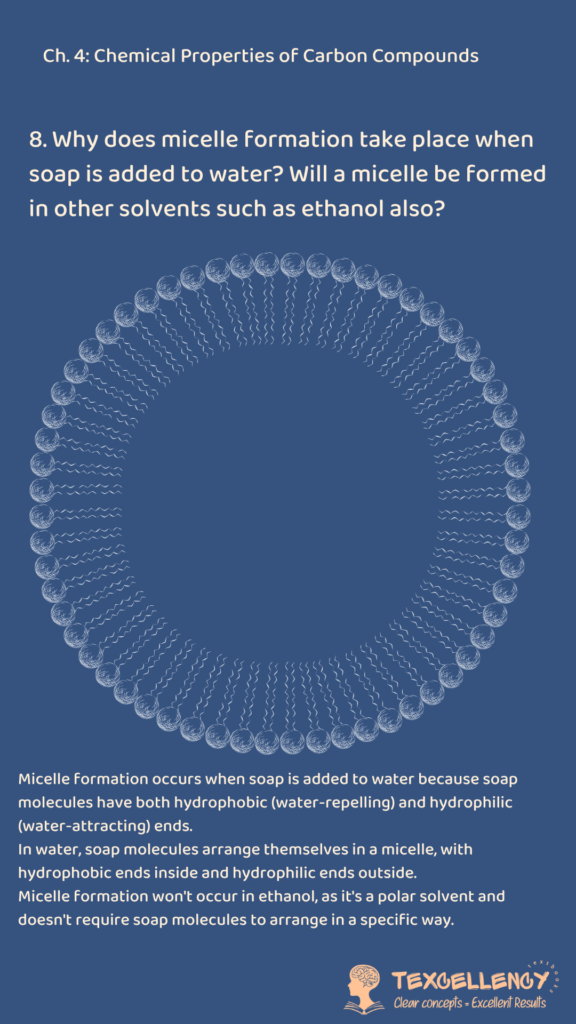
Part 1 — Why micelles form in water: Soap molecules have two opposite ends — a hydrophilic (water-loving) ionic head and a hydrophobic (water-hating) hydrocarbon tail. When soap is dissolved in water, the hydrophilic heads are attracted strongly to the polar water molecules and face outward into the water, while the hydrophobic tails are repelled by water and are forced to cluster inward, away from water. This conflict — heads pulled toward water, tails pushed away from water — drives the soap molecules to spontaneously arrange into a spherical structure called a micelle, with all tails pointing inward and all heads facing outward into the water.
Part 2 — Will micelles form in ethanol? No. Micelles will NOT form when soap is dissolved in ethanol. The reason is that ethanol is an amphiphilic solvent — it has both a polar part (–OH group) that interacts with the hydrophilic head of soap AND a non-polar part (–C₂H₅ group) that interacts with the hydrophobic tail of soap. Ethanol dissolves BOTH ends of the soap molecule equally and comfortably. There is no conflict — no part of the soap molecule is uncomfortable or repelled in ethanol. Without that conflict and driving force, soap molecules simply dissolve uniformly in ethanol without organising into any structured micelle arrangement.
🏭 The Conflict Analogy — Why Water Creates Micelles
Imagine a group of people at a party. Each person has: 🔵 A right hand that is perfectly comfortable in water (hydrophilic head — loves water) 🔵 A left hand that absolutely cannot stand water and wants to stay dry at all costs (hydrophobic tail — hates water)
Now throw this group of people into a swimming pool (water): 🔵 Every person desperately wants their right hand IN the water and their left hand OUT of the water 🔵 The only way everyone can achieve this simultaneously is if they all form a tight circle — right hands facing outward into the pool water, left hands tucked inward away from water, touching each other in the centre 🔵 This spontaneous formation of a tight circle with hands arranged in the same direction = MICELLE
Now put the same group of people in a room with a perfect temperature that BOTH hands love equally (ethanol): 🔵 There is no discomfort — right hand is happy, left hand is happy, everywhere 🔵 Nobody feels any urge to form a tight circle — everyone just wanders around individually 🔵 No driving force → no organised structure → no micelle
This is precisely what happens chemically. Water creates the conflict that forces micelle formation. Ethanol removes the conflict. No conflict = no micelle.
🔴 Part 1 in Detail — Why Micelles Form in Water: The Step-by-Step Story
Step 1 — The soap molecule and its two personalities:
A soap molecule — let us take sodium stearate CH₃(CH₂)₁₆COONa as the example — has two chemically opposite ends:
🔵 The hydrophilic head: The –COO⁻Na⁺ (carboxylate) end. This is ionic and charged. Water molecules, being polar (with partial + and – charges), are strongly attracted to this ionic end. The head “loves” water — it is perfectly comfortable surrounded by water molecules.
🔵 The hydrophobic tail: The long –CH₂–CH₂–CH₂– chain (16 carbon atoms long in stearate). This is completely non-polar. Water molecules, being polar, cannot form any attractive interaction with this non-polar tail. Worse — when a non-polar group is surrounded by water, the water molecules are forced to form a highly ordered, rigid arrangement around it (like an ice cage) — which is thermodynamically unfavourable (high energy, low entropy).
Step 2 — The driving force (the hydrophobic effect):
Nature always tends toward the lowest energy, highest entropy (most disordered) state. When the hydrophobic tail is surrounded by water, it forces water into that ordered cage — entropy decreases, energy increases — the system is unhappy.
The way to relieve this unhappiness: remove the hydrophobic tails from contact with water by clustering them together in the centre of a micelle. When tails cluster together, the ordered water cages around them break and water molecules are released to move freely again — entropy increases, energy decreases — the system becomes happy.
This thermodynamic driving force — the desire to release water molecules from ordered cages around hydrophobic groups — is called the hydrophobic effect. It is the real engine behind micelle formation.
Step 3 — The micelle assembles:
🔵 As soap concentration increases beyond a minimum threshold (called the Critical Micelle Concentration — CMC), the driving force becomes strong enough to organise soap molecules into spherical micelles 🔵 20 to 100 soap molecules (approximately) assemble into each micelle 🔵 All hydrophobic tails point inward — clustered together in the dry, non-polar interior, away from water 🔵 All hydrophilic heads point outward — facing the surrounding water, comfortable in their ionic interactions with water molecules 🔵 The result is a spherical structure with a non-polar oily interior and a polar ionic exterior
Step 4 — Why micelles stay stable and dispersed:
🔵 Each micelle has a surface covered entirely with negatively charged –COO⁻ groups 🔵 Like charges repel — micelles repel each other electrostatically 🔵 This prevents micelles from clumping together or settling out 🔵 The micelles remain individually dispersed in the water as a stable colloidal suspension 🔵 This stable suspension is exactly what carries trapped dirt and grease away during washing
🔶 Part 2 in Detail — Why Micelles Do NOT Form in Ethanol
Understanding ethanol’s dual nature:
Ethanol (C₂H₅OH) has two distinct parts to its molecule: 🔵 –OH (hydroxyl group): Polar, just like water. Can form hydrogen bonds. Interacts strongly with the ionic hydrophilic head (–COO⁻) of soap — just as water does. 🔵 –C₂H₅ (ethyl group): Non-polar hydrocarbon. Interacts comfortably with the hydrophobic hydrocarbon tail of soap — because non-polar dissolves non-polar.
Because of this dual nature, ethanol is an excellent solvent for BOTH polar AND non-polar substances. Chemists call this property “amphiphilic” — compatible with both water-like and oil-like environments.
What happens when soap is added to ethanol:
🔵 The ionic head (–COO⁻Na⁺) of the soap molecule interacts with the –OH part of ethanol — the head is comfortable ✅ 🔵 The hydrocarbon tail (–(CH₂)₁₆–) of the soap molecule interacts with the –C₂H₅ part of ethanol — the tail is also comfortable ✅ 🔵 The soap molecule is happy in ALL orientations in ethanol — no part of it is being repelled or made uncomfortable 🔵 There is no driving force pushing tails inward and heads outward 🔵 The soap molecules simply dissolve as individual molecules uniformly distributed throughout the ethanol 🔵 No conflict → no self-assembly → no micelle
The key principle: Micelle formation requires a solvent that is strongly incompatible with one part of the soap molecule (the tail) while being compatible with the other part (the head). Water satisfies this perfectly — it loves the head, hates the tail. Ethanol satisfies neither condition — it is comfortable with both parts. Hence no micelle in ethanol.
A direct consequence: Soap dissolved in ethanol cannot clean greasy dirt the way it does in water — because without micelle formation, there is no mechanism to trap and suspend the grease. The cleaning action of soap is entirely dependent on micelle formation, which in turn depends on water as the solvent.
🔷 Comparison Table — Water vs Ethanol as Solvents for Soap
Water as solvent: 🔵 Nature: Polar only 🔵 Interaction with hydrophilic head: Strong attraction ✅ 🔵 Interaction with hydrophobic tail: Strong repulsion ❌ (forces tail away) 🔵 Conflict created: YES — head wants in, tail wants out 🔵 Micelle formation: YES ✅ 🔵 Soap can clean grease: YES ✅ (via micelles)
Ethanol as solvent: 🔵 Nature: Amphiphilic (both polar –OH and non-polar –C₂H₅) 🔵 Interaction with hydrophilic head: –OH of ethanol attracts the head ✅ 🔵 Interaction with hydrophobic tail: –C₂H₅ of ethanol is compatible with the tail ✅ 🔵 Conflict created: NO — both ends comfortable 🔵 Micelle formation: NO ❌ 🔵 Soap can clean grease via micelles: NO ❌
🔴 Real-Life Connections
🔵 Why soap works in water but not in alcohol-based hand sanitisers: Alcohol-based sanitisers use ethanol/isopropanol as the solvent — soap in these solvents cannot form micelles and thus cannot clean grease the way it does with water. The sanitiser kills germs directly through the alcohol’s denaturation of proteins — not through micelle-based cleaning.
🔵 Why soap lather collapses when you add alcohol to soapy water: Mixing ethanol into soapy water disrupts the micelles — the ethanol molecules insert themselves into the micelle structure (their non-polar parts interact with the tail interior), breaking the organised arrangement. Lather collapses.
🔵 CMC — Critical Micelle Concentration: Below a certain minimum soap concentration, there are too few soap molecules to organise into micelles — they just float individually. Above the CMC, micelles spontaneously form. This is why a very dilute soap solution does not lather well — the soap concentration is below the CMC.
🔵 Industrial use: Micelle formation is used in pharmaceutical drug delivery — drugs that are insoluble in water can be trapped inside the non-polar interior of micelles formed by surfactants, making them deliverable in the body’s water-based bloodstream.
🎵 Rhyme to Remember
“Water loves the head of soap — pulls it close with glee, But hates the tail — pushes it away, says ‘you’re not for me!’* The tail has nowhere to go — it runs inside the ball,* Heads face outward to the water — that’s the micelle’s call!* Now put soap in ethanol — both ends feel just right,* No conflict, no assembly, no micelle in sight!* Ethanol loves head AND tail — both feel at home,* So soap in ethanol just wanders all alone!”*
🧩 Mnemonics
🔵 “WATER = Welcomes heads, Attacks tails, Creates micElle Effortlessly Reliably” — water’s polar nature welcomes the head and repels the tail, creating the conflict that drives micelle formation. 🔵 “CONFLICT = MICELLE. NO CONFLICT = NO MICELLE.” — the entire reason for micelle formation in one principle. 🔵 “Ethanol = C₂H₅–OH = Non-polar part + Polar part = Comfortable with BOTH ends of soap = No driving force = No micelle.” 🔵 “Micelle = tails huddle inside like penguins in cold water — heads face out, tails hide in.” — the penguin huddle is a perfect visual — penguins cluster together facing outward to share body heat, tails to the cold; soap tails cluster inward, heads face the water. 🔵 “CMC = Minimum soap needed for micelles to form — below CMC, no micelle, no cleaning.”
✅ Exam-Ready Answer (Write This in Board Exam)
Why does micelle formation take place when soap is added to water? Will a micelle be formed in other solvents such as ethanol also?
Why micelles form in water:
A soap molecule has two ends — a hydrophilic (water-loving) ionic head (–COO⁻Na⁺) and a hydrophobic (water-hating) non-polar hydrocarbon tail. When soap is dissolved in water:
🔵 The hydrophilic heads are attracted to the polar water molecules and face outward into the water 🔵 The hydrophobic tails are repelled by water and are forced to cluster inward, away from water 🔵 This conflict — heads attracted to water, tails repelled by water — drives soap molecules to spontaneously arrange into a spherical structure called a micelle, with all tails pointing inward and all heads pointing outward into the water
This arrangement is thermodynamically favourable because it removes the hydrophobic tails from contact with water, releasing the ordered water molecules around them and increasing entropy.
Will micelles form in ethanol?
No. Micelles will NOT form in ethanol. Ethanol has a polar –OH group (compatible with the hydrophilic head of soap) AND a non-polar –C₂H₅ group (compatible with the hydrophobic tail of soap). This means ethanol can dissolve both ends of the soap molecule equally comfortably. There is no conflict — no part of the soap molecule is repelled by ethanol. Without this driving force (the conflict between head’s attraction to solvent and tail’s repulsion from solvent), soap molecules simply dissolve uniformly as individual molecules in ethanol without forming any organised micelle structure.
📌 Key Points Checklist
✅ Micelle forms in water because: hydrophilic head attracted to water + hydrophobic tail repelled by water = conflict = organised spherical assembly ✅ Micelle structure: hydrophobic tails pointing INWARD (away from water) + hydrophilic heads pointing OUTWARD (facing water) ✅ Driving force = hydrophobic effect — tails cluster together to free water molecules from ordered cages around them ✅ Micelles stay dispersed: negatively charged –COO⁻ heads on surface repel other micelles electrostatically ✅ Micelles do NOT form in ethanol because: ethanol’s –OH interacts with the head AND ethanol’s –C₂H₅ interacts with the tail — both ends comfortable — no conflict — no driving force ✅ Ethanol = amphiphilic solvent (both polar and non-polar parts) — dissolves both ends of soap molecule ✅ Without micelles in ethanol — soap cannot trap and remove grease — cleaning mechanism is lost ✅ CMC (Critical Micelle Concentration) — minimum soap concentration needed for micelles to form ✅ Soap in water → micelles → cleans grease. Soap in ethanol → no micelles → cannot clean grease via micelle mechanism ✅ Existing post’s explanation (“ethanol is polar so no micelle”) is incomplete — correct reason is ethanol dissolves BOTH ends of soap, eliminating the driving force
📚 Want ALL of Class 10 Science Explained This Way? Every chapter. Every concept. Every NCERT question — with analogies, rhymes, mnemonics, and real-life examples.