C7 — How Do Organisms Reproduce
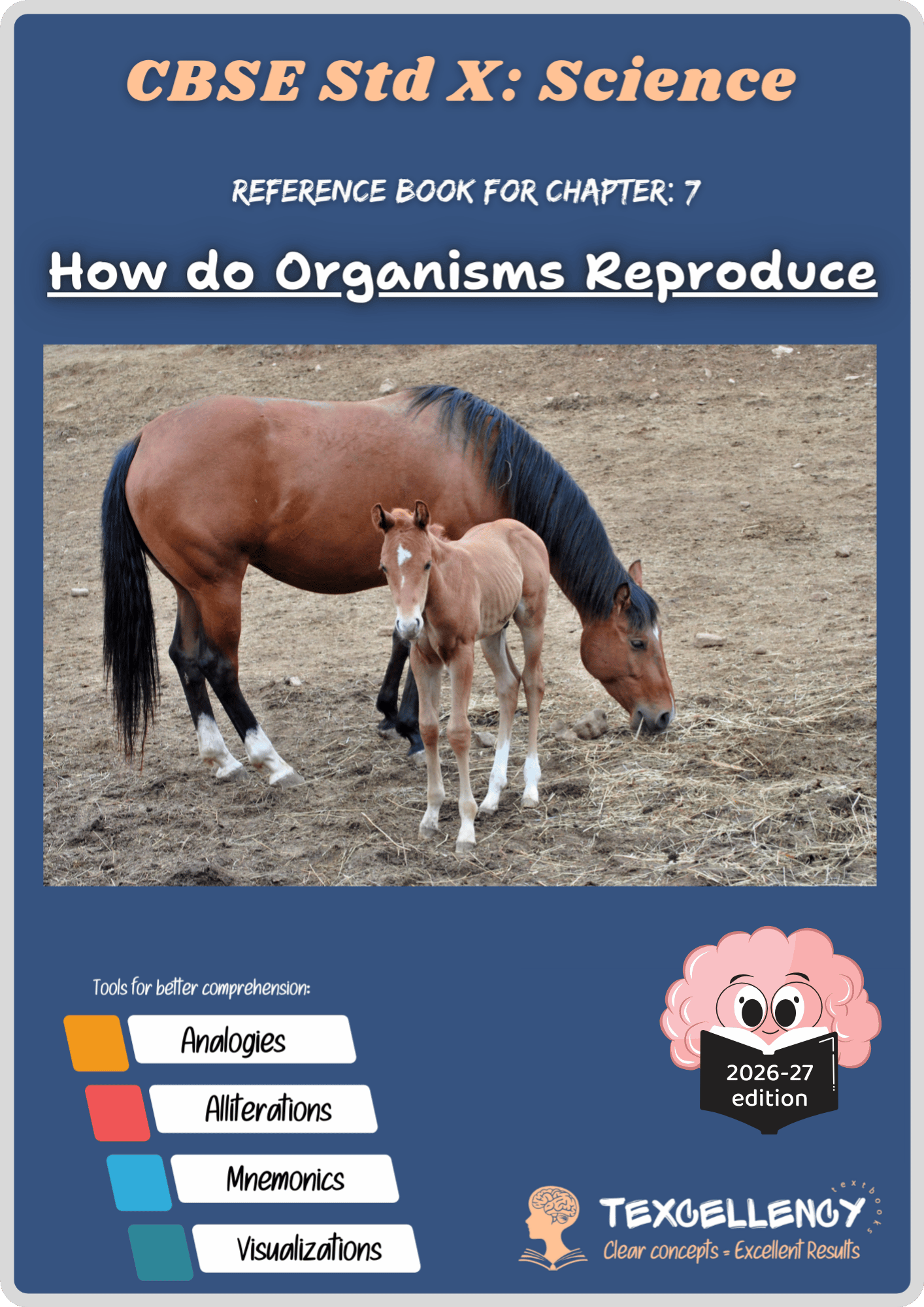
How do Organisms Reproduce is Chapter 7 of CBSE Class 10 Science — a Biology chapter that covers one of the most fundamental processes of life. Asexual reproduction, sexual reproduction in plants and animals, human reproductive systems, and the concept of DNA copying — this chapter is detailed, diagram-heavy, and carries significant marks in the board exam. This Texcellency book explains every concept clearly, sensitively, and scientifically so that CBSE Class 10 students can study the chapter confidently and independently.
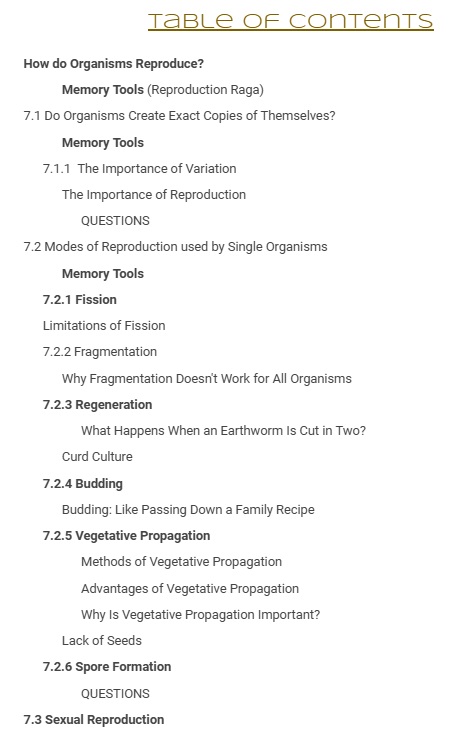
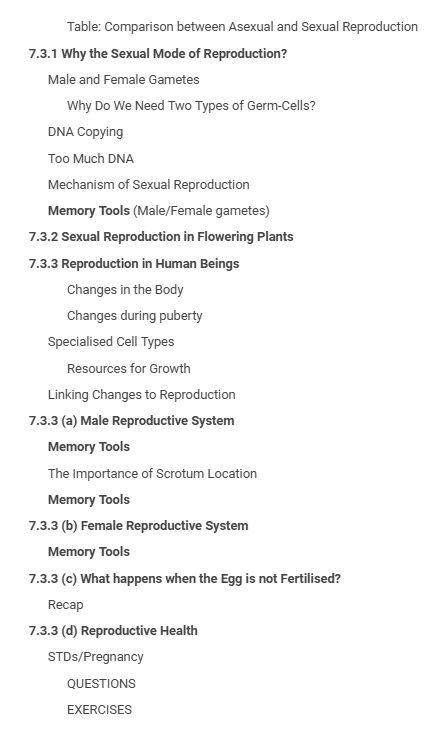
What this CBSE Class 10 How do Organisms Reproduce book covers: Why reproduction is essential for survival of species — the concept explained logically. Asexual reproduction methods — fission, budding, fragmentation, spore formation, vegetative propagation — all explained with examples. Sexual reproduction in flowering plants — pollination, fertilisation, seed formation — made visual and clear. Male and female reproductive systems in humans — structure and function explained simply and scientifically. Menstruation and fertilisation in humans — explained clearly for exam purposes. Contraception methods — as covered in CBSE syllabus. Sexually transmitted infections as per CBSE curriculum. Importance of DNA copying in reproduction — connecting Biology to the bigger picture.
Why this book makes the chapter easier: This is a chapter many students feel awkward studying from textbooks. Texcellency handles the topic with scientific clarity and the right level of detail — helping students focus purely on exam preparation without confusion or discomfort.
Based on the latest CBSE 2026-27 syllabus. Also available as part of the complete CBSE Class 10 Science Books Bundle — all 13 chapters at just ₹999.
======================
Is your daughter or son:
- struggling to grasp the complex reproduction mechanisms in organisms?
- Confused by asexual and sexual reproduction modes?
- Frustrated with understanding genetic variation and cell division?
- Struggling to comprehend human reproduction and reproductive health?
- Having trouble connecting the dots between reproduction strategies and life’s diversity?
Is their current science textbook:
- Leaving them bewildered with abstract concepts and terminology?
- Failing to provide clear illustrations of reproduction mechanisms?
- Lacking practical examples and real-life applications?
If yes, then be sure that lower grades of your children are not their fault. It does not mean that they are slow learners or less efficient in their studies; it simply means that the tools they have been given are not good enough. The textbooks they have been using are not friendly enough.
Welcome to Texcellency books – books that are designed to make the learning process fun and riveting.
The book “How do Organisms Reproduce?” makes the tough subject simple and engaging! Our expert authors have crafted a comprehensive guide to “How do Organisms Reproduce?” using:
- Easy-to-understand explanations of asexual and sexual reproduction
- Engaging examples of reproduction mechanisms (fission, fragmentation, budding)
- Clear illustrations of human reproduction and reproductive systems
- Step-by-step explanations of genetic variation, cell division, and fertilization
- Interactive exercises, quizzes, and memory tools for reinforced learning
With this book, your child will:
- Confidently understand reproduction mechanisms in organisms
- Master key concepts (reproduction strategies, genetic variation, cell division)
- Develop a deeper appreciation for life’s diversity and complexity
- Explore practical applications in everyday life (health, wellness, ecology)
- Boost their scientific curiosity and critical thinking skills
Get your copy of “How do Organisms Reproduce?” today, and help your children discover a more enjoyable, effective way to learn science!
Simplify Biology with Texcellency books: Transform Your Child’s Science Learning Experience with Interactive and Clear Explanations