
Explain the mechanism of the cleaning action of soaps.
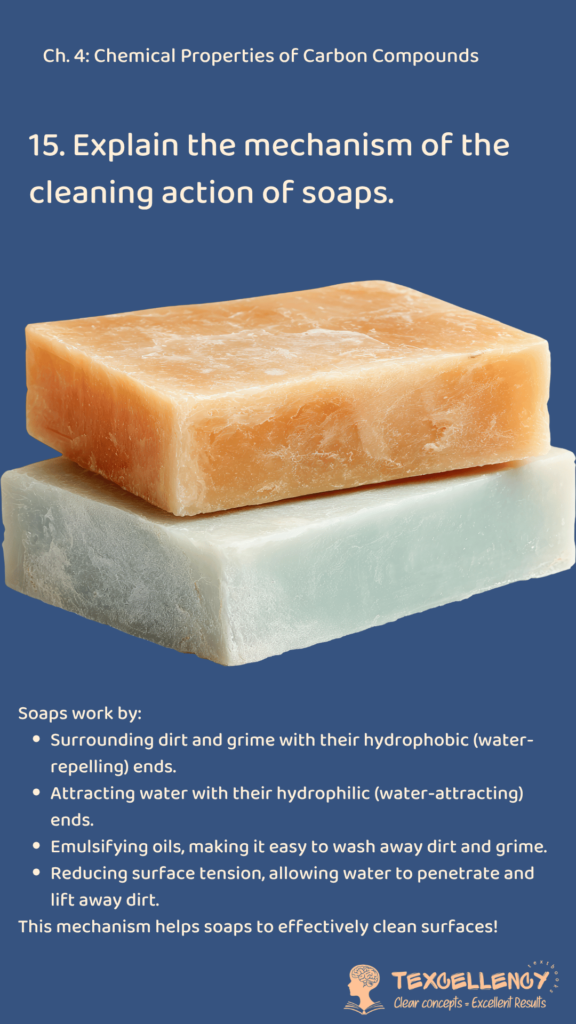
4 bullet points — extremely thin. This is actually one of the richest, most visual topics in Class 10 Carbon chapter — massive opportunity to dominate Google. Here is the full upgrade:
🔷 SEO METADATA
🔵 Page Title Tag: Explain the Mechanism of the Cleaning Action of Soaps — Class 10 Science 🔵 Meta Description: How does soap clean? Full NCERT Class 10 explanation — soap molecule structure, hydrophilic & hydrophobic ends, micelle formation, step-by-step cleaning mechanism, diagram description, mnemonics & exam-ready answer. 🔵 Focus Keyword: explain the mechanism of the cleaning action of soaps 🔵 Secondary Keywords: cleaning action of soap class 10, how does soap work, micelle formation class 10, hydrophilic hydrophobic soap, soap mechanism NCERT, carbon and its compounds soap 🔵 Slug (keep as-is): /explain-the-mechanism-of-the-cleaning-action-of-soaps/ 🔵 Internal Links to Add: link to your “Distinguish Butter and Cooking Oil” post (previous post), your “What are Oxidising Agents” post, and any post on saponification or emulsification.
Explain the Mechanism of the Cleaning Action of Soaps — NCERT Class 10 Science
NCERT Class 10 Science | Chapter: Carbon and Its Compounds | Texcellency Book Series
✅ Answer in One Paragraph (For Quick Revision)
A soap molecule has two ends — a long hydrophobic (water-repelling, oil-loving) hydrocarbon tail and a short hydrophilic (water-loving, oil-repelling) ionic head. When soap is added to dirty water, the hydrophobic tails of soap molecules bury themselves inside the oil/grease particle on the dirty surface, while the hydrophilic heads face outward into the surrounding water. This arrangement forms a spherical cluster called a micelle — with oil trapped inside and water-friendly heads on the outside. When water is agitated (by rubbing or rinsing), the micelles — along with the trapped dirt and grease — are washed away. The dirt is gone. The surface is clean.
This is the complete mechanism. Now let us understand every part of it deeply.
🏭 The Spy Analogy — Understanding the Soap Molecule
Imagine a secret agent who is comfortable in two completely different worlds:
🔵 One hand is perfectly comfortable in the oily criminal underworld — it can blend in with grease, oil, and dirt. This is the hydrophobic tail of the soap molecule. 🔵 Other hand is perfectly comfortable in the water world — it connects with water molecules easily and is attracted to them. This is the hydrophilic head of the soap molecule.
This double identity — one end loves oil, other end loves water — is the entire secret behind how soap works. No other cleaning agent in daily life has this dual personality. That is what makes soap so uniquely effective.
🔴 Step 1 — Understanding the Soap Molecule’s Structure
Before understanding the mechanism, you must understand the soap molecule itself.
What is soap chemically? Soap is the sodium or potassium salt of a long-chain fatty acid.
For example: 🔵 Sodium stearate: CH₃(CH₂)₁₆COONa — a typical soap molecule 🔵 Sodium palmitate: CH₃(CH₂)₁₄COONa — another common soap molecule
The molecule has two clearly distinct parts:
Part 1 — The Hydrophobic Tail (The Oil-Lover)
🔵 What it is: A long hydrocarbon chain — typically 12–18 carbon atoms long, like a long zigzag chain of CH₂ groups 🔵 Chemical nature: Non-polar — it has no electric charges, no attraction to water 🔵 What it loves: Oil, grease, fat — other non-polar substances. The saying in chemistry is “like dissolves like” — non-polar tail loves non-polar oily substances 🔵 What it hates: Water — it is repelled by water molecules (because water is polar and the tail is non-polar) 🔵 Visual: Think of it as a long, thin, waxy tail — like the body of a tadpole
Part 2 — The Hydrophilic Head (The Water-Lover)
🔵 What it is: The ionic end of the molecule — the -COO⁻Na⁺ group (carboxylate ion + sodium ion) 🔵 Chemical nature: Polar and ionic — it carries a negative charge (COO⁻) balanced by a positive sodium ion (Na⁺) 🔵 What it loves: Water — water molecules are polar and are strongly attracted to this charged end 🔵 What it hates: Oil and grease — polar head cannot dissolve in non-polar oil 🔵 Visual: Think of it as a small, round, charged head — like the head of a tadpole
The complete soap molecule looks like a tadpole: round head (hydrophilic, ionic end) + long wavy tail (hydrophobic, hydrocarbon end).
🔶 Step 2 — The Problem: Why Dirt and Water Don’t Mix Without Soap
Most of the dirt on our hands, clothes, and skin is not water-soluble. It is: 🔵 Oily/greasy dirt from cooking, sebum (skin oil), machine grease 🔵 Dust particles stuck to an oily film on the skin 🔵 Carbon soot, grime — trapped in a layer of grease
Plain water is a polar molecule — it forms hydrogen bonds with other water molecules and with other polar substances. But oil is non-polar — water and oil do not mix. When you try to wash greasy hands with plain water, the water just rolls off the oily surface. The oil (and the dirt trapped in it) stays put.
This is the fundamental problem soap solves. Soap acts as a bridge between the water world and the oil world — a surfactant (surface-active agent) that makes the immiscible (oil and water) become mixable.
🔴 Step 3 — The Mechanism: Four-Stage Action of Soap
Stage 1: Soap Molecules Surround the Grease/Oil Particle
When you apply soap + water to a dirty surface:
🔵 The soap molecules immediately orient themselves around the oil/grease particles on the dirty surface 🔵 The hydrophobic tails dive INTO the oil — because they are non-polar just like the oil, they are attracted to and dissolve in it 🔵 The hydrophilic heads stay OUTSIDE — pointing outward into the surrounding water, because they are attracted to water molecules 🔵 This orientation is not random — it is driven by the basic principle that each end of the soap molecule goes where it is most chemically comfortable
Stage 2: Micelle Formation — The Most Important Step
As more and more soap molecules arrange themselves around the oil particle (tails in, heads out), they form a spherical structure called a MICELLE.
What is a micelle? 🔵 A micelle is a spherical cluster of soap molecules arranged with all their hydrophobic tails pointing inward (toward the trapped oil) and all their hydrophilic heads pointing outward (toward the water) 🔵 The oil/grease/dirt is trapped inside the micelle — completely surrounded, isolated from the water 🔵 The outside of the micelle is entirely hydrophilic — it is fully compatible with water 🔵 The micelle as a whole is now suspended in water — it does not settle or separate out because the outer surface loves water
The micelle is the hero of this story. It is the structure that allows oil to stay suspended in water — something that is chemically impossible without soap.
Stage 3: Mechanical Agitation Lifts the Micelles Off the Surface
🔵 When you rub your hands together, rub a cloth, or run water over the surface — the mechanical action dislodges the micelles from the dirty surface 🔵 The micelles, with their trapped dirt/grease inside, float freely in the wash water 🔵 The surface underneath — your hands, the cloth, the dish — is now free of the oil/grease layer
Stage 4: Rinsing Carries the Micelles Away
🔵 When you rinse with water, the micelles (with all their trapped dirt inside) are carried away in the flowing water 🔵 The dirt leaves with the water — it never re-deposits on the clean surface because the micelle keeps it suspended and isolated 🔵 Result: Clean surface, dirty water that gets drained away.
🔷 The Micelle — Described for Your Diagram
If your exam asks you to draw or describe the micelle diagram, here is the precise description:
🔵 Shape: Spherical (like a ball) 🔵 Inside the sphere: Oil/grease droplet — non-polar, surrounded entirely by the non-polar tails of soap molecules pointing inward 🔵 The sphere’s surface: Composed entirely of the ionic (charged) hydrophilic heads of soap molecules pointing outward into water 🔵 Surrounding the sphere: Water molecules — attracted to the hydrophilic heads on the outer surface 🔵 The whole micelle is suspended in water and does not aggregate (because same-charged heads on all micelles repel each other — they stay separated, preventing re-aggregation)
In your diagram: draw a circle. Fill the inside with wavy lines (the hydrocarbon tails converging inward around a central oil droplet). On the outer circumference, draw small circles or dots (the ionic heads) touching the water outside the micelle.
🔶 Why Soap Does NOT Work Well in Hard Water
This is a bonus point that can earn you extra marks in exams.
Hard water contains dissolved calcium (Ca²⁺) and magnesium (Mg²⁺) ions.
When soap is used in hard water: 🔵 The Ca²⁺ and Mg²⁺ ions react with the soap (sodium/potassium stearate) and form insoluble calcium and magnesium salts (calcium stearate, magnesium stearate) 🔵 These insoluble salts appear as a white scum/curd on your skin, bathtub, and clothes 🔵 The soap molecules that have formed this scum can no longer form micelles — they are wasted 🔵 Result: much more soap is needed, cleaning is less effective, and a white sticky residue is left behind
Detergents (synthetic cleaning agents) were specifically designed to overcome this problem — their ionic heads do not react with Ca²⁺ and Mg²⁺ ions, so they work in hard water.
📊 Complete Summary Table — Mechanism Step by Step
| Step | What Happens | Key Term |
|---|---|---|
| 1 | Soap dissolves in water, molecules separate | Surfactant action |
| 2 | Hydrophobic tails insert into oil/grease on dirty surface | Hydrophobic interaction |
| 3 | Hydrophilic heads remain in water, pointing outward | Hydrophilic orientation |
| 4 | Soap molecules arrange in a sphere around oil droplet | Micelle formation |
| 5 | Oil trapped inside micelle, water-compatible outside | Emulsification |
| 6 | Mechanical rubbing lifts micelles off surface | Agitation |
| 7 | Rinsing carries micelles (with trapped dirt) away | Cleaning complete |
🔴 Soap vs Detergent — Key Difference for Exam
| Feature | Soap | Detergent |
|---|---|---|
| Made from | Natural fats/oils + NaOH (saponification) | Synthetic chemicals (petrochemicals) |
| Works in hard water? | ❌ No — forms scum | ✅ Yes — works effectively |
| Biodegradable? | ✅ Yes — environment-friendly | Partially — some are non-biodegradable |
| Examples | Lux, Dove, Lifebuoy | Surf Excel, Vim, Ariel |
| Ionic head | -COO⁻Na⁺ (carboxylate) | -SO₃⁻Na⁺ (sulphonate) |
🎵 Rhyme to Remember
“Soap has a tail that loves the oil, It dives right in without recoil, The head loves water — stays outside, Together they take the dirt for a ride! They form a micelle — a tiny ball, With dirt inside and water to call, Rinse it away — the surface is clean, Best cleaning machine you’ve ever seen!”
🧩 Mnemonics
🔵 “TAIL IN, HEAD OUT” — the hydrophobic tail goes INTO the oil, the hydrophilic head stays OUT in the water. This is the entire mechanism in three words. 🔵 “Micelle = Mud in a water-friendly shell” — the dirt (mud/oil) is inside, the water-friendly heads form the shell outside. 🔵 “Hydro-PHOBIC = Afraid of water (runs into oil)” • “Hydro-PHILIC = Friend of water (stays in water)” — phobic = fear, philic = love. 🔵 “SOAP = Surrounds Oil, Allows Particles (to be washed away)” 🔵 Hard water + soap = SCUM — calcium and magnesium ions ruin soap’s effectiveness.
✅ Exam-Ready Answer (Write This in Board Exam)
Explain the mechanism of the cleaning action of soaps.
Structure of a Soap Molecule: A soap molecule has two distinct ends: 🔵 A long hydrophobic (water-repelling) hydrocarbon tail — which is attracted to oil and grease 🔵 A short hydrophilic (water-loving) ionic head (-COO⁻Na⁺) — which is attracted to water
Mechanism — Step by Step:
Step 1: When soap is dissolved in water and applied to a dirty (oily/greasy) surface, the soap molecules orient themselves around the oil/grease particles. The hydrophobic tails insert themselves into the oil droplet, while the hydrophilic heads remain pointing outward into the surrounding water.
Step 2: Multiple soap molecules arrange themselves around each oil droplet in this way, forming a spherical structure called a micelle — with oil trapped inside and hydrophilic heads on the outer surface.
Step 3: The micelle, being hydrophilic on the outside, remains suspended in water (as an emulsion). Mechanical agitation (rubbing) helps dislodge the micelles from the dirty surface.
Step 4: On rinsing, the micelles — along with the trapped dirt and grease inside — are carried away by the flowing water, leaving the surface clean.
Note: Soap does not work well in hard water because the Ca²⁺ and Mg²⁺ ions in hard water react with soap to form insoluble calcium and magnesium salts (scum), reducing the soap’s cleaning effectiveness.
📌 Key Points Checklist
✅ Soap = sodium/potassium salt of a long-chain fatty acid ✅ Soap molecule has two ends: hydrophobic tail (oil-loving) + hydrophilic head (water-loving) ✅ Hydrophobic tail = long hydrocarbon chain = non-polar = loves oil ✅ Hydrophilic head = -COO⁻Na⁺ ionic group = polar = loves water ✅ Mechanism: tail into oil → head in water → micelle forms → oil trapped inside micelle → rinsed away ✅ Micelle = spherical cluster: oil inside, hydrophilic heads outside facing water ✅ Micelles stay suspended in water = emulsification of oil in water ✅ Soap does NOT work in hard water — Ca²⁺/Mg²⁺ ions form insoluble scum with soap ✅ Detergents work in hard water because their heads don’t react with Ca²⁺/Mg²⁺ ✅ Key terms for exam: hydrophobic, hydrophilic, micelle, emulsification, surfactant, hard water, scum
📚 Want ALL of Class 10 Science Explained This Way? Every chapter. Every concept. Every NCERT question — with analogies, rhymes, mnemonics, and real-life examples.