
Draw the Structure of a Neuron and Explain Its Function — NCERT Class 10 Science
NCERT Class 10 Science | Chapter 7 — Control and Coordination | Texcellency Book Series
🎯 The One-Line Answer Google Loves
A neuron is the basic structural and functional unit of the nervous system. It consists of a cell body, dendrites, axon, myelin sheath, and axon terminals. Its function is to receive electrical signals, process them, and transmit them to the next neuron or target organ — making it the body’s fastest communication unit.
🧠 What is a Neuron — and Why Should You Care?
Right now — as your eyes read this line — billions of neurons are firing electrical signals in your brain. The signal that tells your finger to scroll, the signal that tells your eye to focus, the signal that registers understanding — all of these travel through neurons.
A neuron (also called a nerve cell) is the fundamental unit of the nervous system. Your brain alone contains approximately 86 billion neurons. Each one is a tiny biological electrical wire — receiving signals, processing them, and passing them on — at speeds up to 120 metres per second.
Understanding one neuron means understanding how your entire nervous system works.
🏗️ Structure of a Neuron — Every Part Explained
A neuron has five main parts. Learn each one not just as a name — but as a job description.
🔵 1. Cell Body (Cyton / Soma) The cell body is the main living part of the neuron — containing the nucleus, cytoplasm, and all the organelles needed to keep the neuron alive and functioning. Think of it as the headquarters — the processing centre where decisions are made. It receives all incoming signals from dendrites, integrates them, and decides whether to pass the signal forward.
🔵 2. Dendrites Dendrites are short, branched, tree-like extensions that emerge from the cell body. The word dendrite comes from the Greek word for tree — and they do look exactly like the bare branches of a tree in winter. Their job is to receive incoming signals from other neurons or from sensory receptors and carry them toward the cell body. A neuron can have hundreds of dendrites — giving it the ability to receive signals from hundreds of other neurons simultaneously.
🔵 3. Axon The axon is a single, long fibre that carries the electrical signal away from the cell body toward the next neuron or toward a muscle or gland. While dendrites are many and short, the axon is one and long — sometimes stretching over a metre in length (the axon connecting your spinal cord to your toe is one of the longest cells in the human body). The signal always travels in one direction only — from cell body, down the axon, to the axon terminals. The axon ends in small branches called axon terminals.
🔵 4. Myelin Sheath The myelin sheath is a white, fatty insulating layer that wraps around the axon like the plastic coating around an electrical wire. It is produced by special cells called Schwann cells. The myelin sheath serves two critical purposes — it protects the axon from damage and it dramatically speeds up signal transmission. Signals jump from one gap in the myelin sheath (called a Node of Ranvier) to the next — instead of travelling continuously — making transmission up to 100 times faster than an unmyelinated axon. Diseases like multiple sclerosis damage the myelin sheath — causing slow, disrupted, or failed signal transmission.
🔵 5. Synapse and Neurotransmitters At the very end of the axon terminals lies the synapse — the junction between one neuron and the next. Here is the fascinating part — neurons do NOT actually touch each other. There is a tiny gap between the axon terminal of one neuron and the dendrite of the next, called the synaptic cleft. How does the signal cross this gap? The arriving electrical signal triggers the release of chemical messengers called neurotransmitters — which float across the synaptic cleft and bind to receptors on the next neuron’s dendrite — converting back into an electrical signal. The baton is passed chemically across the gap, then electrically continues in the next neuron.
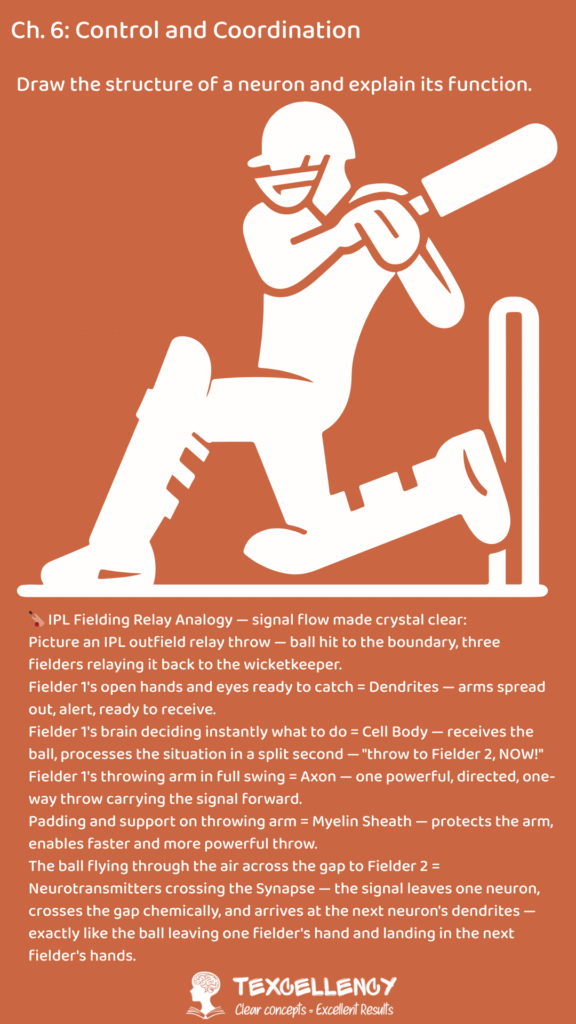
🏏 The IPL Fielding Relay Analogy — Signal Flow Made Crystal Clear
Picture an IPL outfield relay throw — ball hit to the boundary, three fielders relaying it back to the wicketkeeper.
Fielder 1’s open hands and eyes, alert and ready to catch = Dendrites — spread out, receiving the incoming signal from whoever threw it.
Fielder 1’s brain deciding instantly what to do = Cell Body — receives the ball, processes the situation in a split second — “throw to Fielder 2, NOW!”
Fielder 1’s throwing arm in full powerful swing = Axon — one directed, one-way throw carrying the signal forward with full force.
Padding and support on the throwing arm = Myelin Sheath — protects the arm, enables a faster, more powerful, more accurate throw.
The gap between Fielder 1’s hand and Fielder 2’s hands while the ball is in the air = Synaptic Cleft — the signal is briefly in no man’s land, travelling across the gap.
The ball itself flying through the air = Neurotransmitters — the chemical messenger that crosses the gap and delivers the signal to the next neuron’s dendrites, exactly like the ball landing in Fielder 2’s hands.
The entire relay chain — three fielders passing it back to the wicketkeeper = A neural pathway — multiple neurons passing the signal from receptor to brain to muscle.
🌳 The Tree Analogy — for Visual Learners
Think of a neuron as a tree lying on its side:
🌿 Roots spreading in all directions = Dendrites — many, branched, receiving inputs from all around.
🌳 The trunk of the tree = Cell body — the central, essential part containing the nucleus and organelles.
🌲 One long branch extending far in one direction = Axon — single, long, directional, carrying the signal away.
🍂 Leaves at the end of that long branch = Axon terminals — the endpoints where the signal is delivered to the next neuron.
Bark protecting the trunk and main branch = Myelin sheath — insulation and protection.
📊 Parts of a Neuron — Quick Reference Table
| Part | Shape | Direction of Signal | Function |
|---|---|---|---|
| Dendrites | Short, branched, tree-like | Toward cell body | Receive incoming signals |
| Cell Body | Round, contains nucleus | Processes signals | Headquarters — integrates and decides |
| Axon | Long, single fibre | Away from cell body | Transmits signal to next neuron |
| Myelin Sheath | Fatty white coating on axon | — | Protects axon, speeds up transmission |
| Axon Terminals | Small branches at axon end | — | Release neurotransmitters into synapse |
| Synapse | Gap between two neurons | Chemically across gap | Junction for signal transfer between neurons |
⚡ How Does a Signal Actually Travel Through a Neuron?
This is a question that separates average answers from excellent answers in exams.
A nerve signal is an electrochemical impulse. At rest, the inside of a neuron is negatively charged compared to the outside. When stimulated, the neuron membrane briefly reverses this charge — positive inside, negative outside — creating an action potential. This reversal sweeps along the axon like a wave — reaching the axon terminals, triggering neurotransmitter release, crossing the synapse, and starting the action potential in the next neuron.
The signal is always one-way — dendrites to cell body to axon to next neuron’s dendrites. Never backward. The synapse ensures this one-way flow because neurotransmitters are only released from axon terminals — not from dendrites.
🔢 Types of Neurons — Know All Three for Exam
🔵 Sensory Neurons (Afferent) — carry signals FROM sensory organs and receptors TO the brain and spinal cord. When you feel heat, pain, or touch — sensory neurons carry that information inward.
🔵 Motor Neurons (Efferent) — carry signals FROM the brain and spinal cord TO muscles and glands. When your brain says “move your hand” — motor neurons carry that command outward to the muscles.
🔵 Relay Neurons (Interneurons) — found entirely within the brain and spinal cord. They connect sensory neurons to motor neurons and process information. Most of the neurons in your brain are relay neurons.
Memory trick: S-R-M → Sense → Relay → Move — the order in which a signal travels from stimulus to response.
🎵 Rhyme to Remember the Parts
“Dendrites receive from far and near, Cell body thinks — the message is clear, Axon carries the signal long, Myelin keeps the transmission strong, Synapse is the gap in between, Neurotransmitters bridge the scene!”
🔤 Alliterations
“Dendrites Diligently Detect and Deliver signals to the cell body” “Axons Always Advance signals Away from the cell body” “Myelin Makes signals Move Much faster” “Synapses Send signals via Special chemical Substances“
🧩 Mnemonic — Remember All Parts in Order
D → C → A → M → S → “Dedicated Cells Always Make Signals”
Dendrites → Cell body → Axon → Myelin sheath → Synapse
This is also the direction of signal travel — from D to S — input to output.
✅ Exam-Ready Answer (3–4 marks)
A neuron is the structural and functional unit of the nervous system.
Structure: 1. Cell Body — contains the nucleus and cytoplasm; the processing centre of the neuron. 2. Dendrites — short, branched extensions of the cell body that receive incoming nerve impulses. 3. Axon — a single long fibre that carries impulses away from the cell body toward axon terminals. 4. Myelin Sheath — a fatty insulating layer around the axon that protects it and speeds up signal transmission. 5. Axon Terminals — the end points of the axon that release neurotransmitters into the synapse. 6. Synapse — the junction between two neurons where the electrical signal is converted to a chemical signal (neurotransmitters) to cross the gap and continue in the next neuron.
Function: A neuron receives electrical impulses through dendrites, processes them in the cell body, transmits them along the axon, and passes them to the next neuron or target organ via the synapse — enabling the rapid communication that underlies all nervous system activity.
📌 Key Points Checklist
✅ Neuron = basic structural and functional unit of the nervous system ✅ Three main parts: dendrites (receive) • cell body (process) • axon (transmit) ✅ Myelin sheath = fatty insulation around axon = faster signal transmission ✅ Signal always travels: dendrites → cell body → axon → axon terminals → synapse ✅ Synapse = gap between two neurons — signal crosses chemically via neurotransmitters ✅ One-way signal flow — synapse ensures no backward transmission ✅ Three types: Sensory (inward) • Motor (outward) • Relay (within brain/spinal cord) ✅ Longest neuron in human body = axon from spinal cord to toe ✅ Speed of nerve signal = up to 120 metres per second ✅ Myelin sheath damage (e.g. multiple sclerosis) = slow or failed signal transmission
📚 Want ALL of Class 10 Science Explained This Way?
Every chapter. Every concept. Every NCERT question — explained with analogies, rhymes, mnemonics, and real-life examples that make sense and actually stay in memory.
👉 Explore the Full Texcellency Collection 👉 Download Your FREE Book Now
“A good textbook is like a smart GPS — it doesn’t just give you the destination, it tells you every turn along the way, in simple language you actually understand.”