What is the Function of Receptors in Our Body? What Problems Arise When Receptors Do Not Work Properly? — NCERT Class 10 Science
NCERT Class 10 Science | Chapter 7 — Control and Coordination | Texcellency Book Series
🎯 The One-Line Answer Google Loves
Receptors are specialised cells in our sense organs that detect stimuli from the environment and convert them into electrical nerve impulses which travel to the brain for processing. When receptors malfunction — the brain receives no information from that sense — leading to blindness, deafness, loss of smell, inability to feel pain, or loss of balance, depending on which receptor has failed.
🔍 What Exactly Are Receptors?
Close your eyes for a moment. You can still hear sounds, feel the temperature of the air, smell what is cooking in the kitchen, feel the chair you are sitting on. Every single one of these experiences begins at a receptor.
Receptors are specialised sensory cells located in our sense organs — eyes, ears, nose, tongue, and skin. They are the body’s front-line intelligence agents — constantly scanning the environment for any change — light, sound, smell, taste, touch, heat, cold, pressure, pain — and the moment they detect something, they convert that physical or chemical stimulus into an electrical nerve impulse and send it via sensory neurons straight to the brain.
The brain then receives this information, processes it, and decides the appropriate response.
Without receptors — the brain is completely blind, deaf, and numb to the outside world. It has no data. It cannot respond to anything. It is like a highly intelligent general sitting in a war room with no information from the battlefield.
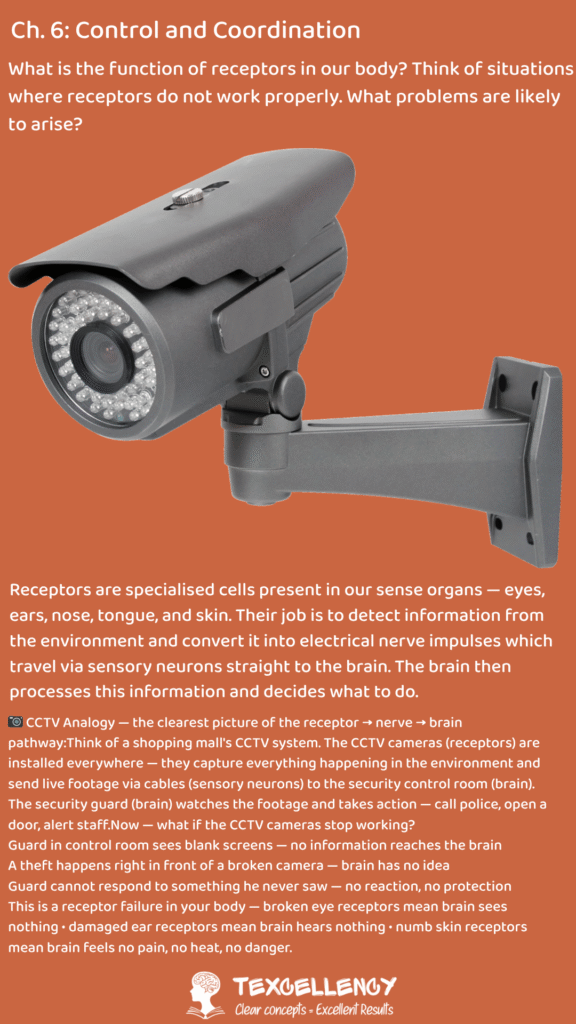
📷 The CCTV Analogy — The Clearest Picture of How Receptors Work
Think of a large shopping mall’s CCTV security system.
CCTV cameras installed everywhere = Receptors — in the eyes (photoreceptors), ears (phonoreceptors), nose (chemoreceptors), tongue (chemoreceptors), and skin (thermoreceptors, mechanoreceptors, nociceptors). Each camera is specialised — some capture video, some capture heat signatures, some detect motion.
Cables carrying live footage from cameras to control room = Sensory neurons — carrying electrical impulses from receptors to the brain.
The security control room = Brain — receiving all the footage simultaneously, processing it, and deciding what action to take.
The security guard watching the screens and issuing instructions = Brain deciding the response — send pain signal, increase heart rate, pull hand back, focus eyes.
Now — what if the CCTV cameras stop working?
The security guard sits in the control room staring at blank screens. He has no idea what is happening anywhere in the mall. Someone could be stealing, a fire could be starting, a customer could be in danger — and he would have absolutely no way of knowing. He cannot act on information he never received.
This is exactly what happens when receptors in your body fail to function. The brain — however powerful — cannot act on information it never receives.
👁️ Types of Receptors — Where They Are and What They Detect
🔵 Photoreceptors — located in the retina of the eye. Detect light. Two types: Rods (detect dim light and shapes) and Cones (detect colour and fine detail). Convert light energy into electrical impulses that the brain interprets as vision.
🔵 Phonoreceptors (Auditory receptors) — located in the cochlea of the inner ear. Detect sound vibrations. Convert sound wave energy into electrical impulses the brain interprets as hearing.
🔵 Chemoreceptors — located in the nose (olfactory receptors detecting smell) and tongue (taste buds detecting sweet, sour, salty, bitter, umami). Convert chemical information into electrical impulses the brain interprets as smell and taste.
🔵 Thermoreceptors — located in the skin. Detect temperature changes — both heat and cold. Crucial for protecting us from extreme temperatures.
🔵 Mechanoreceptors — located in the skin and inner ear. Detect pressure, touch, vibration, and body position. The inner ear’s vestibular receptors help maintain balance and spatial orientation.
🔵 Nociceptors (Pain receptors) — located throughout the skin and internal organs. Detect harmful stimuli — extreme heat, cold, pressure, or tissue damage — and signal pain to the brain. Pain is not pleasant — but it is the body’s critical alarm system.
⚠️ What Happens When Receptors Do Not Work Properly?
This is the second — and often neglected — half of this question. Examiners specifically want real examples of receptor failure and their consequences. Here are the most important ones:
🔴 1. Photoreceptors fail → Blindness or Colour Blindness When the rod cells in the retina degenerate (as in Retinitis Pigmentosa), the person loses peripheral and night vision — eventually leading to complete blindness. When cone cells malfunction — the person cannot distinguish between certain colours — a condition called colour blindness. The eye physically exists and looks normal — but the brain receives no visual data. The security camera is installed but not recording.
🔴 2. Phonoreceptors fail → Deafness When hair cells in the cochlea are damaged — by prolonged exposure to loud music, disease, or ageing — they stop converting sound vibrations into electrical impulses. The result is hearing loss or complete deafness. Wearing earphones at high volume for hours every day gradually destroys these receptor cells — and unlike most body cells, cochlear hair cells do NOT regenerate once destroyed.
🔴 3. Nociceptors (pain receptors) fail → Inability to feel pain — dangerously life-threatening This sounds like a superpower — but it is one of the most dangerous conditions known to medicine. A rare condition called Congenital Insensitivity to Pain (CIP) destroys pain receptors. People with this condition cannot feel pain at all. They suffer serious burns, fractures, and internal injuries without realising it — because no pain signal ever reaches the brain. They have died from appendicitis because they never felt abdominal pain warning them. Pain is not your enemy. Pain is your body’s most important alarm.
🔴 4. Thermoreceptors fail → Burns and Frostbite without awareness In conditions like advanced diabetes, thermoreceptors in the feet stop working properly (diabetic neuropathy). The patient cannot feel heat or cold in their feet — they can place their foot on a hot surface and not realise it until they smell burning. Severe burns and infections follow — often leading to amputation — all because the receptor stopped sending the warning signal.
🔴 5. Vestibular (balance) receptors fail → Vertigo and loss of balance When receptors in the inner ear’s semicircular canals malfunction — as in a condition called Vertigo — the brain receives incorrect or no information about the body’s position and movement. The person feels the entire world spinning around them, cannot stand straight, cannot walk in a straight line, feels severely nauseated. A pilot with faulty vestibular receptors cannot tell if the aircraft is level or tilting — a genuinely life-threatening situation.
🔴 6. Chemoreceptors in nose fail → Loss of smell (Anosmia) This became widely known during the COVID-19 pandemic — when the virus damaged olfactory receptor cells, millions of people suddenly lost their ability to smell — a condition called Anosmia. Not only could they not enjoy food (taste and smell are closely linked), they also could not smell smoke, gas leaks, or spoiled food — removing critical safety warnings from their environment.
🏭 The Factory Sensor Analogy — Understanding Why Receptor Failure is So Dangerous
Imagine a large chemical factory — with temperature sensors, pressure sensors, smoke detectors, and toxic gas detectors installed at every critical point. These sensors continuously monitor conditions and send alerts to the control room.
Now imagine all sensors are switched off. The factory is still running. Workers are still working. But no one knows when the temperature is dangerously high, when a pipe is about to burst, when toxic gas is leaking, when fire has started in a corner. The factory will have an accident — it is only a matter of time.
Your body with failed receptors is that factory with all sensors switched off. Everything looks fine from the outside — but the warning systems are gone, and disasters accumulate silently.
📊 Receptor Failure — Quick Reference Table
| Receptor | Location | Detects | When It Fails |
|---|---|---|---|
| Photoreceptors | Retina of eye | Light | Blindness, colour blindness |
| Phonoreceptors | Cochlea of inner ear | Sound vibrations | Deafness, hearing loss |
| Nociceptors | Skin, organs | Pain | Cannot feel pain → dangerous injuries unnoticed |
| Thermoreceptors | Skin | Heat and cold | Burns/frostbite without awareness |
| Chemoreceptors | Nose, tongue | Smell, taste | Anosmia, loss of taste |
| Vestibular receptors | Inner ear | Balance, position | Vertigo, loss of balance |
| Mechanoreceptors | Skin | Touch, pressure | Cannot feel touch or pressure |
🎵 Rhyme to Remember
“Receptors sit in every sense, Collecting data, sharp and intense — Eyes catch light, ears catch sound, Skin feels heat and touch all around, Nose smells gas, tongue tastes the sweet, Without receptors — your brain’s incomplete! When receptors fail — the signals stop, The brain goes blind — the alarms all drop!”
🔤 Alliterations
“Receptors Receive, Record, and Relay stimuli to the brain” “Photoreceptors Produce Pictures for the brain to Process” “Nociceptors Notify the brain of Nasty, Noxious stimuli” “Failing receptors = Failing to feel, see, hear, smell or sense“
🧩 Mnemonic — Remember All 6 Types of Receptors
P — P — C — T — M — N → “People Prefer Chocolate, Tea, Mangoes, and Namkeen”
Photoreceptors (light) • Phonoreceptors (sound) • Chemoreceptors (smell/taste) • Thermoreceptors (temperature) • Mechanoreceptors (touch/pressure) • Nociceptors (pain)
✅ Exam-Ready Answer (3–4 marks)
Function of Receptors: Receptors are specialised sensory cells present in our sense organs. Their function is to detect stimuli from the environment — light, sound, smell, taste, touch, temperature, and pain — and convert them into electrical nerve impulses. These impulses travel via sensory neurons to the brain, which processes the information and coordinates an appropriate response.
Problems When Receptors Do Not Work Properly: 1. If photoreceptors in the eye fail → loss of vision or colour blindness. 2. If phonoreceptors in the ear fail → hearing loss or deafness. 3. If pain receptors (nociceptors) fail → the person cannot feel pain → dangerous injuries go unnoticed → life-threatening. 4. If thermoreceptors in the skin fail → the person cannot sense heat or cold → severe burns or frostbite without awareness. 5. If chemoreceptors in the nose fail → loss of smell (Anosmia) → cannot detect gas leaks or spoiled food. 6. If vestibular receptors in the inner ear fail → loss of balance → Vertigo.
In all cases, the brain receives no information from the affected sense — and cannot coordinate any protective response for that stimulus.
📌 Key Points Checklist
✅ Receptors = specialised sensory cells in sense organs ✅ Function = detect stimuli → convert to electrical impulses → send to brain via sensory neurons ✅ Brain processes impulses → coordinates response ✅ 6 types: Photoreceptors • Phonoreceptors • Chemoreceptors • Thermoreceptors • Mechanoreceptors • Nociceptors ✅ Photoreceptor failure → blindness / colour blindness ✅ Phonoreceptor failure → deafness (cochlear hair cells do not regenerate) ✅ Nociceptor failure → cannot feel pain → most dangerous receptor failure ✅ Thermoreceptor failure → burns/frostbite without awareness (common in diabetes) ✅ Chemoreceptor failure → Anosmia (loss of smell — also seen in COVID-19) ✅ Vestibular receptor failure → Vertigo, loss of balance ✅ Without receptors → brain is completely cut off from the outside world
📚 Want ALL of Class 10 Science Explained This Way?
Every chapter. Every concept. Every NCERT question — explained with analogies, rhymes, mnemonics, and real-life examples that make sense and stay in memory long after exam day.
👉 Explore the Full Texcellency Collection 👉 Download Your FREE Book Now
“A good textbook is like a smart GPS — it doesn’t just give you the destination, it tells you every turn along the way, in simple language you actually understand.”