The Brain is Responsible for (a) Thinking (b) Regulating the Heartbeat (c) Balancing the Body (d) All of the Above — NCERT Class 10 Science
NCERT Class 10 Science | Chapter 7 — Control and Coordination | Texcellency Book Series
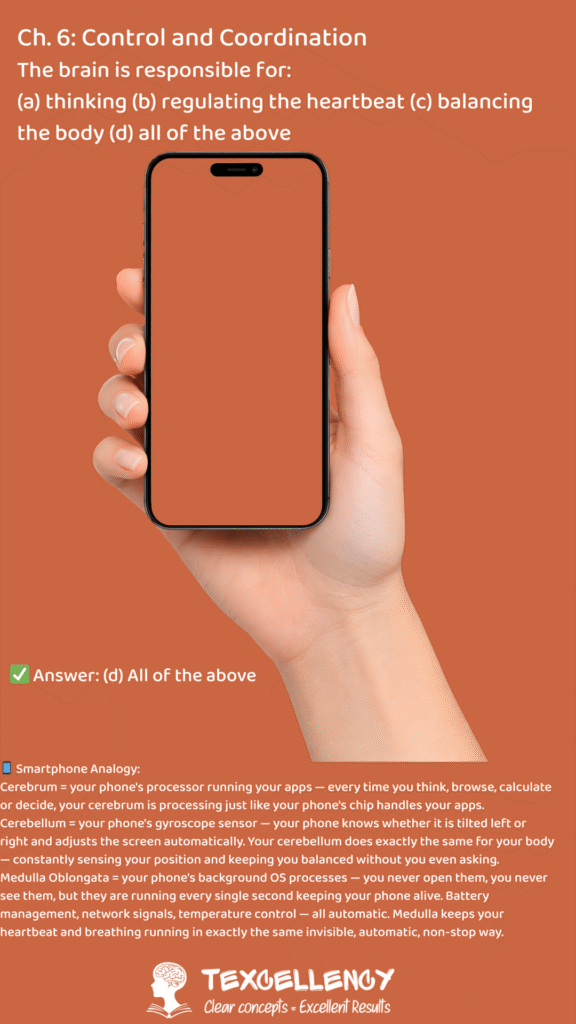
✅ Answer: (d) All of the Above
The correct answer is (d) All of the above. The brain is responsible for thinking AND regulating the heartbeat AND balancing the body — simultaneously, every second of your life. But the key insight that makes this question truly interesting is which part of the brain does which job — and that is what this post is all about.
🧠 The Big Picture — One Brain, Three Divisions, Three Different Jobs
Most students think of the brain as one single unit that does everything. The reality is far more fascinating. The human brain is divided into three major parts — each handling a completely different category of functions — and each so specialised that damage to one part leaves the other two completely unaffected.
🔵 Forebrain — the thinking, reasoning, conscious part. Dominated by the Cerebrum.
🔵 Midbrain — the relay and reflex part. Connects forebrain to hindbrain. Handles visual and auditory reflexes.
🔵 Hindbrain — the automatic, survival part. Contains the Cerebellum (balance) and Medulla Oblongata (heartbeat, breathing).
Think of it as a three-tier government: the Forebrain is the Parliament — debating, deciding, legislating. The Midbrain is the bureaucracy in between — routing information. The Hindbrain is the essential services department — water, electricity, heartbeat — running 24×7 without anyone asking.
📱 The Smartphone Analogy — The One That Makes Everything Click
🟢 Cerebrum = Your phone’s main processor running all your apps. Every time you think, solve a problem, remember something, feel an emotion, make a decision, read this sentence — your cerebrum is processing, exactly like your phone’s chip handling apps. More apps running = more processor load. More complex thinking = more cerebrum activity.
🟡 Cerebellum = Your phone’s gyroscope sensor. Your phone knows whether it is tilted left or right and adjusts the screen automatically — without you doing anything. Your cerebellum does exactly the same for your body — constantly sensing your position, speed of movement, and muscle coordination — and making micro-adjustments to keep you balanced without you ever consciously asking it to. When you ride a bicycle without thinking about balance — that is your cerebellum working.
🔴 Medulla Oblongata = Your phone’s background OS processes. You never open them. You never see them. But they are running every single second keeping your phone alive — battery management, network signal maintenance, temperature regulation — all automatic, all invisible. Your medulla keeps your heartbeat, breathing, blood pressure, and digestion running in exactly the same invisible, automatic, non-stop way. Even when you are in deep sleep — medulla never sleeps.
🏙️ The City Administration Analogy — for the complete brain structure
Imagine running a large city like Mumbai:
Cerebrum = The Municipal Corporation Office — all planning, decision-making, policy changes, new projects, creative solutions happen here. Largest department. Most complex work. Handles everything that requires conscious thought and judgment.
Cerebellum = The Traffic Control Department — does not make big city policies, but ensures everything moves smoothly, in coordination, without collisions. Manages the flow and timing of everything on the roads. Without it — city functions but everything crashes into everything else.
Medulla Oblongata = The Essential Services Department — water supply, electricity, sewage — running 24×7 automatically. No meetings needed. No conscious decisions. Just continuous, uninterrupted, life-sustaining operation. If this shuts down — the entire city collapses within minutes.
Midbrain = The Relay Towers and Switchboard — connecting all departments, routing urgent messages, handling immediate reflexes before they reach the main office.
🔬 Each Brain Part Explained in Detail
🧩 Part 1 — The Cerebrum (Forebrain)
The cerebrum is the largest part of the human brain — making up about 85% of total brain weight. It is divided into two halves called the left and right cerebral hemispheres, connected by a thick band of nerve fibres called the corpus callosum.
The surface of the cerebrum is deeply folded — these folds are called gyri (ridges) and sulci (grooves). The folding is not decorative — it massively increases the surface area of the brain, packing far more processing power into the limited space of the skull.
The cerebrum is divided into four lobes, each handling different functions:
🔵 Frontal Lobe — thinking, reasoning, planning, personality, voluntary movement, and speech production. This is where your conscious decisions are made.
🔵 Parietal Lobe — processes sensory information — touch, pressure, temperature, pain. Also handles spatial awareness and coordination between senses.
🔵 Temporal Lobe — processes hearing, language comprehension, and memory storage. This is where sounds become words and experiences become memories.
🔵 Occipital Lobe — processes all visual information. Everything your eyes see is actually interpreted here — at the back of your head.
Key functions of the Cerebrum: Thinking and reasoning • Voluntary movement • Memory and learning • Language and speech • Emotions and personality • Processing all five senses • Consciousness itself
🧩 Part 2 — The Cerebellum (Hindbrain)
The cerebellum sits at the back and bottom of the brain, below the cerebrum. It looks like a smaller, more tightly folded brain attached underneath — and that is essentially what it is — a specialised sub-processor dedicated entirely to movement coordination and balance.
The cerebellum receives information from the muscles, joints, and inner ear about body position and movement — and simultaneously receives information from the cerebrum about what movement was intended. It then compares the two — and sends correction signals to muscles to ensure the movement is smooth, precise, and balanced.
Without the cerebellum: You could still walk — but you would walk like someone who is extremely dizzy, stumbling, unable to coordinate left and right limbs, unable to perform precise hand movements. A surgeon cannot operate, a cricketer cannot bat, a dancer cannot dance — without a functioning cerebellum.
Key functions of the Cerebellum: Coordination of voluntary movements • Maintaining posture and balance • Fine motor control • Learning movement patterns (like learning to ride a bicycle — stored in the cerebellum)
🧩 Part 3 — The Medulla Oblongata (Hindbrain)
The medulla oblongata is located at the very base of the brain, connecting the brain to the spinal cord. It is the most ancient part of the brain in evolutionary terms — present in virtually all vertebrates — because it controls the most fundamental life-sustaining functions.
The medulla oblongata controls all involuntary, automatic functions — things your body must do continuously without you consciously deciding every time:
Key functions of the Medulla: Regulating heartbeat and heart rate • Controlling breathing rate and depth • Regulating blood pressure • Controlling swallowing and vomiting reflexes • Regulating digestive movements • Controlling sneezing and coughing reflexes
This is why damage to the medulla oblongata is immediately life-threatening — it stops the heartbeat and breathing. An injury to the cerebrum may cause paralysis or memory loss — serious, but survivable. An injury to the medulla oblongata stops the heart — not survivable without immediate intervention.
🔄 The Midbrain — The Bridge in Between
The midbrain sits between the forebrain and hindbrain. It acts as a relay centre — routing signals from the eyes and ears to the appropriate parts of the brain, and handling certain visual and auditory reflexes — like automatically turning your head toward a sudden loud sound, or adjusting your pupils in response to sudden bright light. These happen before your conscious brain even processes what happened.
📊 Parts of the Brain — Complete Quick Reference Table
| Part | Location | Controls | Voluntary or Involuntary |
|---|---|---|---|
| Cerebrum | Front and top | Thinking, memory, voluntary movement, senses, emotions | Voluntary |
| Cerebellum | Back and bottom | Balance, coordination, fine motor control | Involuntary (automatic) |
| Medulla Oblongata | Base of brain | Heartbeat, breathing, blood pressure, reflexes | Involuntary (automatic) |
| Midbrain | Between fore and hindbrain | Relay, visual and auditory reflexes | Involuntary (reflex) |
⚡ Why “All of the Above” is the Answer — The Elegant Summary
🔷 Thinking → Cerebrum (part of the brain) → ✅ Brain does it
🔷 Regulating heartbeat → Medulla Oblongata (part of the brain) → ✅ Brain does it
🔷 Balancing the body → Cerebellum (part of the brain) → ✅ Brain does it
Three completely different brain regions. Three completely different types of functions. All three are parts of the brain. Therefore — all of the above. And now you understand not just the answer, but the entire reason behind it.
🎵 Rhyme to Remember the Three Brain Parts
“Cerebrum thinks the big thoughts through, Solves your problems — old and new, Cerebellum keeps you straight and tall, Makes sure you balance — never fall, Medulla beats your heart each day, Keeps you breathing come what may — Three parts working, never done, Together they make your brain run!”
🔤 Alliterations
“Cerebrum Controls Conscious thinking, Creativity, and Complex decisions” “Cerebellum Coordinates, Controls balance, and Corrects movement” “Medulla Manages the Most vital, automatic, life-sustaining functions“
🧩 Mnemonic — Remember the Three Parts and Their Jobs
C — C — M → “Clever Captains Manage”
Cerebrum = Conscious thinking • Cerebellum = Coordination and balance • Medulla = maintaining Mandatory automatic functions (heartbeat, breathing)
Or use the Three-City trick: Cerebrum = Delhi (Parliament, big decisions, conscious power) Cerebellum = Mumbai (traffic and coordination — everything flowing smoothly) Medulla = Electricity grid (no city can exist without it — invisible but essential)
✅ Exam-Ready Answer
Answer: (d) All of the above
The brain is divided into three main parts, each responsible for different functions:
1. Cerebrum — the largest part of the brain. It is responsible for thinking, reasoning, voluntary movements, memory, emotions, and processing sensory information. This answers option (a).
2. Medulla Oblongata — located at the base of the brain. It controls involuntary functions like heartbeat, breathing, and blood pressure automatically, without conscious effort. This answers option (b).
3. Cerebellum — located at the back of the brain. It maintains posture, coordinates voluntary movements, and keeps the body balanced. This answers option (c).
Since all three functions — thinking, regulating heartbeat, and balancing the body — are performed by different parts of the brain, the correct answer is (d) All of the above.
📌 Key Points Checklist
✅ Brain has three main divisions: Forebrain (Cerebrum) • Hindbrain (Cerebellum + Medulla) • Midbrain ✅ Cerebrum = largest part = thinking, memory, voluntary movement, emotions, senses ✅ Cerebrum has 4 lobes: Frontal • Parietal • Temporal • Occipital ✅ Cerebellum = balance, coordination, fine motor control, posture ✅ Medulla Oblongata = heartbeat, breathing, blood pressure — all involuntary and automatic ✅ Midbrain = relay centre + visual and auditory reflexes ✅ Damage to medulla = immediately life-threatening ✅ Damage to cerebellum = loss of coordination and balance ✅ Damage to cerebrum = loss of thinking, memory, or voluntary movement depending on area ✅ All three are parts of the brain → answer is always (d) All of the above
📚 Want ALL of Class 10 Science Explained This Way?
Every concept, every NCERT question — explained with analogies, rhymes, mnemonics, and real-life examples that make sense and stay in memory long after the exam is over.
👉 Explore the Full Texcellency Collection 👉 Download Your FREE Book Now
“A good textbook is like a smart GPS — it doesn’t just give you the destination, it tells you every turn along the way, in simple language you actually understand.”