
Explain the formation of scum when hard water is treated with soap.
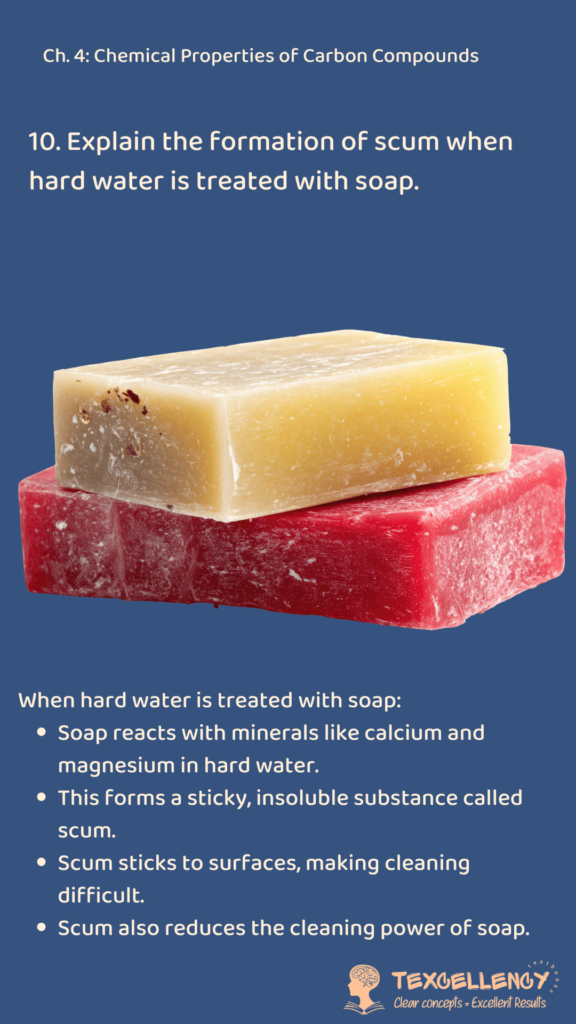
NCERT Class 10 Science | Chapter: Carbon and Its Compounds | Texcellency Book Series
✅ Answer in One Paragraph (For Quick Revision)
Hard water contains dissolved calcium (Ca²⁺) and magnesium (Mg²⁺) ions. When soap — which is the sodium salt of a fatty acid — is added to hard water, these Ca²⁺ and Mg²⁺ ions react with the soap molecules and form insoluble calcium and magnesium salts of the fatty acid. These insoluble salts appear as a white, sticky, greasy precipitate called scum. Scum sticks to clothes, skin, bathtubs, and vessels. The soap molecules used up in forming scum are no longer available to form micelles and clean surfaces — so the cleaning power of soap drops drastically in hard water.
🏭 The Bouncer Analogy — Why Soap Cannot Work in Hard Water
Imagine a nightclub (the dirty surface that needs cleaning). The soap molecules are the helpful staff trying to escort the dirt out (form micelles, clean the surface). But at the entrance, there are two bouncers — Ca²⁺ and Mg²⁺ ions — who grab every soap molecule that enters the water and immediately throw it out of action by handcuffing it (forming insoluble calcium/magnesium stearate). The soap molecule is now stuck — it cannot form micelles, it cannot clean, it is just lying on the floor as useless white scum.
🔵 More soap you add → more soap gets grabbed by the bouncers → more scum forms 🔵 Only after ALL Ca²⁺ and Mg²⁺ ions have been used up (handcuffed all the soap they can) does any remaining soap actually become available to clean 🔵 This is why you need far more soap in hard water areas to get any cleaning done — and even then, scum residue remains
🔴 What is Hard Water? — The Root Cause
Hard water is water that contains dissolved calcium ions (Ca²⁺) and magnesium ions (Mg²⁺) — usually as their bicarbonates, sulphates, or chlorides.
🔵 Sources of Ca²⁺ and Mg²⁺ in water: When rainwater (slightly acidic, contains dissolved CO₂) flows over rocks and soil containing limestone (CaCO₃), dolomite (CaMg(CO₃)₂), gypsum (CaSO₄), or similar minerals, it dissolves them and picks up Ca²⁺ and Mg²⁺ ions. Groundwater and borewell water is typically hard for this reason. 🔵 Soft water — water that does NOT contain significant Ca²⁺/Mg²⁺ ions — is rainwater collected directly, or river water from non-limestone regions. Soap lathers freely in soft water with zero scum. 🔵 Real-life experience: If you live in an area where water leaves white deposits on taps, vessels, and tiles — your water is hard. If soap lathers easily and no scum forms — your water is soft.
🔶 The Chemistry of Scum Formation — Step by Step
Step 1 — Soap dissolves in water:
Soap (e.g. sodium stearate) dissolves in water and dissociates: CH₃(CH₂)₁₆COONa → CH₃(CH₂)₁₆COO⁻ + Na⁺ (Sodium stearate → Stearate ion + Sodium ion)
The stearate ion (CH₃(CH₂)₁₆COO⁻) is the active cleaning agent — the molecule with the hydrophobic tail and hydrophilic head that forms micelles.
Step 2 — Ca²⁺ and Mg²⁺ ions intercept the stearate ions:
Hard water contains Ca²⁺ and Mg²⁺ ions. These are doubly charged positive ions — they are strongly attracted to the negatively charged stearate ions (COO⁻). One Ca²⁺ ion grabs TWO stearate ions (because Ca²⁺ has 2+ charge, it needs two COO⁻ ions to balance it):
2CH₃(CH₂)₁₆COO⁻ + Ca²⁺ → [CH₃(CH₂)₁₆COO]₂Ca↓ (Two stearate ions + Calcium ion → Calcium stearate — INSOLUBLE precipitate ↓)
Similarly with magnesium: 2CH₃(CH₂)₁₆COO⁻ + Mg²⁺ → [CH₃(CH₂)₁₆COO]₂Mg↓ (Two stearate ions + Magnesium ion → Magnesium stearate — INSOLUBLE precipitate ↓)
Step 3 — Insoluble precipitate = Scum:
🔵 Calcium stearate and magnesium stearate are insoluble in water — they do NOT dissolve, they do NOT form micelles, they are completely useless for cleaning 🔵 They appear as a white, greasy, sticky solid — this is the scum 🔵 This scum floats on the water surface, sticks to the skin/clothes/bathtub being washed, and leaves a white filmy residue 🔵 The Na⁺ ions released are harmless and stay dissolved in the water
The complete ionic equation with calcium chloride in hard water: 2CH₃(CH₂)₁₆COONa + CaCl₂ → [CH₃(CH₂)₁₆COO]₂Ca↓ + 2NaCl (Sodium stearate + Calcium chloride → Calcium stearate (scum) ↓ + Sodium chloride)
🔷 Why Scum is Such a Problem — Four Consequences
🔵 Cleaning failure: Every soap molecule that forms scum is permanently lost — it cannot clean anything. In very hard water, almost all the soap forms scum before any cleaning begins. You have to add enormous amounts of soap just to saturate all the Ca²⁺/Mg²⁺ ions before the remaining soap can finally start cleaning. 🔵 Residue on skin: Scum sticks to skin, leaving it feeling rough, dry, and coated with a white film. This is why hair washed in hard water with soap feels rough and sticky rather than clean and smooth. 🔵 Residue on clothes: Scum deposits in the fibres of fabric — clothes washed in hard water with soap feel stiff, look dull, and the fabric deteriorates faster. The white marks left on dark clothes after washing in hard water are calcium/magnesium stearate deposits. 🔵 Bathtub ring: The classic white/grey ring seen inside bathtubs and on bathroom tiles in hard water areas — this is solidified scum, a mixture of calcium stearate, magnesium stearate, and trapped dirt.
🔴 Why Detergents Do NOT Form Scum — The Key Comparison
This is a favourite follow-up question in exams and deserves a clear explanation.
🔵 Soap’s ionic head: –COO⁻Na⁺ (carboxylate group) — the COO⁻ reacts with Ca²⁺ and Mg²⁺ to form INSOLUBLE calcium/magnesium carboxylates (scum) 🔵 Detergent’s ionic head: –SO₃⁻Na⁺ (sulphonate group) — the SO₃⁻ also reacts with Ca²⁺ and Mg²⁺, but the resulting calcium and magnesium sulphonates are SOLUBLE — they do not precipitate, they stay dissolved, they do not form scum
2R–SO₃Na + CaCl₂ → (R–SO₃)₂Ca + 2NaCl (The calcium sulphonate formed here is SOLUBLE — no precipitate — no scum)
🔵 Since no soap molecules are “wasted” forming scum, detergent molecules remain available to form micelles and clean effectively — even in the hardest water 🔵 This is the principal advantage of synthetic detergents over natural soaps — they work in hard water
Comparison at a glance — Soap vs Detergent in hard water: Soap + hard water → scum forms → cleaning inefficient → more soap needed → residue on skin/clothes Detergent + hard water → no scum → cleaning fully effective → no residue
🔶 Temporary vs Permanent Hardness — Bonus Knowledge for Extra Marks
🔵 Temporary hardness — caused by dissolved calcium bicarbonate Ca(HCO₃)₂ and magnesium bicarbonate Mg(HCO₃)₂. Called “temporary” because it can be removed simply by boiling the water. On boiling: Ca(HCO₃)₂ → CaCO₃↓ + H₂O + CO₂. The CaCO₃ precipitates out (the white scale inside kettles and water heaters is this CaCO₃ deposit). Once removed, the water is soft. 🔵 Permanent hardness — caused by dissolved calcium sulphate (CaSO₄) and magnesium sulphate (MgSO₄) or their chlorides. Called “permanent” because boiling does NOT remove these — they remain dissolved even at 100°C. Removal requires ion exchange resins (water softeners), adding washing soda (Na₂CO₃), or distillation. 🔵 Both types cause scum with soap — the distinction is about how to remove the hardness, not about whether scum forms.
🎵 Rhyme to Remember
“Hard water holds Ca²⁺ and Mg²⁺ inside, Soap meets these ions — they react with pride,* Calcium stearate forms — insoluble and white,* Scum on the bathtub — what an unwelcome sight!* Two soap molecules grabbed by each Ca²⁺,* No micelles, no cleaning — soap wasted, it’s sad!* Detergent says no — its sulphonate stays free,* Works in hard water — cleans perfectly!”*
🧩 Mnemonics
🔵 “Ca²⁺ and Mg²⁺ = SOAP KILLERS in hard water” — they react with and destroy soap molecules, turning them into useless insoluble scum. 🔵 “SCUM = Soap + Calcium/magnesium → Useless Mess” — the four letters summarise the entire reaction. 🔵 “Soap has COO⁻ — forms insoluble Ca/Mg salt = SCUM. Detergent has SO₃⁻ — forms SOLUBLE Ca/Mg salt = NO scum.” — the ionic head decides the outcome. 🔵 “Hard water → Hard to lather → Hard to clean → Hard on clothes and skin” — all consequences linked to one root cause. 🔵 “Boiling fixes TEMPORARY hardness — Water softener fixes PERMANENT hardness”
✅ Exam-Ready Answer (Write This in Board Exam)
Explain the formation of scum when hard water is treated with soap.
Hard water contains dissolved calcium ions (Ca²⁺) and magnesium ions (Mg²⁺) — usually as their sulphates, chlorides, or bicarbonates.
Soap is the sodium salt of a long-chain fatty acid (e.g. sodium stearate, CH₃(CH₂)₁₆COONa). When soap is added to hard water, the Ca²⁺ and Mg²⁺ ions react with the soap molecules and form insoluble calcium and magnesium salts of the fatty acid:
2CH₃(CH₂)₁₆COONa + CaCl₂ → [CH₃(CH₂)₁₆COO]₂Ca↓ + 2NaCl (Sodium stearate + Calcium chloride → Calcium stearate (insoluble scum) ↓ + Sodium chloride)
The insoluble calcium stearate (and magnesium stearate) forms a white, sticky, greasy precipitate called scum. This scum: 🔵 Sticks to skin, clothes, bathtubs, and utensils 🔵 Leaves a white film/residue after washing 🔵 Wastes soap — the soap molecules used in forming scum can no longer form micelles or clean surfaces 🔵 Reduces the cleaning efficiency of soap drastically
Synthetic detergents do not form scum in hard water because their ionic head (sulphonate group –SO₃⁻) forms soluble calcium and magnesium salts — unlike soap’s carboxylate group (–COO⁻) which forms insoluble salts.
📌 Key Points Checklist
✅ Hard water = water containing dissolved Ca²⁺ and Mg²⁺ ions ✅ Soap = sodium salt of fatty acid (e.g. sodium stearate CH₃(CH₂)₁₆COONa) ✅ Scum = insoluble calcium stearate + magnesium stearate formed when soap reacts with hard water ✅ Equation: 2CH₃(CH₂)₁₆COONa + CaCl₂ → [CH₃(CH₂)₁₆COO]₂Ca↓ + 2NaCl ✅ One Ca²⁺ ion reacts with TWO soap molecules (because Ca²⁺ is doubly charged) ✅ Scum = white, sticky, insoluble precipitate — sticks to skin, clothes, bathtubs ✅ Scum wastes soap — those molecules can no longer form micelles or clean ✅ Detergent does NOT form scum — its SO₃⁻ head forms soluble Ca/Mg salts ✅ Temporary hardness (bicarbonates) — removed by boiling ✅ Permanent hardness (sulphates/chlorides) — NOT removed by boiling, needs ion exchange or washing soda
📚 Want ALL of Class 10 Science Explained This Way? Every chapter. Every concept. Every NCERT question — with analogies, rhymes, mnemonics, and real-life examples.