
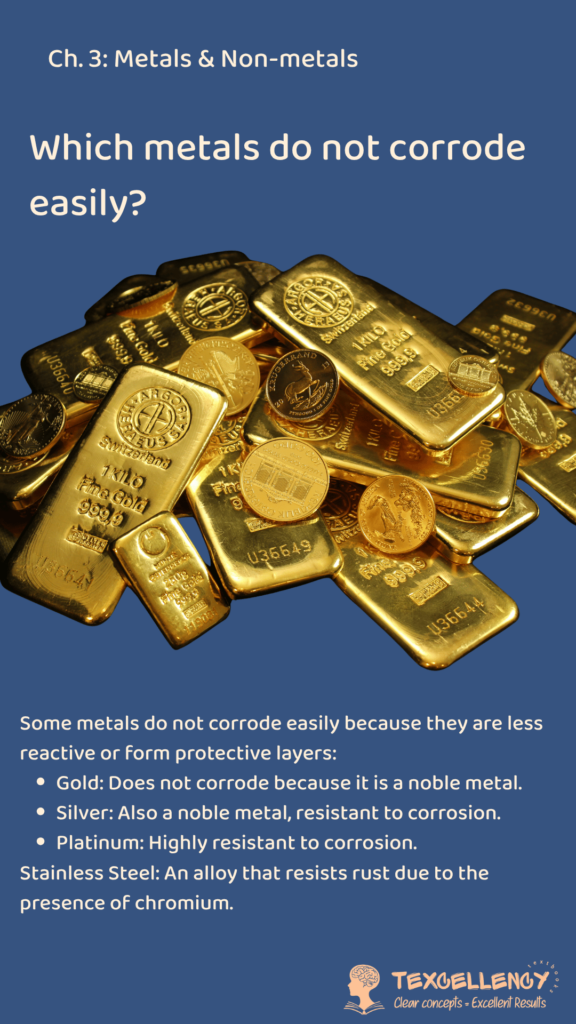
Q. Which metals do not corrode easily?
NCERT Class 10 Science | Chapter: Metals and Non-Metals | Texcellency Book Series
✅ Answer in Brief (For Quick Revision)
Metals that do not corrode easily fall into two categories:
🔵 Category 1 — Metals low on the reactivity series (naturally unreactive): Gold (Au), Platinum (Pt), Silver (Ag), and Copper (Cu) — these metals are chemically unreactive toward oxygen and moisture under normal conditions, so they do not corrode easily. 🔵 Category 2 — Metals that form a protective oxide layer (passivation): Aluminium (Al), Chromium (Cr), and Zinc (Zn) — these metals ARE reactive, but they instantly form a thin, dense, impermeable oxide layer on their surface that shields the underlying metal from further corrosion.
The most exam-important and conceptually rich case is aluminium — which is highly reactive yet extremely corrosion-resistant — because of passivation. Understanding WHY aluminium does not corrode despite being reactive is the heart of this topic.
🏭 The Bodyguard Analogy — Two Ways to Stay Safe
Imagine two types of VIPs who never get attacked:
🔵 Type 1 — The Naturally Untouchable VIP (Gold, Platinum): This VIP is so powerful and important that no enemy (oxygen, moisture, acid) dares to approach. He never needs a bodyguard — his own nature makes him immune. This is gold and platinum — so low in reactivity that environmental agents simply cannot react with them.
🔵 Type 2 — The Well-Protected VIP (Aluminium, Chromium, Zinc): This VIP is actually quite vulnerable — if you could get to him, he would react easily. But the moment danger appears, an instant force field (the oxide layer) surrounds him completely. The force field is so perfect, so dense, so impenetrable that no enemy can get through. This is aluminium — reactive metal, but protected by an instantaneous, self-forming, impenetrable Al₂O₃ shield.
Both types are effectively corrosion-resistant — but for completely different chemical reasons.
🔴 What is Corrosion? — The Definition First
Before listing metals that resist corrosion, you must understand exactly what corrosion is.
Corrosion is the gradual destruction or degradation of a metal by chemical reaction with its surrounding environment — typically involving oxygen, moisture, carbon dioxide, acids, or salts.
🔵 The most familiar corrosion is rusting of iron: 4Fe + 3O₂ + xH₂O → 2Fe₂O₃·xH₂O (hydrated iron oxide — the red/orange flaky rust) 🔵 Rusting requires BOTH oxygen AND moisture — iron in completely dry air does not rust; iron in oxygen-free water does not rust either. Both must be present together. 🔵 Corrosion is different from rusting — rusting applies only to iron and steel. Corrosion is the general term for all metals.
Consequences of corrosion: 🔵 Weakening and eventual destruction of metal structures 🔵 Loss of electrical conductivity (corroded contacts fail) 🔵 Loss of aesthetic appearance (tarnished jewellery, dull surfaces) 🔵 Economic loss — corrosion costs nations enormous amounts annually in infrastructure repair
The question “which metals do not corrode easily” is therefore asking: which metals are resistant to this chemical attack by the environment?
🔶 Category 1 — Metals That Are Naturally Corrosion Resistant (Low Reactivity)
These metals sit at the BOTTOM of the reactivity series — they are the least chemically reactive of all metals and therefore least susceptible to attack by oxygen and moisture.
Gold (Au) — The Most Corrosion-Resistant of All Common Metals: 🔵 Gold is at the very bottom of the reactivity series — below platinum, below silver, below copper, below hydrogen 🔵 Gold does NOT react with oxygen → no gold oxide forms on its surface → it retains its shine permanently 🔵 Gold does NOT react with water, dilute acids, or most concentrated acids 🔵 The ONLY thing that dissolves gold is aqua regia — a freshly prepared mixture of concentrated hydrochloric acid (HCl) and concentrated nitric acid (HNO₃) in the ratio 3:1. The name “aqua regia” means “royal water” in Latin — because it can dissolve the “royal metal” (gold). 🔵 Real-life: gold jewellery retains its shine for thousands of years — gold ornaments found in ancient Egyptian tombs (3000+ years old) are still perfectly shiny. Gold circuit contacts in electronics never corrode. 🔵 This is why gold has been valued as money, jewellery, and a store of value across all human civilisations — its unchanging, uncorroding nature was recognised even before chemistry was understood.
Platinum (Pt) — Even More Noble Than Gold: 🔵 Platinum is one of the “platinum group metals” (PGMs) — the most chemically inert metals known 🔵 Like gold, it does not react with oxygen, water, or most acids 🔵 Slightly more resistant to corrosion than gold in some conditions — dissolves only in aqua regia 🔵 Real-life: used in catalytic converters in cars (must withstand extreme temperatures and chemical environments without corroding), laboratory crucibles and electrodes (requires chemical inertness), expensive jewellery (more prestigious than gold in some cultures), and as a standard for the international kilogram (the physical standard kept in Paris was originally made of platinum-iridium alloy — because it never changes)
Silver (Ag) — Corrosion Resistant But Tarnishes: 🔵 Silver is resistant to corrosion by oxygen and moisture — it does not rust or form a thick oxide layer 🔵 HOWEVER — silver does tarnish — it reacts with hydrogen sulphide (H₂S) present in trace amounts in air (from pollution, burning coal, even some foods like eggs and onions): 2Ag + H₂S → Ag₂S + H₂ (silver sulphide — black compound) 🔵 This is why silver jewellery and silverware turn black/dark over time — this is silver sulphide (Ag₂S), not silver oxide 🔵 Important distinction for students: tarnishing ≠ corrosion. Tarnishing is a surface discolouration. Corrosion involves structural degradation. Silver tarnishes but does not corrode in the destructive sense. 🔵 Real-life: sterling silver (92.5% Ag + 7.5% Cu) used in jewellery and cutlery. Silver-coated electrical contacts (silver is the best electrical conductor among metals). Silver mirrors (silver backing on glass mirrors).
Copper (Cu) — Corrosion Resistant But Forms Verdigris Over Time: 🔵 Copper is relatively low on the reactivity series — below hydrogen — it does not react with dilute acids or water 🔵 Copper is resistant to atmospheric corrosion under normal conditions 🔵 BUT over many years, copper reacts with oxygen + CO₂ + moisture → forms basic copper carbonate (Cu₂(OH)₂CO₃) — the green verdigris layer 🔵 This green layer actually protects the underlying copper from further corrosion — it is a form of natural passivation 🔵 Real-life: copper pipes in plumbing (last decades without significant corrosion), copper roofing (eventually turns green — the green domes of many historical buildings), copper wire in electrical wiring, the Statue of Liberty (copper covered in verdigris = the green colour)
🔷 Category 2 — Metals That Form Protective Oxide Layers (Passivation)
This is the most conceptually important category — and the one that produces the most exam questions. These metals ARE reactive — some are quite high on the reactivity series — yet they resist corrosion because they form a self-sealing oxide shield on their surface the moment they contact air.
Aluminium (Al) — The Most Important Example of Passivation:
🔵 The paradox: Aluminium is actually a REACTIVE metal — it sits above zinc, iron, nickel, tin, and lead on the reactivity series. If you destroyed the oxide layer, aluminium would react vigorously with water and acids. Yet aluminium does not corrode in normal use. Why?
🔵 The answer: Instant Passivation. The moment aluminium is exposed to air, the surface aluminium atoms react with oxygen almost instantaneously: 4Al + 3O₂ → 2Al₂O₃
🔵 The properties of this Al₂O₃ layer that make it so protective: It is extremely thin (only a few nanometres — billionths of a metre). It is completely transparent (you cannot see it). It is extremely hard — one of the hardest substances known (Al₂O₃ is corundum, the same substance as ruby and sapphire). It is very dense and impermeable — oxygen and moisture cannot diffuse through it to reach the aluminium underneath. It is tightly bonded to the aluminium surface — does not flake or peel off (unlike iron rust, which is loose and flaky and exposes fresh iron to further rusting).
🔵 Result: Once the first few nanometres of Al₂O₃ form, all further corrosion stops completely. The aluminium metal underneath is permanently protected — the oxide layer is self-repairing (if scratched, new Al₂O₃ instantly forms).
🔵 Contrast with iron: Iron also forms an oxide (Fe₂O₃·xH₂O — rust). But rust is porous, loose, and flaky. It does NOT adhere to the iron surface. It falls off, exposing fresh iron underneath to further rusting. This is why iron rusts progressively until completely destroyed, while aluminium’s corrosion is instantly self-limiting.
🔵 Real-life: aluminium aircraft (must be corrosion resistant for safety — corroded aircraft fail). Aluminium drink cans (thin but do not corrode despite containing acidic beverages — the oxide layer protects them). Aluminium kitchen foil. Aluminium window frames and doors.
Anodising — Enhancing Aluminium’s Natural Passivation: 🔵 Anodising is an industrial process that deliberately grows a thicker, more durable Al₂O₃ layer on aluminium by passing electric current through it in an acid bath 🔵 This thicker oxide layer is harder and can be dyed in colours (red, blue, gold, black aluminium items in electronics, bicycles, cameras are anodised) 🔵 Anodised aluminium is even more corrosion resistant than natural aluminium
Chromium (Cr) — The Protector of Stainless Steel: 🔵 Chromium forms a thin, dense Cr₂O₃ (chromium oxide) layer on its surface — same passivation principle as aluminium 🔵 This Cr₂O₃ layer is transparent, hard, and impermeable 🔵 Stainless steel exploits this property — by adding 10.5–30% chromium to iron, the chromium’s oxide layer protects the entire alloy from rusting 🔵 Composition of stainless steel: Fe (iron, ~68–88%) + Cr (chromium, ~10–25%) + Ni (nickel, ~0–20%) + small C (carbon) 🔵 Real-life: surgical instruments (must be sterilisable and non-corroding). Kitchen utensils, sinks, and cookware. Architecture (handrails, building facades). Food processing equipment. Railways (stainless steel carriages).
Zinc (Zn) — Protects Itself and Protects Iron: 🔵 Zinc forms a protective zinc oxide/zinc hydroxide/zinc carbonate layer on its surface in air 🔵 Additionally, zinc acts as a sacrificial anode when used to coat iron (galvanisation) — zinc is above iron in reactivity series, so it corrodes preferentially, protecting the iron underneath 🔵 Galvanisation: coating iron/steel with a thin layer of zinc to prevent rusting 🔵 Real-life: galvanised iron sheets (used in roofing, buckets, pipes — the silvery-grey coating is zinc). Zinc-carbon batteries.
🔴 The Reactivity Series — Understanding WHY Some Metals Corrode and Others Don’t
The reactivity series (activity series) ranks metals in order of decreasing reactivity:
K > Na > Ca > Mg > Al > Zn > Fe > Pb > H > Cu > Ag > Pt > Au
🔵 Metals at the TOP (K, Na, Ca, Mg) — extremely reactive — corrode violently and rapidly. Sodium bursts into flame on water. These metals are never found in free form in nature. 🔵 Metals in the MIDDLE (Al, Zn, Fe) — moderately reactive — corrode but at varying rates. Al and Zn resist corrosion through passivation. Fe corrodes progressively (rusts). 🔵 Metals at the BOTTOM (Cu, Ag, Pt, Au) — least reactive — most corrosion resistant. Found in free/native form in nature (gold nuggets, silver ore, native copper).
The connection: corrosion resistance is directly related to position in the reactivity series — the lower the metal, the more naturally corrosion resistant. EXCEPT where passivation (Al, Zn, Cr) overrides the reactivity.
🔶 Why This Matters — Real-World Consequences of Corrosion (and Its Prevention)
🔵 Economic cost: Corrosion costs India and the world trillions of dollars annually — bridges collapse, pipelines fail, vehicles rust, infrastructure deteriorates. Preventing corrosion is a massive engineering challenge. 🔵 Engineering solutions using corrosion-resistant metals: Aircraft are made of aluminium alloys (not steel — steel would rust and is heavier). Surgical instruments are stainless steel. Electrical contacts are gold-plated. Chemical plant equipment is platinum or titanium-lined. 🔵 Prevention methods beyond using corrosion-resistant metals: Painting (barrier coating). Galvanising (zinc protection). Electroplating (chromium, nickel plating). Cathodic protection (passing current to make the metal a cathode — prevents oxidation). Alloying (stainless steel = iron + chromium).
📊 Summary Table — Metals and Their Corrosion Resistance
Gold: Very low reactivity + no reaction with O₂/moisture → Doesn’t corrode at all → Jewellery, electronics, ancient artefacts Platinum: Very low reactivity + no reaction with O₂/moisture → Doesn’t corrode at all → Catalytic converters, lab equipment, jewellery Silver: Low reactivity + resistant to O₂ → Resists corrosion but tarnishes (Ag₂S with H₂S) → Jewellery, silverware, electrical contacts Copper: Low reactivity + below H in series → Resists corrosion, forms protective verdigris over years → Pipes, wiring, roofing, the Statue of Liberty Aluminium: High reactivity BUT instant Al₂O₃ passivation layer → Excellent corrosion resistance → Aircraft, cans, kitchen foil, window frames Chromium: Moderate reactivity BUT instant Cr₂O₃ passivation layer → Excellent corrosion resistance → Stainless steel, chrome plating Zinc: Moderate reactivity + ZnO/Zn(OH)₂ passivation + sacrificial anode → Good corrosion resistance → Galvanised iron, batteries
🎵 Rhyme to Remember
“Gold and platinum — too noble to corrode, Silver tarnishes but holds its corrode-free code!* Copper resists — turns green over years,* Verdigris protects — no corrosion fears!* Aluminium is reactive — but hear this well,* Al₂O₃ forms instantly — creates a perfect shell!* The oxide seals tight — transparent and thin,* No oxygen passes — no corrosion gets in!* Chromium in stainless steel does the same thing,* Cr₂O₃ layer makes iron a corrosion-free king!”*
🧩 Mnemonics
🔵 “GASP C = Gold, silver, Platinum, Copper — the four naturally corrosion-resistant metals” — the four metals at the bottom of the reactivity series that resist corrosion naturally. 🔵 “Al + O₂ = Al₂O₃ INSTANTLY = SHIELD. Fe + O₂ + H₂O = Fe₂O₃·xH₂O SLOWLY = FLAKY RUST.” — the key contrast between aluminium passivation and iron rusting. 🔵 “Passivation = Instant. Impermeable. Self-repairing.” — three properties of protective oxide layers that make them work. 🔵 “Stainless steel = Iron’s bodyguard is Chromium (10.5%+ Cr).” — chromium protects iron from corrosion in stainless steel. 🔵 “Aqua regia = 3 HCl + 1 HNO₃ = the only thing that can dissolve gold.” — memorable because only one thing can defeat gold. 🔵 “Silver TARNISHES (Ag₂S, black) but does NOT CORRODE structurally — tarnishing ≠ corrosion.”
✅ Exam-Ready Answer (Write This in Board Exam)
Which metals do not corrode easily?
Metals that do not corrode easily can be classified into two groups:
Group 1 — Metals with Low Reactivity (naturally corrosion resistant): These metals sit at the bottom of the reactivity series and are chemically unreactive toward oxygen and moisture. 🔵 Gold (Au) — does not react with oxygen or moisture at all. Retains its shine permanently. Dissolves only in aqua regia. 🔵 Platinum (Pt) — extremely resistant to corrosion. Does not react with oxygen, water, or most acids. 🔵 Silver (Ag) — resistant to corrosion but tarnishes (forms black Ag₂S with hydrogen sulphide in air). 🔵 Copper (Cu) — resists corrosion but slowly forms verdigris (green basic copper carbonate) over many years.
Group 2 — Metals That Form Protective Oxide Layers (Passivation): These metals are reactive but resist corrosion by forming a thin, dense, impermeable oxide layer on their surface that prevents further attack. 🔵 Aluminium (Al) — very reactive, but instantly forms a thin Al₂O₃ layer when exposed to air. This layer is transparent, extremely hard, and impermeable — protecting the aluminium metal underneath from further corrosion. 4Al + 3O₂ → 2Al₂O₃ (instantaneous surface reaction) 🔵 Chromium (Cr) — forms a protective Cr₂O₃ layer. This is why stainless steel (iron + chromium alloy) does not rust — the chromium’s oxide layer protects the entire alloy. 🔵 Zinc (Zn) — forms a protective oxide/carbonate layer and also acts as a sacrificial anode in galvanisation to protect iron.
Key distinction: Aluminium is corrosion-resistant NOT because it is unreactive, but because its oxide layer (Al₂O₃) is adherent, dense, and self-repairing — unlike iron rust (Fe₂O₃·xH₂O), which is porous and flaky and exposes fresh iron to further corrosion.
📌 Key Points Checklist
✅ Two categories: low reactivity metals (Au, Pt, Ag, Cu) + passivating metals (Al, Cr, Zn) ✅ Gold: most corrosion resistant — only dissolved by aqua regia (3 HCl + 1 HNO₃) ✅ Platinum: extremely corrosion resistant — catalytic converters, lab equipment, jewellery ✅ Silver: resists corrosion but tarnishes (Ag₂S, black) with H₂S in air — tarnishing ≠ corrosion ✅ Copper: resists corrosion but forms verdigris (green basic copper carbonate) over years — this itself protects copper ✅ Aluminium: reactive metal BUT forms instant, transparent, impermeable Al₂O₃ layer = passivation = excellent corrosion resistance ✅ Al₂O₃ = hard, adherent, self-repairing — unlike rust (Fe₂O₃·xH₂O) which is loose and flaky ✅ Chromium: forms Cr₂O₃ protective layer — same passivation principle as aluminium ✅ Stainless steel = Fe + Cr (10.5%+) — chromium’s Cr₂O₃ layer protects the whole alloy from rusting ✅ Zinc: protective ZnO layer + sacrificial anode action in galvanisation — protects iron from rusting ✅ Reactivity series: metals at bottom (Au, Pt, Ag, Cu) = naturally corrosion resistant | metals at top (Na, K, Ca) = corrode violently ✅ Passivation = self-forming, self-repairing oxide shield that prevents further corrosion despite high reactivity
📚 Want ALL of Class 10 Science Explained This Way? Every chapter. Every concept. Every NCERT question — with analogies, rhymes, mnemonics, and real-life examples.