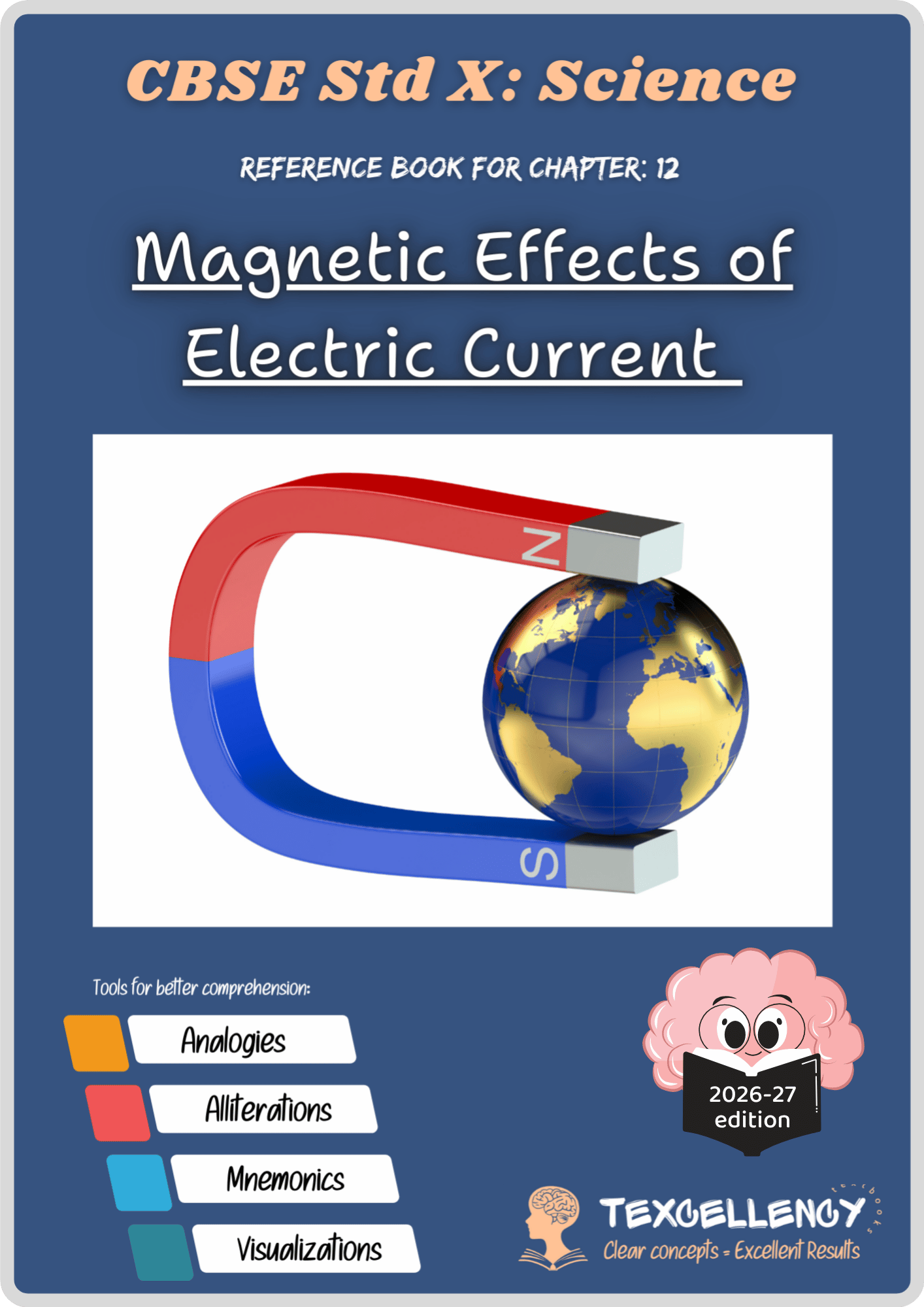
C12 — Magnetic Effects of Electric Current
Magnetic Effects of Electric Current is Chapter 12 of CBSE Class 10 Science — a Physics chapter that connects electricity and magnetism in ways that explain how motors, generators, and most modern technology actually work. This Texcellency book on Magnetic Effects of Electric Current makes concepts like Fleming’s Left Hand Rule, electromagnetic induction, and AC versus DC current easy to understand for every CBSE Class 10 student — without needing a physics tutor to explain it.
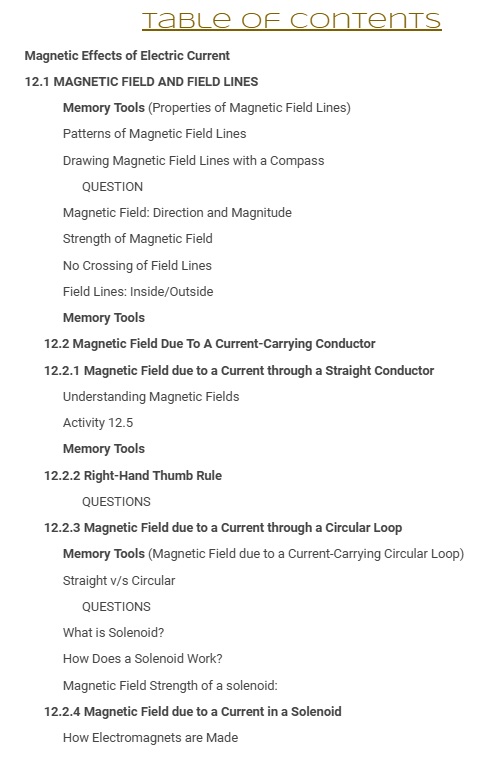
What this CBSE Class 10 Magnetic Effects of Electric Current book covers: Magnetic field and field lines — what they are and how to visualise them. Magnetic field due to a current-carrying conductor — explained step by step. Right Hand Thumb Rule — when to use it and how to apply it correctly. Force on a current-carrying conductor in a magnetic field — the concept and its applications. Fleming’s Left Hand Rule — explained clearly with real-world motor examples. Electric motor — how it works, why it works, and its uses. Electromagnetic induction — the concept that powers the modern world, made simple. Fleming’s Right Hand Rule and its application to generators. Electric generator — AC generator and DC generator explained with clear logic. Domestic electric circuits — earthing, fuse, MCB — why they are essential for safety.
Why this chapter is important and why Texcellency helps: Magnetic Effects of Electric Current is a chapter that builds directly on the Electricity chapter and prepares students for higher Physics in Class 11 and 12. Texcellency ensures students build a solid, logical foundation here — making both their Class 10 board exam and their future studies much easier.
What Your child will Learn:
The fundamentals of magnetic fields and field lines:
+ Properties, patterns, direction, and magnitude
+ Strength of magnetic field
The magnetic field generated by current-carrying conductors:
+ Straight conductor, circular loop, and solenoid (electromagnet)
+ Right-hand thumb rule for direction
The force exerted on current-carrying conductors:
+ Fleming’s left-hand rule for force direction
+ Maximum force calculation
The basics of domestic electric circuits:
+ Schematic diagrams
+ AC (alternating current) and DC (direct current)
+ Frequency and direction change
+ Advantages of AC over DC
This book matters because it helps:
- Develop a deep understanding of electromagnetism and its applications
- Master key concepts (magnetic field, force on conductors, electric circuits)
- Enhance problem-solving skills with magnetic field calculations
- Explore practical uses of electromagnetism in everyday life (motors, generators, transformers)
- Build a strong foundation for advanced studies in physics and engineering
Get your copy of Magnetic Effects of Electric Current today, and help your children discover a more enjoyable, effective way to learn science!
Simplify these concepts with Texcellency books: Transform Your Child’s Science Learning Experience with Interactive and Clear Explanations.
Based on the latest CBSE 2026-27 syllabus. Also available as part of the complete CBSE Class 10 Science Books Bundle — all 13 chapters at just ₹999.