C6 — Control and Coordination
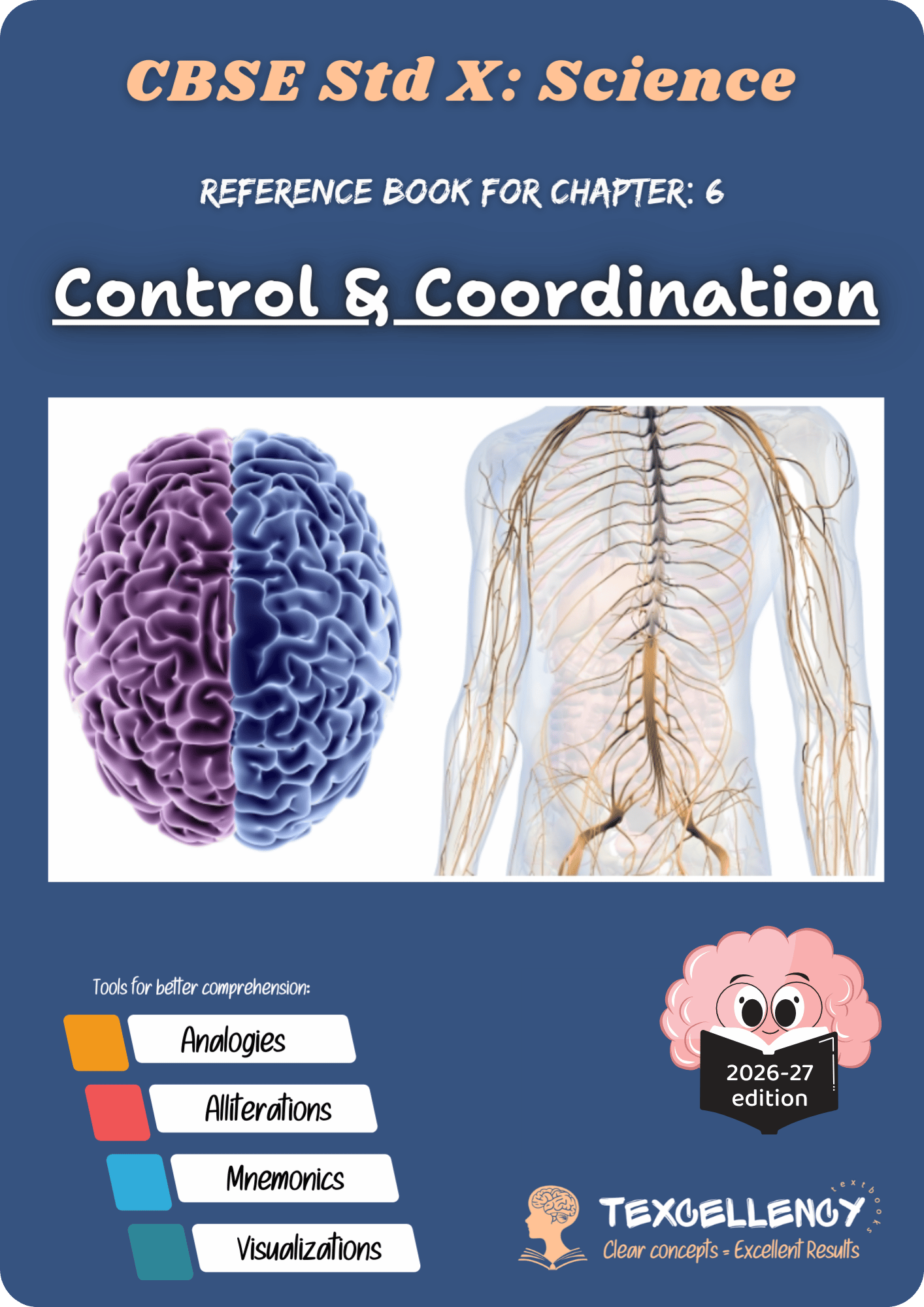
Control and Coordination is Chapter 6 of CBSE Class 10 Science — a fascinating Biology chapter that explains how the human body and plants sense, respond, and stay in balance. The nervous system, the brain, reflex actions, hormones, and how plants respond to stimuli — this chapter is rich with concepts that students find confusing when read from NCERT. This Texcellency book on Control and Coordination makes the entire chapter logical, visual, and genuinely easy to understand for any CBSE Class 10 student.
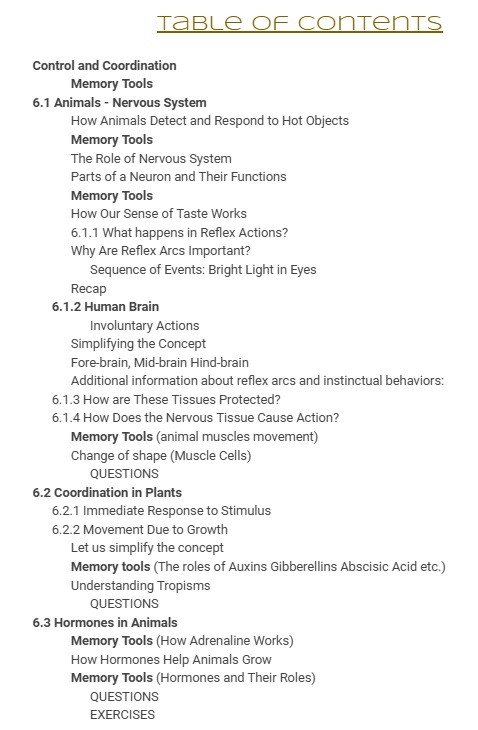
What this CBSE Class 10 Control and Coordination book covers: The nervous system — neurons, nerve impulses, and how signals travel in the body — explained simply. The human brain — cerebrum, cerebellum, medulla — each part’s function made clear and memorable. Reflex action and reflex arc — explained with real examples like touching a hot object. How sense organs send signals to the brain — the complete pathway simplified. Hormones in animals — endocrine glands, adrenaline, insulin, thyroxine — what each does and why. Plant hormones — auxins, gibberellins, cytokinins, abscisic acid — explained with plant behaviour examples. Tropic movements in plants — phototropism, geotropism, hydrotropism — made visual and logical.
Why this book works for Class 10 students: Control and Coordination involves a lot of interconnected systems and students often get lost in the terminology. This Texcellency book creates a clear mental map of the entire chapter — so students can answer any question, including the increasingly common competency-based and assertion-reasoning questions in CBSE board exams.
Based on the latest CBSE 2026-27 syllabus. Also available as part of the complete CBSE Class 10 Science Books Bundle — all 13 chapters at just ₹999.
=====================
Is your daughter or son:
- Struggling to understand how living organisms respond to their environment?
- Confused by the complex nervous system and its functions?
- Frustrated with grasping reflex actions and involuntary behaviors?
- Struggling to comprehend plant coordination and hormone regulation?
- Having trouble connecting the dots between stimuli, response, and muscle movement?
Is their current science textbook:
- Leaving them bewildered with abstract concepts and terminology?
- Failing to provide clear illustrations of nervous system structure and function?
- Lacking practical examples of hormone regulation in animals and plants?
If yes, then be sure that lower grades of your children are not their fault. It does not mean that they are slow learners or less efficient in their studies, it simply means that the tools they have been given are not good enough. The textbooks they have been using are not friendly enough.
Welcome to Texcellency books – books that are designed to make the learning process fun and riveting.
This book about Control and Coordination makes the tough subject simple and engaging! Our expert authors have crafted a comprehensive guide to Control and Coordination using:
- Easy-to-understand explanations of nervous system structure and function.
- Engaging examples of reflex actions, instinctual behaviors, and muscle movement.
- Clear illustrations of plant coordination, tropisms, and hormone regulation.
- Step-by-step explanations of hormone roles in growth, development, and animal response.
- Interactive exercises and quizzes to reinforce learning.
With this book, your child will:
- Confidently understand control and coordination mechanisms in animals and plants.
- Master key concepts (stimuli response, nervous system integration, hormone regulation).
- Develop a deeper appreciation for the intricate systems governing life.
- Explore practical applications in everyday life (neuroscience, botany, medicine).
- Boost their scientific curiosity and critical thinking skills.
This book will help explore control and coordination mechanisms in animals and plants:
Animal Control and Coordination:
Nervous system structure and function
Neurons, reflex actions, and reflex arcs
Human brain (fore-brain, mid-brain, hind-brain)
Involuntary actions and instinctual behaviors
Nervous tissue protection and muscle movement
Plant Coordination:
Immediate response to stimuli
Movement due to growth (tropisms)
Plant hormones (auxins, gibberellins, abscisic acid)
Hormonal Control in Animals:
Adrenaline and other hormones
Hormone roles in growth and development
Key concepts:
Detection and response to stimuli
Nervous system integration
Muscle movement and coordination
Plant growth regulation
Hormone regulation in animals
Get your copy of Control and Coordination today, and help your children discover a more enjoyable, effective way to learn science!
Simplify these concepts with Texcellency books: Transform Your Child’s Science Learning Experience with Clear and Interactive Explanations.